40

I'm new to home wiring and had a question I'd like explained to me. I removed a vent hood over my oven and I thought I had to complete the circuit so I tied the hot and neutral wires that were powering the hood together with a wire nut, but all the lights on that breaker in the house didn't work after that. I then tried turning on the breaker with the hot and neutral wires NOT touching and all the lights worked!

This doesn't make sense to me; this might be a super simple question but I'm just trying to understand.

Why did the breaker work when those two wires weren't connected, but when I secured them with a wire nut then all of the lights also on that breaker didn't work?

Niall C.
  • 20,909
  • 19
  • 95
  • 135
Skoant
  • 433
  • 1
  • 4
  • 3

11 Answers11

106

You don't need to "complete the circuit". Tying together the hot and neutral wires creates a short circuit, which should immediately trip the circuit breaker. If you're removing a vent hood, you should put a wire nut on the end of each now-unused wire (to prevent a short circuit) and close up the box.

Every unused outlet in the house is an "incomplete circuit". Presumably you don't install jumper wires across each outlet every time you unplug something, right?

Dan C
  • 552
  • 1
  • 5
  • 15
Mark
  • 4,437
  • 2
  • 19
  • 24
83

Here is what happened. Before you started, this is what the system looked like:

Then you removed the vent hood:

OK so far. But then "I thought I had to complete the circuit so I tied the hot and neuteral wires that were powering the hood together with a wire nut". I can't even begin to guess how you dreamed up the idea of tying the hot and neutral lines together, but here is a diagram of it:

Bzzzt. Poof. Note that there is now a complete circuit from hot, thru the breaker, back to neutral. Or more accuractly, a short circuit. Fortunately the breaker is meant to open the circuit when exactly this kind of failure occurs. It kept the wires from getting very hot and burning your house down. No, seriously.

Since the breaker tripped, it shut off power in that circuit. That is why the lights that are on the same breaker don't work anymore.

This also demonstrates why the laws require a licensed electrician to do work on power wiring. Amateurs that know what they're doing can make useful changes, but these changes are not legal (in most modern countries), and almost certainly violate your insurance policy. If your house had burned down due to this, the insurance company would have legitimate reason not to pay.

Unfortunately, as you have shown, those that don't know what they're doing also don't know that they don't know. The laws have to be universal, so require certain training and certification for doing things that could cause serious injury and property loss.

Basically, stop monkeying with stuff you don't understand. You are very lucky that you didn't manage to defeat the remaining safety system (the circuit breaker), and it saved you from your own stupidity. Next time you may not be so lucky. Ordinary circuit breakers don't save you from electrocution, for example.

Olin Lathrop
  • 2,452
  • 1
  • 15
  • 13
51

You seem to be under the impression your electrics work like this: enter image description here

When infact, your circuit will more than likely look something like this enter image description here

To bridge the live and neutral causes a short back to the distribution board, which can quite easily cause fires. Please, do not do this kind of work if you do not understand the basics of how it works. I am not trying to be condescending here, but people die doing stuff like this; If you are not 100% sure, consult with a professional.

James T
  • 629
  • 4
  • 13
39

Let's try the water analogy.

The hot wire (black) is the water supply, the neutral wire is the drain. Your vent hood is a dishwasher.

Normally a dishwasher is connected to both supply and drain, but it also has valves and a place to do some work.

You have removed the dishwasher, along with its valves, pumps, etc. and connected the water supply directly to the drain.

This would normally cause a pressure drop in your house (showers, taps etc. don't work) and a huge bill at the end of the month, except your supply has a device that detects excess flow from the supply-to-drain connection and shuts it off.

When you remove an electrical appliance like your vent, the proper process is putting a wire nut on EACH wire, not both wires. Just like we would cap the supply and drain pipes after pulling the dishwasher.

If there are several wires in the outlet box, we often join all the wires of the same color together, but before this is done each wire must be investigated to ensure that tying them together is appropriate and safe.

Taegost
  • 103
  • 3
peter
  • 399
  • 2
  • 2
26

There's some great answers here already, but I thought maybe showing some maths would help with understanding.

NOTES

  • To keep things a bit simpler, we're going to focus on purely resistive loads, and ignore impedance, power factor, etc.
  • To get more accurate result, we'll include the resistance of all the wiring in the circuit. For all the examples, we'll assume 200' of 12 AWG copper wire is used (0.00193 ohms/ft). Unless otherwise specified

We'll start with a simple circuit, that contains only a single 60 watt light bulb
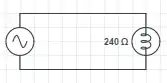
power supply connected to bulb with 240 ohms resistance

We can calculate the total resistance like this

Rt = R1 + R2

Here Rt is the total resistance, R1 is the resistance of the light bulb, while R2 is the resistance of the wire.

Rt = 240 ohms + 0.386 ohms
Rt = 240.386 ohms

Next, we can use Ohm's law to calculate the total current through the circuit.

It = E / Rt  
It = 120 volts / 240.386 ohms  
It = 0.499 amperes

Through this example, you can see that the circuit will only draw about half an ampere.

What would happen if we removed the light bulb, and "completed the circuit"?
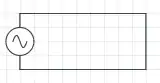
power supply with one end of the same wire connected to each terminal

With the light bulb gone, the only resistance in the circuit is the wire.

Rt = 0.386 ohms

Using that to calculate the current

It = 120 volts / 0.386 ohms  
It = 310.88 amperes

We end up with a current draw 15.5 times the rated current (20 amperes) allowed by the circuit breaker. This causes the circuit breaker to trip, and open the circuit.

Next we'll take a look at a more complex example, where we have three bulbs in parallel.
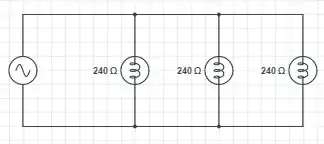
circuit with 3 bulbs with 240 ohms resistance, each on its own branch

To calculate the resistance in a parallel circuit, it's not as simple as adding the resistances together. Instead you have add the reciprocals, and divide 1 by the result.

Rt = 1 / (1/R1 + 1/R2 + 1/R3)
Rt = 1 / (1/240 ohms + 1/240 ohms + 1/240 ohms) 
Rt = 80 ohms

Next we'll have to add in the resistance of the wire in the circuit.

Rt = 80 ohms + 0.386 ohms
Rt = 80.386 ohms

We can calculate the current through the circuit:

It = 120 volt / 80.386 ohms  
It = 1.49 amperes

Finally, let's remove one of the bulbs and "complete the circuit".
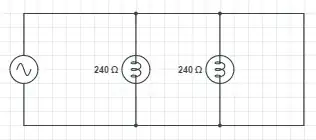
same circuit with one bulb removed and the space it filled closed, so one branch is just wire

In this example, the bulb resistance will be replaced by the resistance of 1' of 12 AWG copper wire.

Rt = 1 / (1/240 ohms + 1/240 ohms + 1/0.00193 ohms  
Rt = 0.001929969 ohms

Again we have to add in the resistance of the wire in the circuit.

Rt = 0.001929969 ohms + 0.386 ohms 
Rt = 0.387929969 ohms

Due to the low resistance, we can assume the current will be quite high.

It = 120 volts / 0.387929969 ohms
It = 309.3341829759 amperes

Once again the current is more than 15.5 times the rated circuit capacity, which should hopefully trip the circuit breaker.


tl;dr

By "completing the circuit", you're actually creating a short-circuit (low resistance path). Because the resistance through this path is so low, the current will always be quite high. The circuit breaker reacts to the high current, and opens the circuit before the wiring can be damaged.

Tester101
  • 133,087
  • 80
  • 327
  • 617
22

The other answers are all helpful but I thought it might be good to add one that is limited to your direct question:

Why did the breaker work when those two wires weren't connected, but when I secures them with a wire nut then all of the lights also on that breaker didn't work?

The breaker did work. A circuit breaker's job is to interrupt, or "break", the circuit and stop the flow of electricity in case of a fault. In this case, the fault was the short circuit created when you tied those two wires together. So the breaker did exactly what it was supposed to do.

Dan C
  • 552
  • 1
  • 5
  • 15
14

A complete circuit allows power to flow. You don't want power to flow unless it is doing something useful. If the two wires are connected with each other, with no load, such as a light or a toaster in between, the current will flow but it will only heat the wires briefly until the circuit breaker trips.

You can think of the hot lead (usually black or red) as out and the neutral lead (white) as back or return. When you put a load (a light, a vacuum, a range hood) between the hot and the neutral, power flows. This is parallel wiring. You can have multiple separate loads between the hot and the neutral. Each of them is connected to the hot side and the neutral side. When no device is working (drawing power), no current flows. There is never a direct connection between the hot and the neutral wires.

When you remove the load, with a switch that breaks the connection, or when you remove it entirely, power does not flow. As noted elsewhere, when you disconnect a load, you cap each unused wire separately so power does not flow, even accidentally.

The notions that you need to complete the circuit only applies in serial wiring, which home wiring is not.

bib
  • 33,975
  • 10
  • 68
  • 102
14

Oh, you completed the circuit all too well! You created an express path for energy from the power plant, through the transformers, to the "hot", through the wire-nut and to the "neutral", back to the transformers and power plant. Within your home, you made a huge current path, and lots of current took advantage of it. Too much, said the breaker!

The trouble is, this very-well-completed circuit wasn't doing anything useful for you, and was making a lot of heat in places you really do not want heat.

We want loads to use, but also impede, current flow somewhat. That can be tricky. For instance, a fluorescent tube or sodium-vapor lamp is a lot like that wire-nut. It wants to flow lots and lots of current, so much that the current would destroy the lamp. That's why they have "ballasts" to impede the current flow just right, so the lamp runs within spec.

Think of hot and neutral as having potential (voltage pressure) between them. You want it that way. Any useful load put across them completes the circuit, drawing only as much current as the load requires.

Harper - Reinstate Monica
  • 313,471
  • 28
  • 298
  • 772
9

You say you are new to home wiring and ask a question showing a complete lack of understanding how electricity and home wiring works because a circuit breaker intervened in order to save your life and property.

The point is that a circuit breaker still relies on a number of assumptions regarding the kind of correctness of wiring in order to do its job. So do a number of other safety measures.

If you continue on your path to learning about home wiring in the manner you do now, you may be less lucky and kill yourself and/or burn down the house and/or kill rescuers or visitors, or yourself or of future tenants who rely on properly done wiring. Home wiring carries lots of potentially lethal and destructive energy, and it's only by properly wiring stuff up that the numerous safeguards built into the system are set up in a manner where they do their job.

Home wiring is a topic utterly unsuitable for learning by trial and error. It is also utterly unsuitable to approach by a process of assumption and deduction because you cannot afford mistakes, and even if you end up with a configuration that happens to work, any future changes done by someone else on the assumption that stuff is done in a standard manner may kill people.

Home wiring is simple and kept simple: there are rules and procedures and standards. Exactly because the consequences of errors can be terrible.

user60990
  • 99
  • 1
1

Let me explain this to you in a very simple way,

You said the circuit needs to be completed right ? but for a circuit to be completed you need to have a voltage source , a resistance and some wires to connect them. and when you do so , the circuit completes and the current resistance and voltage are related by the following equation: V=IR

Since you removed the resistance (which in your case was a vent hood) , now the circuit can not be completed. Connecting the hot and neutral wire is equivalent to shorting the voltage source which will cause a huge current to flow through the wires. It is the same as connecting the two terminals of the battery when not using , do you always keep the two terminals of an unused battery connected in order to complete the circuit ? NO! you just keep it open , but in case of house wiring you terminate it so that it may not accidentally get shorted.

Hope this answers your question.

Remember its always good to make mistakes but in controlled environment, SAFETY FIRST!

0

Why did the breaker work when those two wires weren't connected, but when I secures them with a wire nut then all of the lights also on that breaker didn't work?

To put an emphasis on the name of the component:

The breaker working means that the breaker breaks the circuit. If you connect the two wires, you essentially unbreak the circuit, which causes the breaker to break the circuit you've just unbroken.

The job of the breaker is to keep the circuit broken. It might become unbroken (aka connected) by accident or failure. This is why you don't connect unused hot and neutral wires to “complete the circuit”, because you actually have installed a device that has the single job that the circuit is never completed (in the way you were completing it).

duct tape
  • 131
  • 5