35

We have a very old house, circa 1850-1900. It seems that as often as every week we have had to replace an electronic device. In the past six months, we have had to in total, replace:

  • 1 washing machine
  • 1 refrigerator
  • 1 PC motherboard (of my custom PC)
  • 1 laptop
  • 3 laptop chargers
  • 4 hard drives
  • 1 tv
  • 1 monitor
  • 1 Nvidia shield remote
  • 1 PLC controller board
  • 4 modems and routers
  • 1 plug in smoke alarm

I tested all outlets in the house for voltage, they all test 108-120 volts, AC. Within reason, correct? Under full load, every circuit stays above 108 volts. Polarity is correct on all plugs but one, which is never used. All electronics (that can be) are protected by at least a 2000 joule surge protector, a piece.

No one in my family knows what is going on. Most of the insulation is tar, and hemp, however, there seems to be nothing wrong with the circuit, as I said. I have taken every measure (that I know of) myself to diagnose my problem, but came back empty handed. Any suggestions?

The only other thing I could say is that my area seems to be really weird with electromagnetic radiation. Half of the time, we can't get a local radio station broadcasted no more than 20 miles away. We can't get any AM half the time either. Could there be something there? Or would it just be something to have FirstEnergy look at?

11 Answers11

41

No, 108V is NOT "within reason". You have all the symptoms of a VERY SERIOUS power wiring problem. You should consult a licensed electrician immediately before your house burns down. The symptoms you describe suggest that your power wiring could catch your house on fire at any moment. Seriously, this is not something to fool around with.

Richard Crowley
  • 776
  • 4
  • 7
17

In addition to what @RichardCrowley says (and he's right, do call the power company), just because you measure 108V-120V that doesn't mean that there are no transients that spike much higher. Equipment dies infrequently from undervoltage, but often dies from overvoltage - particularly electronic equipment where a specific component (perhaps metal oxide varistor) in the power supply deliberately goes short circuit and blows an (internal) fuse under such circumstances.

Your surge protector may be junk, or may not be good enough (neither is uncommon).

Causes of such transients can include lightning strike, very heavy inductive loads nearby matched with a poor supply, faulty supply transformers, or electronic warfare (though I'm guessing you haven't been annoying any nation states).

In any case the answer is the same (electronic warfare aside): call the power company.

abligh
  • 512
  • 1
  • 4
  • 16
15

Most houses in the USA receive two "hot" wires which supply current in opposite directions at any given time along with a neutral wire. If the loads served by both not wires are perfectly balanced, no current will need to flow in the neutral. Otherwise the current in the neutral will be the difference between the currents in both legs.

If the neutral becomes disconnected but the loads on both sides are perfectly balanced (not a common situation), everything will work normally [since there would be no need for the neutral wire to carry any current]. If the neutral is disconnected but the two sides are not balanced (a more common situation) the side which is more heavily loaded will receive less voltage than the side which is less heavily loaded, but the amounts of voltage will go up and down depending upon loads.

The only way some outlets would be able to receive 108 volts while others are receiving 120 would be if a huge amount of power is being dissipated somewhere continuously (so much so that something would be quote noticeably hot) or there's an open neutral somewhere that's allowing some devices to receive more voltage than they should while others receive less. Open neutrals can be extremely destructive and dangerous, and your description makes that sound like a possibility.

supercat
  • 1,108
  • 5
  • 8
12

Your house may have been built 1850-1900, but surely the electrical wiring isn't over 100 years old? If it is, replace it now. All of it.

Laurence
  • 255
  • 1
  • 5
11

Since there seems to be some debate in the comments: here is the standard on voltage tolerances in the US. For point-of-utilization, the requirement is 110V-125V for lighting circuits, 108V-126V for everything else.

However, they allow a range of 106V-127V, with the stipulation that

[This range] includes voltages above and below [normal] limits that necessarily result from practical design and operating conditions on supply or user systems, or both. Although such conditions are a part of practical operations, they shall be limited in extent, frequency, and duration. When they occur, on a sustained basis, corrective measures shall be undertaken within a reasonable time to improve voltages to meet [normal] requirements.

In other words, seeing 108V on any circuit that supplies lights is unacceptable, and should be corrected by your electric company.

(Additionally, it's extremely unusual to see a swing of 12V in outlets within the same house. That's something they should also correct)

4

In Canada (which I believe is the same in the U.S.), a residential feed is 3 wires; insulation on each conductor is color-coded red and black for two power phases and white for neutral. Across red and black is a nominal 240V, between red and white or between black and white is a nominal 120V. The white neutral wire should always be at ground potential, and in a properly balanced service, there should be little or no current flowing in the white wire to/from the house (although in practice there is bound to always be some imbalance). All outlet boxes should be grounded back to the service panel, which in turn should be grounded to well... ground. I think the neutral is supposed to be grounded at the utility company transformer for your house, to keep the neutral at ground potential (although I don't recall if it is bonded at the service panel as well or instead).

Bottom line: perhaps the problem is that neutral is floating with respect to ground. If so, this could be responsible for the damage to your electronics and appliances, and would be very dangerous as both a fire and electrocution hazard. Note that in the case of a floating neutral, you can measure any "hot" to neutral and always get the expected nominal 120V, while neutral to ground could be anything from zero to thousands of volts, in which case "hot" to ground would be that same zero to thousands of volts PLUS the 120. That could cause over-voltage failures in all sorts of devices, not to mention over-current failures in human hearts.

Anthony X
  • 1,369
  • 1
  • 11
  • 17
3

There is a large amount of information in the answers but one thing I do not see is a discussion on the grounding system. With a home of this age there were only 2 conductors run in the electrical system and the neutral was normally bonded to the water pipe. One of the issues I have come across in the last few years in older homes is the original water mains have been replaced with plastic pipe and no new ground rod driven (UFER grounds were not invented until World War 2 so unless the home has a new foundation it will not have this type of grounding system). I would suggest the addition of a minimum of 1 and possibly 2 new rods to be added and connected at the service panel with #6 copper wire. The surge arrestor not having a good ground would allow higher than normal transients on the line. The suppressors used by power company's clamp at higher values than home models and only limit the spikes when in line from the load (if there is a strike between the station and your home or large electric motors in use close to your home the sub station limiters don't limit your spikes). I mentioned Large electric motors do you live close to a industrial plant, do they still have electric busses (I used to live in Dayton and the busses create spikes also.)? Even several miles away when large motors are started or stopped the line voltage can swing and huge spikes may be present. A good solid ground to attach your surge suppressor to may be all that is needed. I have installed several large units (whole house suppressors/ arrestors) on homes that were on the same "Main feeder" as a Lumber Mill. The home(s) Had similar equipment losses to yours with newer wiring, after the install they quit losing equipment until the unit failed. I then installed a much larger system that has a monitor to show if it is working and have not been back for years other than to install similar systems in that neighborhood.

Ed Beal
  • 103,727
  • 4
  • 79
  • 158
2

I'd go with 'dirty power' coming in as a first guess, probably as @abliegh suggested >very heavy inductive loads nearby<. That could also be the cause of AM interference. That is upstream of the meter, so the power company may not need to get in the house so may not shut you down. Power Quality Analyzer would be required. Better yet if it does a high speed datalogging to catch fast transients that you would never see with a DMM.

Gordo
  • 21
  • 1
2

It's important to note that electronic devices rely very heavily on the sine wave of the AC power coming into your house (60 Hz in the US). That's why there's two flavors of generators: regular (common and can run electrical equipment) and inverter generators. Knowing the difference can help you explain why your electronic equipment is failing (emphasis mine)

Conventional generators have been around for quite a while, and the basic concept behind them has remained essentially unchanged. They consist of an energy source, usually a fossil fuel such as diesel, propane or gasoline, which powers a motor attached to an alternator that produces electricity. The motor must run at a constant speed (usually 3600 rpm) to produce the standard current that most household uses require (in the U.S., typically 120 Volts AC @ 60 Hertz). If the engine’s rpm fluctuates, so will the frequency (Hertz) of electrical output.

With an inverter generator, the engine is connected to an efficient alternator, which produces AC electricity, just like a conventional generator. But then a rectifier is used to convert the AC power to DC and capacitors are used to smooth it out to a certain degree. The DC power is then “inverted” back into clean AC power of the desired frequency and voltage (e.g., 110-120VAC @ 60Hz). Regulation is very good and this system produces consistent power characteristics independent of the engine speed. The result is much “cleaner” power (“pure sine waves”) than is possible with a conventional generator, essentially the same quality of electricity that you typically get from your electric company. Why is this important? Well, more and more products today use some form of microprocessor. Not just your computer, but also your phones, TVs, game consoles, printers, DVD players, and even kitchen appliances and power tools. And all these microprocessors are very sensitive to the quality of the electricity they use. Using power that isn't "clean" can make these devices malfunction, or even damage them. So any application that uses sensitive electronics – and that includes a lot more things than you might think – will likely benefit substantially from the cleaner power provided by an inverter generator.

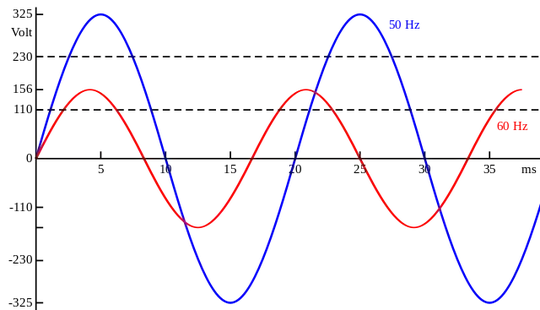
A clean sine wave looks like this

(image source)
Based on the other answers, it sounds like your wiring has been damaged. The fact that you're getting EMF interference would also lead me to think that this is the cause of your problems. Even if your wiring is "fine", it may not have sufficient shielding to prevent spikes (modern wire insulation provides some limited EMF shielding).

You'll need a trained electrician, to be sure. But make certain, whatever you do, that they confirm you're getting a clean 60Hz. Even a small variance will cause all sorts of problems for computers, up to, and including, failure.

Machavity
  • 26,498
  • 8
  • 44
  • 100
1

It's almost certainly caused by some part of the circuit having an intermittent connection. Any inductive load on such a circuit would send voltage spikes throughout the rest of the system.

A bad connection like that can produce a LOT of heat. It can easily get to the point of melting the contacts, creating sparks, and so easily lead to fire. Honestly, it's amazing your house is anything but ash.

Tar + hemp + 1000° = fire

Jayy
  • 279
  • 2
  • 12
1

One more factor:

It sounds like you are using ordinary cheap surge suppressors. These devices have a very serious flaw: They are sacrificial in nature, there's a MOV (or perhaps more than one) in there that absorbs small surges but when it eats a big one it dies. Next time around there's no surge protection. No such strip can actually indicate if it's working, the lights are a lie. (At best indicating whether the MOV was blown up, something that can happen when it eats a big one.)

The normal advice is after a big surge you replace the suppressors--obviously not an option for you given how often it's happening. The other alternative is the much more expensive units that don't use MOVs.

Loren Pechtel
  • 982
  • 1
  • 7
  • 14