My wife and I have several lights on dimmer switches throughout our home. We generally prefer the ambient lighting provided by dimmed lights. I am curious, though, if we are saving any electricity by dimming the lights. I feel like I read somewhere that dimmers work by rapidly turning on and off the current to a light, though it's just as likely I fundamentally don't understand how a dimmer switch works.
Asked
Active
Viewed 9.8k times


11 Answers
51
Yes. And here's why.
Rheostat dimmers
Old dimmers, used a variable resister to dim the light. Lets look at a simple example.
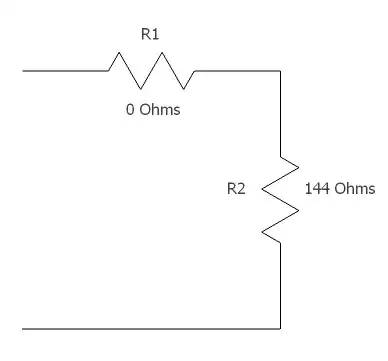
We can find total resistance (RT), by adding up all the resistance.
RT = R1 + R2 = 0 Ohms + 144 Ohms = 144 Ohms
Then we can find the total current (IT).
IT = ET / RT = 120V / 144 Ohms = .83A
We'll then calculate the voltage across each resistive load.
E1 = IT * R1 = .83A * 0 Ohms = 0V
E2 = IT * R2 = .83A * 144 Ohms = 120V
Finally, we'll calculate the total wattage (WT)
WT = V^2/R = 120V ^2 / 144 Ohms = 100 Watts
Lets see what happens when we increase the resistance of R1
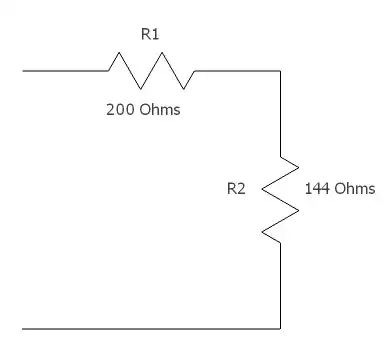
RT = 200 Ohms + 144 Ohms = 344 Ohms
IT = 120V / 344 Ohms = .349A
E1 = .349A * 200 Ohms = 69.77V
E2 = .349A * 144 Ohms = 50.23V
WT = 120V ^2 / 344 = 41.86 Watts
As you can see, we've increased the resistance of R1 and effectively reduced the voltage across R2. And now we have a dim light.
Thyristor dimmer
Modern dimmers use a TRIAC, to reduce the amount of time the light is on. However, because of the circuitry in the dimmer, there is not a direct 1:1 energy savings. Dimming the light to 50%, will not equate to a 50% savings in electricity.
A typical waveform in an AC system would look like this.
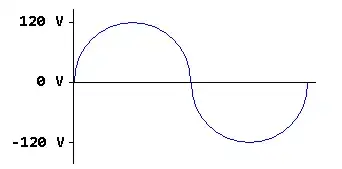
A TRIAC prevents electricity from flowing every time voltage reaches 0, something like this.
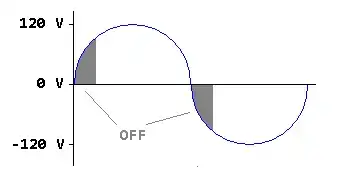
So you end up with a waveform that looks like this.
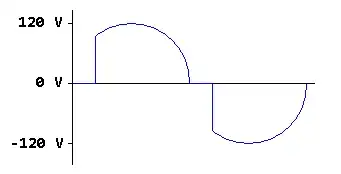
With the TRIAC, the light is actually turning off and on 120 times per second. With every cycle, you're saving a small amount of power. Is it enough to actually see on your electric bill? I guess it would depend on how long the lights are on, and what percentage they are dimmed.


22
Short answer is yes, you will save in electrical cost. Probably any dimmer made in the past 20 year has the technology to save you money. This is from Lutron, one of the largest dimmer manufactures in the world.
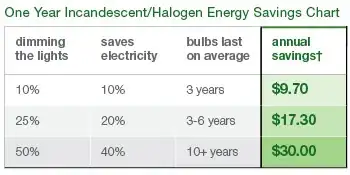
As you see, not only will you save electricity but your lamps will last longer. Thats why 130 volt lamps last longer than 120 volt lamps.
Dimming LED are easy but to get the best dimming experience you will need a dimmer designed for LED's. These have what I used to call a trim screw so you can adjust the dimmer to use the whole dimming range. Trim screws were used for fan speed controls and you would adjust the trim screw down to where the fan is spinning when the speed control is turned to the lower setting.

lqlarry
- 7,617
- 1
- 20
- 37
11
While rheostats were used as dimmers in theatrical lighting back in the early days, this has not been common since the 1950s or earlier and I have never seen a domestic light dimmer that didn't use a thyristor. You don't save a lot of energy dimming incandescent lamps due to the highly nonlinear relationship of efficiency to filament temperature (brightness) but it is NOT due to the extra voltage being burned up in the dimmer. Rather as the lamp is dimmed, the light output shifts towards infrared with a larger percentage of the power turning straight into heat in the bulb than visible light. You still save some, but not as much as you might think.
Some of the modern LED bulbs that can be dimmed really do save a lot of power though. On several I've measured, a 10-13W "bulb" dimmed down to what looks roughly half as bright to my eyeballs draws only 2-3 Watts.

James
- 111
- 1
- 2
5
I spent a fair amount of time researching this exact question recently, including paying an electrician to come to our home. He had NO understanding of the problem. Most dimmers that you buy are simply variable resistors. This means that if you have a 100 watt bulb on the circuit, but dimmed half way, you are sending out 50 watts to the bulb and 50 watts gets turned into heat in the switch box.
Dump too much heat into the switch box, and you may find you are cooking the dimmer. In our case, 300 watts of bulbs on a dimmer, dimmed down to a low ambient lighting was sufficient to cook a dimmer switch that was rated to handle 500-600 watts. (Our electrician saw that the dimmer switch was theoretically rated to handle the wattage, so it could not possibly be our problem.)
So, no, you are NOT saving electricity at all by dimming a bulb down, at least with a standard dimmer. You can buy LED bulbs, or CFL bulbs to help here. But beware that all LED bulbs do not seem to work on all dimmer switches. And CFL bulbs do not dim terribly well at all, even those that are designed to dim.
You can also buy an electronic dimmer. This is a dimmer that does its job by cutting the power off completely, many times per second. It does indeed save electricity, because the electrons which do not pass on to the light are not just shunted through a resistor to generate heat. Electronic dimmers are more expensive. Note that most dimmer switches you buy at the home store are still the resistor kind.
Finally, you can do one other thing. If you normally run the switch dimmed down quite far, then put fewer or smaller bulbs in the receptacles. For example, we had five 60 watt incandescent bulbs on a single circuit, that we normally ran dimmed way down for ambient lighting. While I plan on buying LED bulbs to replace them, dimmable LEDs are far too expensive now to justify this. Simpler was just to back out 3 of the 5 bulbs. Two 60 watt bulbs, still dimmed down half way are entirely adequate to light the area as we wanted it to be lit.
4
With incandescents (which are, as others have noticed, the only reliably dimmable bulbs), even in the best case scenario, their light output goes down faster than their power usage - so for example (made up numbers, but the principle holds), if you dim them to 75% of normal brightness, you're still using maybe, 80-90% of the original power. The brighter they are, the more efficient they are.
lqlarry
- 7,617
- 1
- 20
- 37

Aric TenEyck
- 515
- 1
- 5
- 9
3
Dimming your lights will reduce power use. Some people have been suggesting that any power not going out the bulb is instead making heat at the switch. While some power will make heat, you will not be using nearly as much power as at the bulb.
Here is some simple electric math Power Equations: P=IE Power is equal to current times voltage total voltage across the circuit is essentially constant ~120V AC.
If your dimmer is a simple Rheostat resistor, as you raise resistance your current will lower according to Ohms Law V=IR Voltage is equal to current times resistance, since voltage is constant we can rearrange by dividing both sides by "R" to I=V/R to prove that current lowers as resistance increases with a constant voltage.
another way of writing the power law is: P=(V^2)/R with voltage held constant and resistance increasing the output power will lower. Power has a negative correlation with resistance.
if you had a 100W bulb and dimmed to 50W output, you would NOT be producing 50W of heat at the Dimmer. That would burn your house down.
The other type of dimmer you are likely to see is a TRIAC dimmer. This dimmer essentially turns the power on and off over 100 times per second, thus will use less power as the lights are off a greater amount of time out of every second the more that they are dimmed.

Handyman Matt
- 31
- 1
3
While it is true that adding a variable resistance in series with a light bulb will lower the current and therefore lower the power (as the resistance increases) the fact remains that power is wasted in the form of heat through the variable resistor. I don't think there are any of these older "rheostat" (variable resistor) types being sold today. The newer design on the market modifies the AC waveform to be on only a portion of each cycle. This design is more efficient as it does not waste unused power however the silicon component used in the dimmer must also dissipate heat and does this through its mounting flange (usually aluminum). This is one reason why only a certain number of switches and wires are permitted to be in the box.

SteveR
- 3,889
- 1
- 19
- 17
3
I tested a $5 Leviton rotary dimmer, rated 600 watts, by dimming Christmas lights. The load totaled 520 watts. The dimmer worked by attenuating the AC voltage supplied. What I found is the dimmer temperature increased when the AC voltage is maxed and the temperature decreased when the voltage was attenuated. I initially thought the heat dissipated goes up when dimming, but now it looks like the majority of the heat generated is due to the inefficiency of the transistors inside. The higher the voltage and more current flowing through the hotter the unit got. At 520 watts load it got hot enough that I could not touch the heatsink longer than a few seconds.
The lesson here is don't use dimmers if you're gonna leave the light on at max most of the time. Energy not converted to light is wasted as heat. Dimming the light will use less electricity and save you money. Whether the light is dimmed or not the dimmer wastes some energy in the form of heat. The wasted energy goes up proportionally with the load.

Jessica Money
- 31
- 1
2
You're really talking about a "Watts vs VA" issue.
Go back and look at Tester101's "triac dimmer" illustration.
- Watts is the power you actually use (excluding the black area under the sine wave).
- VA is the entire sinewave that the generator must generate to create the part you use.
"Power factor" is the difference between the watts you are actually using, and the entire sine wave. And triac dimmers have poor "power factor", which varies based on setting obviously.
So for generating capacity, triac dimming doesn't save that much energy, because either the generator has to create the whole sinewave, or some "power factor correction" needs to be done to redistribute the energy around the full waveform. That is something "rotary converters" were rather good at, entirely as a side-effect: the inertia in the spinning machine served as an "AC capacitor" to time-shift energy to redistribute it around the sinewave. Of course now that would be done electronically.
However, your meter only observes the power you are using, and knows nothing about power factor. So you are getting a bargain, only having to pay for the part of the sinewave you use.

Harper - Reinstate Monica
- 313,471
- 28
- 298
- 772
2
I am answering this question 10 years later, but with some fun data. Many of the answers focus on energy wasted as heat, especially at the dimmer switch itself. I used a thermal-infrared camera to measure temperatures at my dimmer switch. In each panel, the lower temperature reading is at the switch, and the upper temperature reading is on the wall next to it for reference.

The dimmer switch "wastes" roughly the same energy (as heat) on high or low settings, but the light "wastes" much more energy as heat than the switch. So dimming the light saves energy.
Here are some details from the data:
- Even with the switch off, some heat is generated. This seems to be because of the locator light that is always on by default.
- The dimmer switch seemed to heat up one degree more on the high setting. I'm not sure how accurate the thermal camera is.
- The light itself produces a lot more heat, and the switch controls 4 lights. Using the Stefan-Boltzmann law, I estimate that with the dimmer switch on high (bottom row of images), I'm producing about 18x more power in heat at the LED lights than at the dimmer switch.
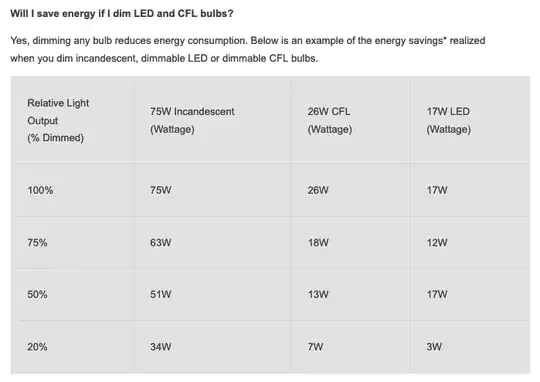
There is a lot of (sometimes contradictory) info in the other answers about whether dimmer switches are usually thyristor or rheostat type. My particular switch is a Leviton, and I can't find the type on their website, but I get the general impression that those saying that rheostats are not used any more are correct. In any case, the Leviton website gave the following helpful table that also answers the original question for all types of bulbs:

giardia
- 131
- 3
-1
Electricity to me is a black science and I have no expertise on the subject. But it seems to me that when using a resistor type dimmer you are pulling power through the meter to the switch and then restricting delivery to the appliance or globe by changing some of that unwanted power to heat. That would mean saving power by using a resistor type dimmer switch is an illusion. Sure the result you see is less light. But what you pay for is not what you see but what is registered at the meter. Newer dimmers that turn the power on/off 120 times a second are a different story.

John Dee
- 1