7

I am in the process of creating a custom threshold to go from a tiled surface down to a carpeted surface. The tile is about an inch above the carpeted floor, so I decided to make a custom threshold in order to introduce a nice slope. This should help protect the exposed tile edge from too much stress and avoid a lot of stubbed toes, which were a problem with that transition even before the added height of the new tile.

To start, I glued together two 7'-long 1"x4" boards with a 1" offset. I want to cut along the length of these boards to create a nice angle for the transition. Here's an image of a very rough mock-up of the layout.
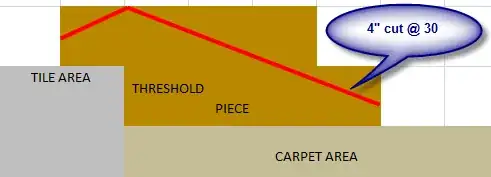
enter image description here

The problem comes with the longer cut on the boards. It's about a 4" deep cut and needs to be at approximately 30 degrees (from the base). I'm not sure which tool I should use for the cut. I think it's a bit too deep for most table saws and I'm not sure if that angle would be recommended on a band saw.

Does anyone have any advice on what tool would be best for this cut? Or, if there's a better way to smooth out a 7'-long, 1"-deep transition, I'd be open to trying something else. I'm willing to buy new machinery to pull this off, so almost any reasonable suggestion is fair game.

Tester101
  • 133,087
  • 80
  • 327
  • 617
BrosephRoseph
  • 173
  • 1
  • 6

2 Answers2

7

Yeah, that 4" would be a long cut. It could be done in two passes, one from each side. The middle area would have a bit of an overlap and maybe a blade mark, but that could be sanded down. Plus you are probably going to finish it anyways.

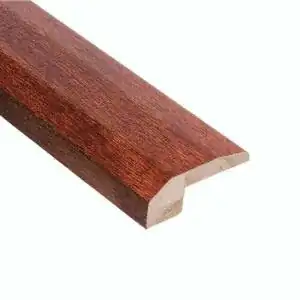
What I would recommend though is changing the shape of your transition piece to make it easier to cut, and would also make it more pleasant to walk ok. I posted a similar question regarding a transition from tile to hardwood. Although your question is different, some of the answers there might help you out. For example, take a look at the shape of this transition piece:

reducer

In your case, this would be 3 separate cuts instead of one long one. Also the flat top surface will make it more pleasant to walk on vs. the angle (point) you have at the top of your example.

mohlsen
  • 6,359
  • 14
  • 39
  • 47
0

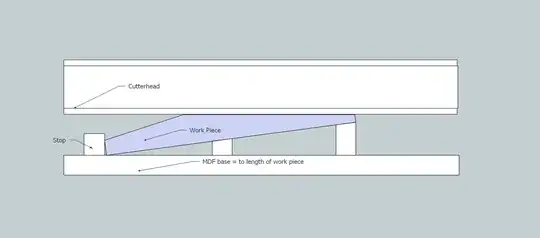
The obvious and most direct answer is a table saw as described by mohlsen and in all cases where applicable this is the most reliable method. However, just to offer a different approach, the same effect can be achieved by making a fixture and feeding the piece through a planer. Its more labor intensive and not without its down sides but the cut is generally more polished than a double table saw cut, and one can achieve extreme angles not possible on a table saw. here's a diagram:enter image description here

The fixture also needs a stop on the trailing end to keep the piece from working out backwards. Just go slow if your planer has a speed adjustment and take light passes. Usually its best to make your rabbets and secondary bevels first but not always.