What is the minimum width of an egress/entrance door? Is it 32 or 36 inches?
Asked
Active
Viewed 1.7k times

1 Answers
7
Here is a table from the International Building Code (modified for Florida).
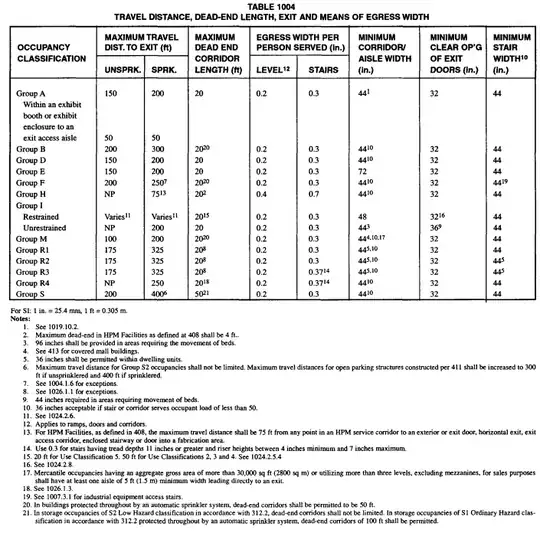
According to this the only egress doors that are required to be wider than 32", are Group I Occupancies.
Institutional (Group I) occupancies include buildings with occupants that are under supervised care, live in a controlled environment where they’re limited physically by either age or health, or they have personal liberties restricted by detention for penal or correctional purposes. Group I-3, which includes prisons, jails and correctional facilities, is further subdivided into “conditions.” However, unlike the occupancy subgroups, the 5 conditions are numbered with increasing risk to the higher numbers.
However, building codes can vary from location to location, and can be adapted by state, city, and town. To be sure what is used in your area, you'll have to contact your local government.
keep in mind that the 32" is the Minimum Clear Opening, so a 32" door may or may not be adequate.
Note:
More information on how to measure egress openings is available in section 1003.2 Measurement of means of egress, in the document linked above.
Here's the section on doorways.
1003.2 Measurement of means of egress
1003.2.3 Doorways
1003.2.3.1 The clear opening at swinging doors shall be measured between the face of the door and the stop, with the door open 90 degrees.
1003.2.3.2 There shall be no projections into the required clear opening lower than 34 inches (864 mm) above the floor or ground. Projections into the clear opening between 34 inches (864 mm) and 80 inches (2032 mm) above the floor or ground shall not exceed 4 inches (102 mm) measured horizontally. Door stops at the head of the door frame are allowed to project into the clear opening according to 1003.2.5.

Tester101
- 133,087
- 80
- 327
- 617