2

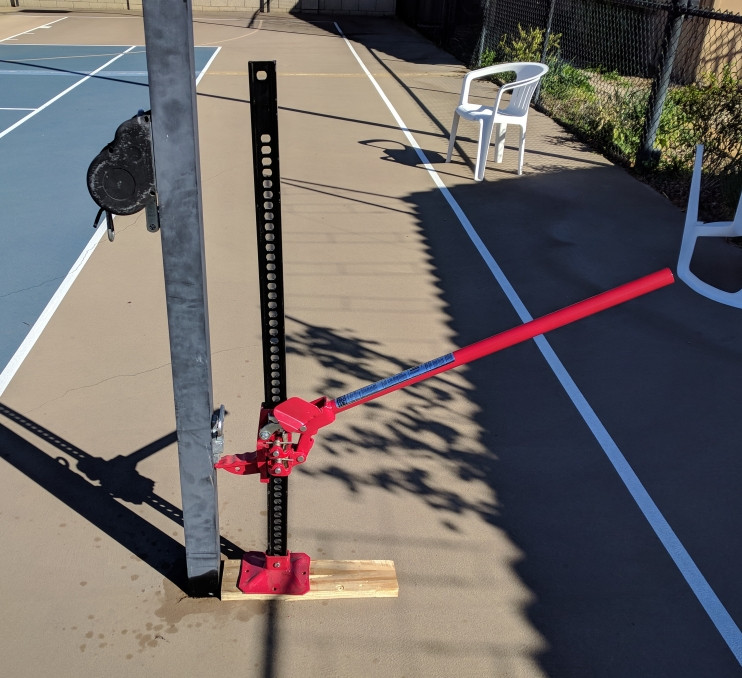
I have a square metal pole in the ground which has a metal sleeve and it's rusted that I can't get it out. In the past I've removed these poles using a Jeep jack (as in the image) and it's worked well. Now the Jeep jack is starting to break at the lip. The length of this pole under the ground is 18 inches.

So far I've tried spraying a ton of PB Blaster Penetrant into the area between the pole and the sleeve and come back and tried again and sprayed again leaving periods of 30 minutes to 4 hours between each try. I've done this 4 times so far.

I'm looking for more ideas on how to free this pole from the sleeve. Thanks.

enter image description here

Guy
  • 2,113
  • 14
  • 37
  • 51

6 Answers6

3

Eighteen inches of the post penetrating into the sleeve with rust most likely to be along most of the internal overlap will be next to impossible to get apart. One of the most helpful techniques for freeing rusted parts is heating the outer part so that it expands to loosen the joint - but that technique is not possible in this situation.

I suggest that you will likely have to break or cut out the concrete around the sleeve in order to get the whole thing removed all at once. This effort could be really a lot of work if the sleeve had been installed into its hole with concrete poured around it.

Too bad to hear that your jack is breaking. If there were a way to apply the load on the jack close to the body of the jack as opposed to way at the tip would be way better. If the casting of the jack is actually broken or cracked you should remove the unit from service so that you do not try to reuse the jack at a future time and have a safety compromise.

Michael Karas
  • 67,833
  • 7
  • 68
  • 153
1

Comments aren't for answers and I realized that my comment was more in the line of an answer:

jsotola has a good idea about collapsing one of the pole sides, but consider to drive a rod down all four sides, removing the rod each time. This will help break the bond on the sleeve. After dimpling the faces, you may be able to wrench the pole free. Also when you apply penetrating liquid, attach a vibrating sander to the pole to help the penetration.

Heat and cold are good methods, but as Michael Karas suggests, difficult for your installation. If the top of the pole is open or can be cut open, dropping bits of dry ice may chill the metal to assist in the release.

fred_dot_u
  • 11,958
  • 2
  • 21
  • 35
1

All the answers and observations so far have been appropriate in my experience. It would seem that the sleeve you describe is embedded in concrete and that the pole (square tube) was designed to be removed (each season) and most likely that they are both galvanized steel.

The wedge technique is ultimately infallible although certainly destructive. The flat sides of the post can be bent into the void with pry bars and/or steel wedges (see wood splitters) and sledge hammers. On the plus side, the damaged section of the post can be cut off afterward and a new replacement section welded on for reuse. The more expensive risk is to the pavement and the sleeve which are not as easily repaired.

I have used vibration in many cases like this. If you have access to pneumatic hammers this may be a good solution. Even though you place a blunted chisel tip on the edge of the sleeve, you risk damaging all three components: the sleeve, post and the concrete. High frequency - low impact vibration works best.

I have used electrolysis as well. Using a automotive battery charger, washing soda, water and time you may be able to loosen the expansive corrosion between the sleeve and post. Making a sound electrical connection to the sleeve is imperative. Delivering the washing soda/water solution to penetrate between them after all that oil has been sprayed in there is the unknown factor. Presumably you can flood the post through an opening. Charging the sleeve and the post with opposite polarities, sufficient electrolytes and time you might release the corrosive grip with minimal damage.

It appears from your photo that this is a tennis court net post. It is also entirely possible that the post is bent in toward the court and that bending it back outwardly, with a come-a-long will straighten it and allow it to be removed with the jack. Instead of using the tip of the jack, perhaps you can turn it sideways or use a sling so the force is kept closer to the jackpots, the shackle hole is designed for this use.

herb guy
  • 376
  • 1
  • 5
1

You can use a drill to make a hole through the pole and run a thick bolt through that to give you a better jacking point. Then use a bottle jack with a lot of leverage and keep spraying that pb blaster. It won't be as destructive as chiseling out the sleeve from the concrete. two jacks would be best so you can lift from both sides. Better yet would be to chain it to the bucket of a skid loader or something like that and just lift.

Jon
  • 1,707
  • 13
  • 27
0

If thermite is not a banned substance in your area and the tube is open at the top, mix up a batch, pour it into the tube, light it by dropping a sparkler into the tube, and retreat to a safe distance. When the drama subsides, the tube and sleeve should be glowing red hot. You should be able to jack the tube out pretty easily at that point.

MTA
  • 15,038
  • 1
  • 22
  • 53
0

Slow steady force has not broken the rust bond, so let’s keep the steady force add some shock. Gather these . . .

MATERIALS

  • A free-standing ladder at least as tall as the post
  • A piece of steel plate about an inch bigger than the opening at the top of the post
  • Duct tape
  • A sledge hammer
  • A 2-3 foot length of steel cable and cable clamps
  • An old blanket or some heavy towels
  • Eye protection, hearing protection

GOAL

The goal is to apply steady lifting force to the post and to maintain that force even if the post moves up by a microscopic amount. We’ll use the jack pulling a loop of steel cable as if it is a really strong rubber band pulling up on the post. With that steady force a constant, we’ll smack the top of the post straight down to break the rust bond.

PROCEDURE

Climb the ladder with the steel plate and duct tape in hand. Tape the steel plate securely in place over the top end of the post. Leave the center of the plate as bare steel. We want to get as much shock as possible when we hit the plate with the sledge hammer; a layer of tape would diminish the shock.

Use the cable clamps to form a loop of cable. Place the loop over the post and lower it to a point just below the spot where the jack is engaged in your photo.

Move the jack to the other side of the post. Twist the cable into a figure 8, engage the jack with the loop of cable and place the cable under a little tension.

Wrap the old blanket around the cable so that if the cable breaks, it won’t hurt anyone.

Operate the jack to place the cable and post under as much tension as possible. If the cable breaks or slips, you’ll need a better cable or clamps.

Put on your eye and hearing protection and climb the ladder with the sledge hammer. Hit the flat face of the steel plate with the sledge hammer several times as hard as you can. Climb down.

If the jack is now easier to operate, you have made some progress. Return to maximum tension and give the top of the post a few more whacks.

Repeat.

NOTES

I’d recommend against using nylon strap or rope in place of steel cable. They are too stretchy, and if the post suddenly comes loose, it could be launched out of the sleeve. A small loop of steel cable will only stretch a fraction of an inch.

If you can’t get the steel cable to work, get a helper to apply constant jacking force directly to the post while you smack it from the top. But give the helper hearing protection, a hard hat and a face shield in case the hammer or steel plate go flying. A full-coverage motorcycle helmet would work.
MTA
  • 15,038
  • 1
  • 22
  • 53