6

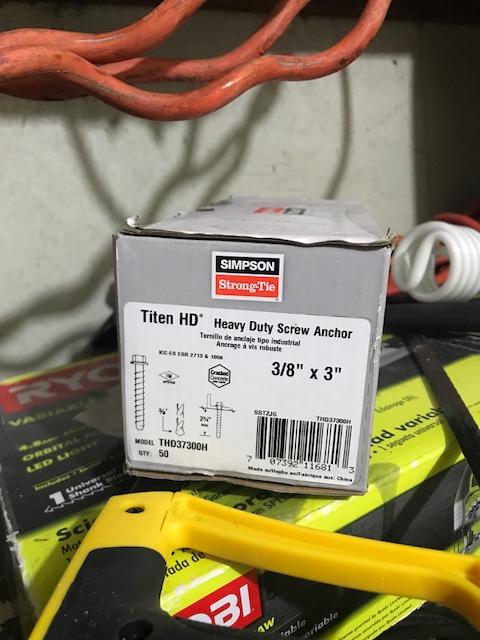
I need to drill (44) holes in (22) 1/4"-thick stainless steel plates. These are for 3"x3/8" heavy Duty Screw Anchors that will go through the plate and into the concrete.

My question is: if possible, can I use one drill bit that will make the hole through the 1/4"-thick steel plate and the concrete where the screw will be inserted? This is hard reinforced concrete.

If not, what drill bits should I use? And can I use a regular drill?

rbhat
  • 2,153
  • 11
  • 61
  • 91

3 Answers3

9

No.

Steel bits need to be very sharp to do their job. In fact, unless you set a depth gauge just barely through the metal, you'll wreck the cutting edge with every hole when you contact concrete and need to resharpen.

Concrete bits create holes by pounding and disintegrating the material. They have cutting edges, but that's mostly to focus the impact and clear debris. They become dull over time as well, but it doesn't dramatically affect their performance.

Ideally you'll drill your plates in advance, then use them as guides for drilling the concrete. Herb Guy offers some good advice on that note: "Try to find a local welding, ironworks or machine shop. They can punch or drill those holes for faster and cheaper than you ever will and make the S/S plate hole's ø 1/8” larger so the hammer drill tip and anchor shields/wedges pass through."

Otherwise, I suggest having several of each type of bit on hand. The steel bits will need time to cool after several holes (unless you lubricate with oil), so you'll want to rotate them, and the concrete bits occasionally throw their carbide teeth.

isherwood
  • 158,133
  • 9
  • 190
  • 463
4

If you mean non-magnetic , eg 304. stainless , you have a problem. I am assuming a limited amount of experience. If the drill turns without cutting , it coldworks the stainless making it even more difficult to cut. I would say get several 1/8" bits and several 3/8" drill bits. The "chisel" at the center of the point scrapes metal away instead of cutting it so you want it as small as possible. You make a small hole first ( and smaller than 1/8 would be good.) Low RPM, high pressure, high sulfur cutting oil, if a bit is not very sharp, change it or sharpen it. If any bit touches the concrete, it is ruined.As isherwood says you need to drill the metal before it is on the concrete. High Speed Steel bits will keep cutting up to 1000 F , so the big problem is the bit must cut and not slip/spin. Sorry for duplication. If it is magnetic stainless , eg. 410. it will not be quite as bad because the workhardening is not as extreme.

blacksmith37
  • 8,401
  • 2
  • 18
  • 33
1

I found this post looking to answer my own similar situation. Drill bits are expensive and only good for 1 hole once it hits the concrete. I used 5/16" self tapping screws to drill through the steel, then a 3/8" Diablo rebar eating roto hammer bit. The screws were cheap, about $15 for 100. One screw often drilled more than one hole through the steel, sometimes 3.