Debuzzing coils seem to start at 11 millihenries (See this example) -- which is only about 4 ohms of inductive reactance at 60 hertz.
For 300W bulbs, you want an inductor that can handle at least 3 amps, the higher the inductance the better. Beware, also, of insulation quality and heat tolerance.
I show that Digikey carries some possible candidates (none in stock). The Hammond Manufacturing, 159ZG is probably your best bang for the buck. Note that it's designed as a DC choke so it might be louder and warmer than a purpose-built LDC, like this one at Amazon. Each 300W bulb needs it's own coil.
Note that LDC's can sometimes buzz as badly as the lamp, but you can relocate LDC noise easier.
Since you mention Digikey, there is another option to stop the buzzing available to someone who knows what they are doing. You can use a rectifier bridge (Vishay GBPC3502-E4/51 or better) between the dimmer and the lamp. This works by doubling the frequency that the lamp sees and halving the amplitude swings.
A rectifier is much cheaper, makes no noise of its own, and increases incandescent bulb life.
I won't provide any more details because, if you don't already know how to install this, you could get somebody hurt. Just be sure any rectifier is mounted in a grounded metal box.
Update:
The OP tried a straight rectifier and, in this case it didn't work. But, the good news about the rectifier approach is that it's easy to change it to filtered DC. Filter the DC enough and nothing will buzz.
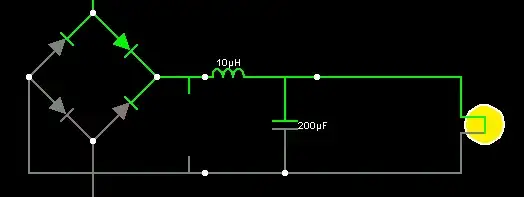
- Use a 10uH inductor, anything more greatly increases the price without affecting performance much.
- For the capacitor, you need about 200µF to start getting good filtering with 60Hz and a 300 watt load.
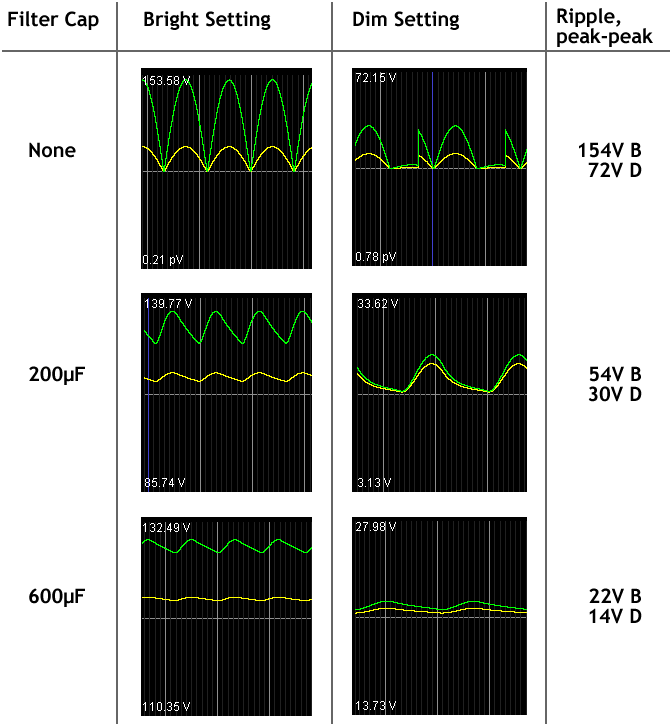
Here's the effects on the voltage, to the lamp, for three capacitor values. Note that the inductor is still required to deal with all the spikes, and harmonics, a dimmer induces...

Reference this simulation (crude but free!).
We can see that by 600µF, the power is smooth enough that buzzing should be eliminated.
Here's an 820µF cap that should work nicely, cost about $4. (Just in case, monitor its temperature carefully for the first few hours of operation.)