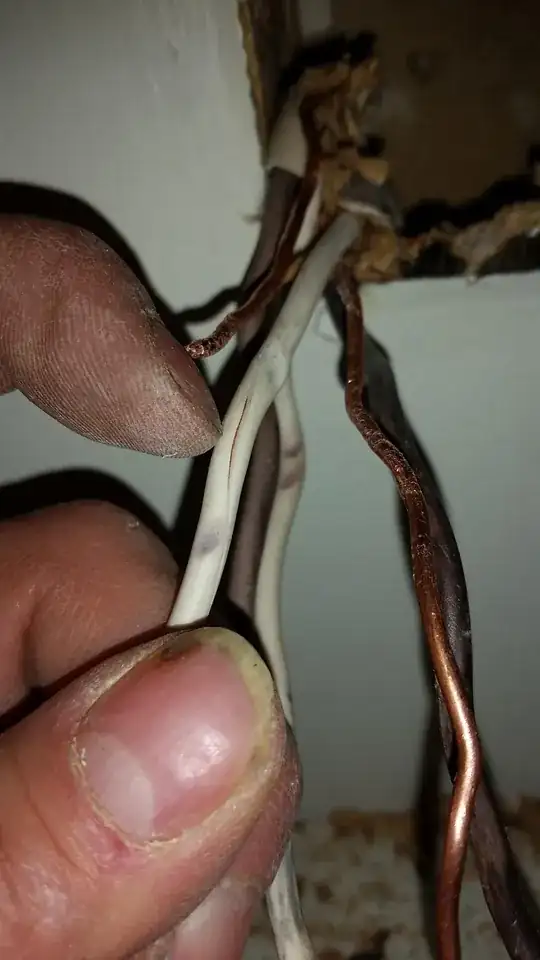
 I've run across this a few times in the house where I've been doing repairs. Normally, I would just tape it up and call it good. I mean, the tape itself is rated at 600 volts. Someone told me recently tape is not listed for repair, only marking. I am a bit confused about UL listings. Where do you find them? And how do you know what something is listed for? And finally, what is the proper way to repair cracks or cuts in wiring insulation?
Asked
Active
Viewed 1.7k times
3

Nicknamednick
- 1,056
- 2
- 9
- 23
3 Answers
6
Electrical tape can insulate a splice all on its own, so this should be fine
UL-listed thermoplastic electrical tapes are intended to be the sole insulating means on a splice or joint (the White Book says as much), and are tested for their capacity as an insulating material, so using them to repair damaged wire insulation within a junction box should be fine in practice, even though neither the NEC nor the UL White Book speak directly to this use of the product.

ThreePhaseEel
- 87,685
- 36
- 144
- 243
6
PVC and rubber Electrical tape has been used for decades to insulate electrical joints. It is sufficient for the job. Nothing else is required.
Here is the 2015 UL White Book listing for insulating tape.(somewhat formatted)
INSULATING TAPE (OANZ) USE
This category covers rubber insulating tape for insulating joints and splices in electrical conductors where an outer covering of protective mate-rial, such as friction tape, is intended to be applied over the insulating tape. This category also covers thermoplastic tape intended for use as the sole insulation and covering of joints and splices in electrical conductors. This tape is suitable as electrical insulation at not more than 600 V and at temperatures not exceeding 80°C (176°F).
PRODUCT MARKINGS
The wrapper or carton containing a single roll of tape, or the central paper core on which the tape is wrapped, is marked with (1) the manufacturer's name or trademark, (2) the catalog or type number, and (3) the words ‘‘For use at not more than 600 V and at not more than 80°C (176°F),'' or an equivalent statement. Tape determined to be flame retardant is marked ‘‘Flame Retardant.'' Tape determined to be suitable for exposure to sunlight is marked ‘‘Sun-light Resistant.'' Tape determined to be suitable to insulate splices while subjected to tem-peratures down to -10°C is marked ‘‘Cold Resistant.''
PRODUCT IDENTITY
One of the following product identities appears on the product: Elect. Insul. Tape Elec. Tape Electrical Insulating Tape Electrical Tape Insul. Tape Insulating Tape Other product identities may be used as shown in the individual certifications.
ADDITIONAL INFORMATION
For additional information, see Electrical Equipment for Use in Ordinary Locations (AALZ ). REQUIREMENTS The basic standard used to investigate products in this category is UL 510, ‘‘Polyvinyl Chloride, Polyethylene, and Rubber Insulating Tape.'' UL MARK The Certification Mark of UL on the product, or the UL symbol on the product and the Certification Mark on the smallest unit container in which the product is packaged is the only method provided by UL to identify products manufactured under its Certification and Follow-Up Service. The Certification Mark for these products includes the UL symbol, the words ‘‘CERTIFIED'' and ‘‘SAFETY,'' the geographic identifier(s), and a file num-ber. Alternate UL Mark UL MARK The Listing Mark of UL on the product, or the UL symbol on the product and the Listing Mark on the smallest unit container in which the product is packaged, is the only method provided by UL to identify products manufac-tured under its Listing and Follow-Up Service. The Listing Mark for these products includes the UL symbol (as illustrated in the Introduction of this Directory) together with the word ‘‘LISTED,'' a control number, and the product name ‘‘Insulating Tape'' (or ‘‘Insul. Tape''), ‘‘Electrical Tape'' (or ‘‘Elec. Tape'') or ‘‘Electrical Insulating Tape'' (or ‘‘Elect. Insul. Tape''), or other appropriate product name as shown in the individual Listings.
UL, in performing its functions in accordance with its objectives, does not assume or undertake to discharge any responsibility of the manufacturer or any other party. UL shall not incur any obligation or liability for any loss, expense or damages, including incidental or consequential damages, arising out of or in connection with the use, interpretation of, or reliance upon this Guide Information.


2
Read NEC 110.3.
When a manufacturer sends equipment to UL for testing, they include its labeling and instructions. UL tests the equipment consistent with those instructions.
As a result the equipment is now listed for use according to instructions.
Use contrary to instructions violates 110.3 because the item has not been tested for that use.

Harper - Reinstate Monica
- 313,471
- 28
- 298
- 772