24

I have two countertop outlets in my kitchen that I am in the process of replacing with new, GFCI-protected outlets. These two outlets are on a circuit together, and they are the only loads on that circuit. After wiring the new outlets up and testing them, I noticed an odd behavior. When tripping the "upstream" outlet, the "downstream" outlet does not receive any power. I assume this is because they are wired in series.

  1. Is it possible to wire these two outlets in parallel so that when the "upstream" outlet trips, it won't cut off power to the "downstream" outlet?
  2. Would this a wise thing to do?
  3. Would it be up to code?
  4. If so, how do I do it?

Edit: I realize now that I have confused series and parallel with inline and not inline. Thank you all for clearing that up and for such great answers!

Chris Cudmore
  • 14,169
  • 7
  • 61
  • 91
Drew Spickes
  • 405
  • 2
  • 4
  • 8

4 Answers4

20

GFCI receptacles have two sets of contacts, line, and load. The Line side of the receptacle is used to power the device, while the load side is used to power other devices down the line. Any device connected to the load side of a GFCI receptacle, will be protected by the GFCI receptacle.

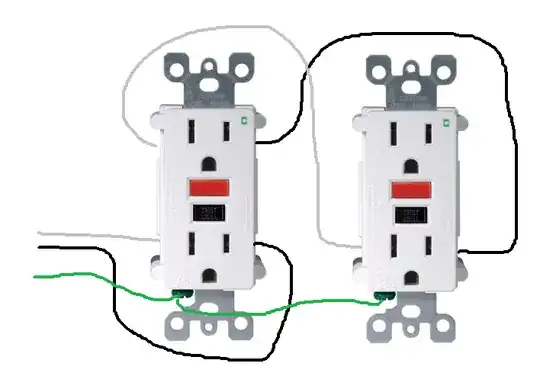
For example, if you have a setup like this (which I assume you have).

enter image description here

There is no need to have a GFCI receptacle as the second receptacle, since it will already be protected by the first GFCI receptacle. Because of this, if the first device trips all devices on the load side will not be powered (as you have noticed).

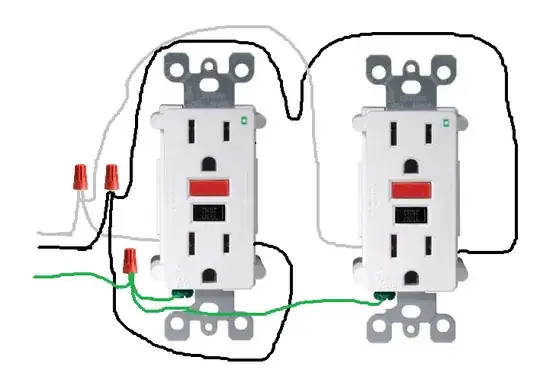
You can use pigtails to connect the receptacles like this.

enter image description here

But in a setup like this, you'll be required to have a GFCI receptacle at both outlets. The devices down stream are no longer protected by the first GFCI receptacle, because they are not fed by the load side of the device.

FYI:
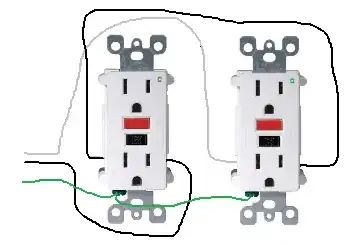
This is what it would look like if the receptacles were wired in series. enter image description here

Tester101
  • 133,087
  • 80
  • 327
  • 617
11

This is the correct behavior. You only need 1 GFCI outlet per circuit (assuming it's at the beginning of the line and the rest of the outlets are loads).

They are correctly wired in parallel - if they were in series, you wouldn't get the correct voltage at the other outlets when there is any type of load present.

Steven
  • 27,770
  • 10
  • 56
  • 90
5
  1. It is possible. You have to ask yourself if that's what you REALLY want; the design of a GFCI outlet is such that it will protect everything "downstream" of it and 99% of the time this is a very good thing.

  2. Again, consider whether you REALLY want to not have GFCI protection on these outlets (and whether it's allowable by code). Sometimes it's a no-brainer; say your fridge is on your kitchen appliance branch circuit (perfectly acceptable). If the GFCI for countertop outlets trips while you're away from home, you don't want your fridge cutting out. So, you can often keep the fridge running by strategically placing unchained GFCIs in the circuit around the fridge outlet, bypassing protection for the fridge. Same for the microwave. BUT, most devices, such as your DW and disposer (those can be on the same branch as the countertop outlets IF the home was built or last reno'ed before 1996) require GFCI protection anyway along with all countertop outlets. Even the fridge should probably have GFCI protection if it has water/ice dispensers; it should just have its OWN GFCI, which trips when the fridge itself shorts and not the toaster next to it.

  3. Code does not specifically require everything downstream of an installed GFCI outlet to be protected by that GFCI outlet, and so technically, bypassing protection is allowed. However, code does apply to individual outlets; any receptacle outlet within 6 feet of a sink, tub, toilet, shower or other "wet" area MUST be GFCI-protected either by having a GFCI outlet there, or having one upstream that has this outlet as part of its "load". So, if bypassing GFCI at any given point would make any downstream outlet non-compliant, you'll need to either suck it up and protect the whole line, or install a second GFCI further downstream to protect the needed outlet. As GFCIs start at about $11 and run up to $25 depending on a variety of factors (15/20A, TR/WR, EZ-wire, color, style, brand, region) putting multiple GFCIs on a circuit can become an expensive way to wire your home (though probably less expensive than rewiring the circuit completely).

  4. If you really do want it this way, it's accomplished by connecting both line AND load wires to the "line" terminals on the GFCI outlet. You will not be able to use the "load" terminals to connect wires as those will cut out when the GFCI does. The best way to do this is to wire-nut the line and load wires together (hot separate from neutral of course) along with a third piece of insulated wire to connect to the GFCI terminal. The following will also work but licensed electricians may cringe; firmly screw both the line and load wires onto the line terminal (I see this all the time when working with daisy-chained switches in multi-gang boxes so it can't be THAT bad). This works perfectly fine if you use "EZ-Wire" GFCI outlets; they have a plate that clamps down with the screw to hold wires so you don't have to curl around the screw terminal. Most of these have holes or notches for two wires per terminal and they're very secure.

KeithS
  • 14,367
  • 7
  • 45
  • 74
3

GFCIs come marked with two sets of terminals. One pair is marked LINE and the other marked load.

Typically, you would connect the line voltage to the Line pair, and you would run from the load pair to any downstream outlets and or lights. The load pair of terminals is already protected, so you need not use GFCIs further down the chain. So, if the GFCI outlet is the first item in the chain, everything downstream will also be turned off in a fault situation (As if the breaker tripped.)

What you need to do in your situation is to pigtail wires in the box before it connects to the GFCI, and to run a cable to the next outlet, which will now be unprotected unless you also use a GFCI outlet. (SEE TESTER101's answer with MSPAINT!!!) I believe the code says GFCI's are required within 6 feet from any sink. I go a bit further (9', with some common sense), to ensure that I can't touch the toaster with an 18 inch cord, with my 10" chef's knife while touching the sink. I also have stainless steel appliances which look like an attractive ground to me, so I treat them as if they were sinks.

Chris Cudmore
  • 14,169
  • 7
  • 61
  • 91