3

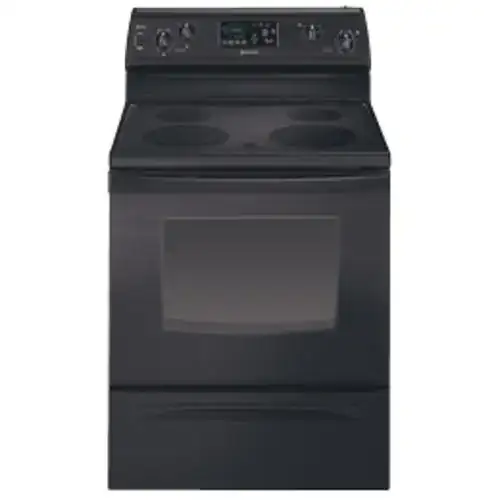
I've got a Whirlpool RF378LXPB0.

enter image description here

The two front burners (that can heat a smaller, inner burner, or both the small and larger around it) do not heat up all the way. When turning them on HI, the elements heat up red but then turn off after a few seconds. Once they cool down a bit they'll turn back on and heat up a bit until shutting off once again. I'm not mechanically or electrically inclined, and am not sure where to even start looking.

Tester101
  • 133,087
  • 80
  • 327
  • 617
brazilianldsjaguar
  • 133
  • 1
  • 1
  • 5

4 Answers4

10

The "burners" on an electric range have TWO settings - off and on. There is no in between. So they turn on and off to maintain a goal.

With the burner set to high, normally they stay on almost all the time, heating the pot on top of it to boil water. With the heat control set to an intermediate value, the burner will kick on and off repeatedly to maintain a goal temperature. However, if you leave a pot off of the burner, they will overheat if they stay on permanently. The temperature sensor recognizes this fact, and that there is no need to leave the burner on.

All of this is different for a gas range, where it is the amount of gas that is fed to the burner to control the heat.

Note that an electric range will cook more slowly than a gas range. So you may think the stove is not working properly, when it actually is working as it is designed. One other important point - a smooth top range like this cooks most efficiently with flat bottomed pots. You need good contact over the bottoms to get good heat transfer, and good heat transfer is essential for cooking. Check this fact by taking one of your pots and hold a ruler across the diameter (underneath the pot). Or take the pot and touch the edge of your counter top. Sight along that straight edge. Most pots tend to have a bit of a dish to them, so the center of the pot may stand off by as much as 1/4 inch. Those pots will perform poorly. (Sorry, but they will.)

That concave pot bottom is fine for a gas range. But it will hurt you with a smooth top electric range.
3

The heaters are probably thermostat controlled and what you see is a normal behaviour of the thermostat maintaining a target temperature. Many electric heaters work this way (some are able to control input power instead, but such device is a lot more difficult to produce for most electric heater types).

Suma
  • 198
  • 1
  • 9
2

Stoves in the USA are designed to be able to produce the maximum heat setting on both 240 volts and on 208 volts. At 208 volts it will be on a higher percentage of time, but not as red. At 240 volts it gets hotter when on, but goes off for more time to make up for that.

Many residences, particularly those in high-rise or large buildings, will get their single phase power using just two phase lines of a three phase system operating at 208/120 volts. So these will be 208 volts, not 240 as is the norm for true single phase power. In the past, stoves had optional 208 volt elements or 208 volt models and complicated setting controls only in specific steps. Now electronic thermostatic control is cheap enough, that is used which also provides variable settings. And it solves the 208 vs. 240 volt issue at the same time. It's all cheaper this way.

Skaperen
  • 1,370
  • 1
  • 9
  • 9
2

We have the same stove and this is a flaw in the Whirlpool design. The heaters are electronic (they look like IR LEDs) and thus switch on and off very fast. This makes it very difficult to cook some foods (e.g. grilled cheese) because the stove may be effectively on "max" for 2 seconds and then "zero" for 10 seconds. The toast burns before the cheese melts.

The best solution we have found is to use a heavy cast-iron frying pan. It has a higher heat capacity that a stainless pan, and thus evens out the heat quite a lot.

The best solution would be for Whirlpool to cycle the heaters every quarter second, thus maintaining a more even heat.