1

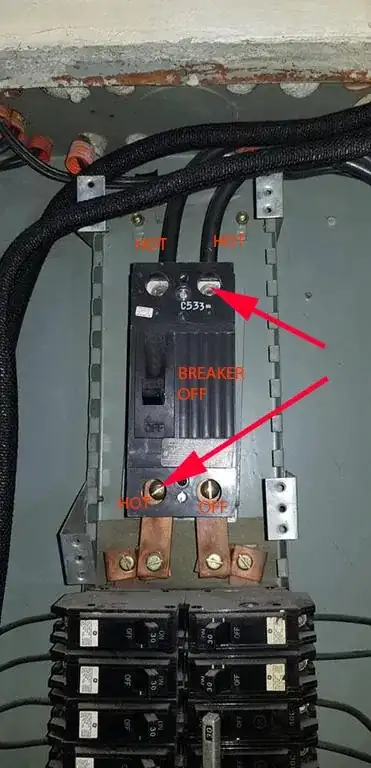
Supposed the breaker is off but the left side is still hot (let's say breaker defective). Won't it work if you measure the terminal in the hot right and load left like in the following picture?
2

Why won't it work (if it won't work)?

Original message:
1

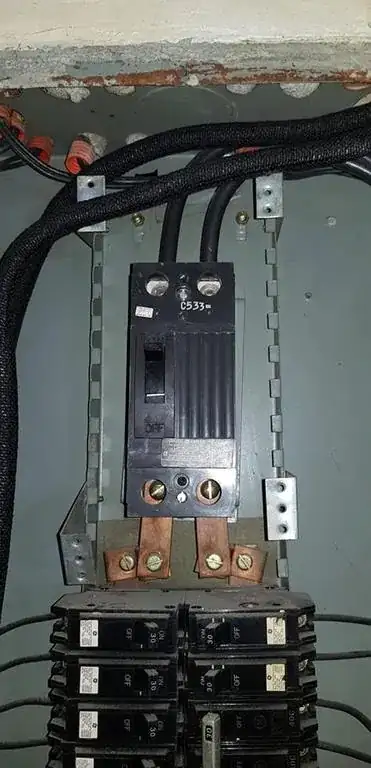
I'll connect two chair lugs to the screws in the above 125A main breaker feeder cooper. If I shut down the main breaker, how do I check both hot wires are gone without any neutral (we don't use neutral since all our equipments are 240v)? A defective breaker may only disable one of the hots. If I use a multimeter, where will I put the other lead on for each?

Samzun
  • 301
  • 1
  • 6
  • 17

6 Answers6

2

That's what a non-contact tester is for. You test with it before and make sure it is showing voltage and then flip the breaker and make sure it is clear. It should not be the only thing you do before working on potentially live wires/equipment, but it provides a very useful double-check.

manassehkatz-Moving 2 Codidact
  • 139,495
  • 14
  • 149
  • 386
2

There are several ways to test to verify if the line(s) are dead, first non contact tester. Test the incoming line to verify the tester is working, then check both legs after the breaker , now verify the tester is still working on the hot side of the breaker if both legs show dead and both tests on the hot side showed good it is safe., Using a volt meter, verify the meter is working on the hot side, check leg 1 to ground, check leg 2 to ground, just to be crazy check leg 1 to leg 2. If all show dead verify the meter is still working.

Now you know how to properly test with both kinds of meters.

Ed Beal
  • 103,727
  • 4
  • 79
  • 158
1

You can check against PE (if present) or metal water pipe because almost all distribution systems are referenced to earth.

DDS
  • 2,402
  • 11
  • 15
1

Between the line and the load on the breaker. You want to test if the breaker disconnects both of its load terminals from its line terminals.

Dan D.
  • 1,380
  • 9
  • 14
1

I can't say for sure since I am unfamiliar with the electrical service in the OP's location. I believe at the utility transformer it's the same as the common US system, 240V line to line with a grounded center tap, so 120V line to ground at the transformer. However there is no service neutral / grounded conductor, not sure if there's a grounding electrode system, and no equipment grounding system. I believe the line to ground voltage in the house would be less than 120V due to ground resistance.

Most non contact voltage testers depend on a ground path through the person holding the tester. They may be less reliable with a system with no grounded conductor on the service / GES / EGS.

I'd definitely recommend that the OP back up the NCVT with readings from a solenoid tester or other voltage tester / meter. I'd check line to line and line to ground on both sides of the main breaker before and after opening the breaker. If any reading is other than expected, it's a show stopper.

There are a lot of other things you need to know to work safely in the panel, I am just addressing the OP's question about testing.

batsplatsterson
  • 25,515
  • 1
  • 34
  • 83
1

Just test line to line. First test the load side with the breaker closed and record that voltage, i.e. 240V. Then open the breaker and test it again, if both sides are open, it would read zero. Anything other than zero means there is a problem and if it reads less than the prior reading, it means there is eather a cross connected circuit somewhere from another source, or one pole of that breaker is not opening, but it is reading through a load somewhere.

JRaef
  • 15,146
  • 1
  • 20
  • 40