13

I'm about to perform a few electrical changes in my house in order to be able to control lighting fixtures (230V, 30 to 200 mA) from a PC. I have some doubts about the way stranded wires should be connected to the plugs.

For instance, I suppose the way of connecting the wires shown on the next photo is dangerous, because the connection can easily become loose, is it? It seems that pulling the plug a few times by the wire instead of the plug itself would have disastrous effects on the connection.

Stranded wires are loosely twisted around the connectors of the plug, the screws being relatively useless

If yes, should I solder stranded wire to make it solid? If so, what should I take care of, aside using a rosin-core solder? Once I solder it, how am I supposed to connect it to the metallic parts of the plug?

Arseni Mourzenko
  • 435
  • 2
  • 5
  • 11

10 Answers10

24

One should never apply lead alloy solder to stranded wires (often called "tinning") that are to be tightened under a screw. Eventually, the solder will cold-flow under the pressure and the screw connection will become loose.

This doesn't happen overnight; it can take months or years. I have personally seen this happen on several occasions.

It can be okay to just tin the very tip, to help keep the twisted wire strands together while tightening the screw. However, it is preferable just to leave some extra wire sticking out, and cut that off flush after tightening the screw.

Mike Waters
  • 667
  • 4
  • 14
17

With that style of terminal tinning the wires with solder is going to cause more problems than it solves.

However the plug in the picture does not look correctly wired to me.

Firstly the wires should wrap around the screws, not merely run down one side of them. They should be wrapped such that turning the screw will tighten the wire around the screw.

Secondly the cord grip does not seem to be correctly installed. It should clamp on the sheath not the individual conductors and it may need inverting to give a good grip on a thin cable or it may not be suitable for thin cables at all. If pulling the cord out puts stress on the electrical terminations the cord grip is not doing it's job properly.

Peter Green
  • 5,358
  • 13
  • 29
13

It's a given that any wires in cordage will be stranded. Being designed for a different kind of service is what makes cordage different from in-wall wiring, and why you should not use one for the other.

So it's a given that any plug whose primary use is cordage is designed to work with stranded wire. Here, you should follow the instructions and labeling on the plugs, because following those instructions are the basis for the testing and certification which the plug received from your NRTL. (Nationally Recognized Testing Laboratory) such as UL, CSA, TUV etc.

Not following the instructions is an "off-label use" (to put it kindly) and can result in an illegal install and non-payout of fire insurance.

Speaking of non-payout, you need to be careful what you are sticking on mains power, and in particular, built into walls. Random electronic components out of the Digi-Key catalog are unfit for use in mains power. Equipment made for use in mains wiring can get its cert/listing faster if it is built with listed components, that is all a component listing means, it does not mean you can use components directly.

So for instance "random relay" is not listed for use in mains, but an "RIB" unit containing that same relay can be used. (RIB ~= Relay In Box).

If your aim is smart appliance control, you may be better off using existing, listed/certified smart devices (i.e. Not Sonoff), and having your electronics communicate with them. Generally, the rules are greatly relaxed for homebrew equipment when it is entirely low voltage and fed by a listed/certified wall wart.

Harper - Reinstate Monica
  • 313,471
  • 28
  • 298
  • 772
8

I would not use solder - it won't help the grip much (arguably, stranded wire may actually grip the screw better as it deforms) and while it is probably not a bad conductor, it won't beat copper.

What is important is to wind the wire around the screws in the correct direction. To quote Harper from another answer (and I have seen him mention this quite a few times): Hook the wire clockwise around the screw, so tightening the screw makes it wrap more.

manassehkatz-Moving 2 Codidact
  • 139,495
  • 14
  • 149
  • 386
7

You should not use solder. The flat headed screw is designed to hold stranded wire in place. As other answers said, using solder will prevent the screw head getting a good grip on all the strands of wire and eventually it will work loose.

The mistake you made was to strip too much insulation from the wires and then try to make the joint stronger by wrapping the wire round the end of the pins after it went under the screw heads.

The correct way is to strip only enough insulation to make a loop around the screw, a bit LESS than one complete turn (about 3/4 of a turn is fine) so the wire doesn't overlap itself under the screw head. Wrap the wire round the screw in the direction so that tightening the screw pulls the wire tighter under the screw head rather than pushing it away.

The wires in your picture are coming towards the screw from the correct side, but they don't wrap far enough around the screw, because you thought you should wrap the end around the connector pins instead.

alephzero
  • 884
  • 6
  • 8
5

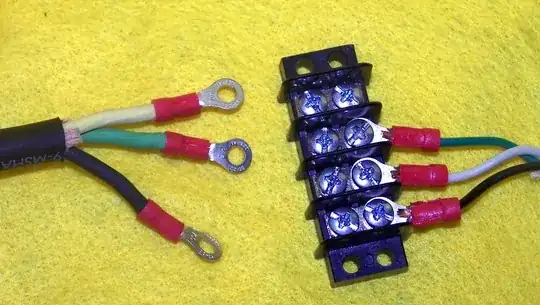
For the particular connection in the OP image, I would suggest using ring terminals on the wire, as they are intended to be screwed down:

image_from_https://tech.txdi.org/electricalconnections

user2813274
  • 219
  • 2
  • 8
1

Generally speaking, no. The screws are designed to hold the wires in place.

If you don't feel the plug screws are sufficient, buy a newer one. They all use screws to connect, however.

Machavity
  • 26,498
  • 8
  • 44
  • 100
-1
  1. Use Electric wire ferrules:

"An electric wire ferrule (sometimes end terminal) is a metal tube crimped over stranded wire to secure the strands within a screw terminal."

  1. The cord grip must clamp on the sheath of the whole cord and not just individual conductors.

  2. Maybe most important: The earthing or grounding system is not connected! Either use a third conductor for earth/ground or use a plug which by design just has two conductors, if that is even permissible for the applied voltage and current.

-2

Soldering is fine, if it's a permanent installment. Reason being, what I often do is tin the stranded wire and solder it to the pin after removing the screw. That way, it's not ever going to come adrift. Obviously not the intended way, as screws are provided,but to my mind, it's a better electrical and probably physical connection. As also mentioned, the outer sheath needs to be under the clamp so that the people who insist on pulling the plug out by the wire don't put extra strain on the internals.

Tim
  • 5,501
  • 14
  • 31
-2

A good solution for stranded wires in screw terminals: ferrules

They are common in some parts of the world. Last time I checked, Lowes & Home Depot did not carry them. I bought a ferrule assortment off amazon.