22

Working on the propane conversion of my gas stove. One of the orifices to be changed is in a very hard to access location - shown in the photo. The orifice is the "nut" I'm referring to, which you can fit a wrench onto.

Although it is possible to get a wrench on it there is a very limited range of motion due to surrounding apparatus. I've tried to mark this in the photo with the red lines. The very short arc that the wrench can turn in means that it never gets a 'bite' on the orifice / nut and I can't even loosen it.

It would be much more work to disassemble the other parts in this area, so I'm hoping for a solution to remove and then reinstall just the orifice part. Maybe there's a specialty type of wrench... or something else I'm not thinking of.

Hard to reach

Machavity
  • 26,498
  • 8
  • 44
  • 100
StayOnTarget
  • 5,675
  • 21
  • 58
  • 102

10 Answers10

24

A Crowfoot Wrench would work nicely. A 10 piece set of these is only $15.00

enter image description here

Jerry_Contrary
  • 3,733
  • 10
  • 24
16

I'm a gas fitter and service tech. My bag has the tools to do the job. Sometimes these tight spots require a bit of a turn with one tool and a bit of a turn with another. A lot of the available arc can be chewed up by lash, torsion and flex of components. The first tool I'd reach for, for something like this is a line wrench. I'd get a 12 point enter image description here Amazon

After all, this is the tool made for this job

If that didn't work it's the 6" or 8" Knipex Cobraenter image description here Home Depot

These are amazing and are designed to avoid stripping and marring.

Joe Fala
  • 6,414
  • 10
  • 36
15

What you may be overlooking, or what may not be present on your wrench, is the the open wrench is not square to the shaft. It is canted by 1/24 of a circle (15 degrees).
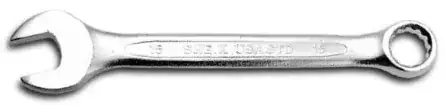
enter image description here

As a result, there's a 30 degree difference between the wrench (normal) and (flipped).
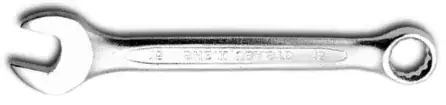
enter image description here

That means you only need a 30 degree arc of motion, not a 60 degree arc. When you run out of travel, remove the wrench, flip it over, raise it 1/12 of a circle (30 degrees), and it will fit on the next flat.

If your range of motion is being compromised by the wrench being all loosy-goosey on the nut (that's a technical term), then you have the wrong size wrench. Do not proceed further because you'll damage the hex corners, which will make the lash problem much worse. In particular, watch out for English vs. Metric. The only wrench sizes that match up are 3/4=19mm, all others will be sloppy.

An adjustable wrench (commonly called a 'monkey wrench', inaccurately) is one answer, but you have to get that tight and might have to retighten on every turn.
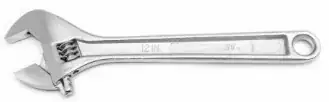
enter image description here

It certainly looks like you have more than 30 degrees of motion there (though perhaps not quite 60 degrees). If you are tighter than 30 degrees, first stop and think about how the manufacturer intended this thing to be serviced, because not least, they had to build it and they certainly didn't want their factory workers spending 10 minutes fastening this one thing. If the range of motion is simply impossible, then you need the extreme options offered by others, or perhaps a "stubby" (short length) wrench that allows you to work inside the obstructions...
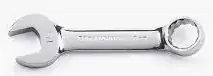
enter image description here

Harper - Reinstate Monica
  • 313,471
  • 28
  • 298
  • 772
15

The best tool I have found for the type of application you are working with is a 12-point split-box wrench. These are also available in a 6-point design.

enter image description here

(Picture Source: http://constructionmanuals.tpub.com/14256/css/Types-and-Uses-Continued-156.htm)

The split end lets the wrench get onto a fitting even when a tubing is inline. The box construction also gets better grip on the fitting than trying to use a conventional open ended flat sided wrench. The 12-point design and ability to flip the wrench over if needed from stroke to stroke makes this the tool of choice if the working angle to the fitting is small.

Michael Karas
  • 67,833
  • 7
  • 68
  • 153
5

An open end Ratchet wrench is likely the best tool for this job.

Something like this: enter image description here

UnhandledExcepSean
  • 10,074
  • 5
  • 39
  • 47
3

One solution I have is a set of wrenches with angled heads - you can see one end has a greater angle than the other, very handy in many situations :

enter image description here

Mind you, the set cost me quite a bit... But that was a long time ago.

Solar Mike
  • 30,038
  • 2
  • 34
  • 69
2

EDIT this won't work because in this instance the fastener is obstructed by a pipe. Leaving for completeness.


There appears to be plenty of width to the slot. How about a socket with a long extension bar and a universal joint?

enter image description here

They add slop but that's no more than annoying. You'd require a deep socket to go over any bolt too.

Criggie
  • 11,950
  • 2
  • 26
  • 79
1

Try an open-end ratcheting wrench. Here's a video showing how they work at about 30 seconds into it; manufacturer demo and not intended as an endorsement:

https://www.youtube.com/watch?v=QWBlQdporxE

0

I would try with my socket set and ratchet handle. If there's enough space to get the socket and ratchet over the nut, then you need only a few degrees of wiggle at right-angles to the nut in order to un-do it one click of the ratchet at a time. (Also you can be sure of getting the nut back on, whereas if you get it off with an open wrench of any sort, this may prove to be a problem!)

I have seen the equivalent of a ring spanner with a ratchet mechanism built in, which is hardly any thicker than any standard wrench. I have yet to need to buy one, but it's probably the ultimate solution to such a problem. This is an example:

Before anybody points this out: ratchet mechanisms are "weak". They do not allow one to exert really high torque, and tend to fail if you try to dislodge a really stubborn nut, for example by bashing the handle with a hammer. If this is a problem, start with a standard wrench to loosen the nut a little. Then switch to the ratchet.

nigel222
  • 866
  • 4
  • 6
0

I suggest the wrench is the wrong size for a perfect fit on the nut. Plumbing fittings are commonly made in their own peculiar series of sizes. Just a little misfit at the nut becomes a large loss-of-movement at the handle. Suggest you explore the fit. If it is desperate, you might be able to shim the wrench for a neat fit on the nut.

BigPete
  • 11
  • 1