22

I’d like to run power from a Uninterruptible Power Supply (UPS) in ROOM A to where a work computer is used in ROOM B. I was thinking of installing an outlet box in ROOM A near where the UPS is plugged in, then run wire under the house to another outlet in the other room. That way I could just plug the UPS power out into the receptacle in ROOM A and the computer into the outlet in ROOM B on the other side of the house. Of course this line would not be connected to a circuit breaker, only from outlet to outlet.

I want to run the UPS to be available for use in both rooms, that’s the reason for the additional line.

Would there be any problems with this from a code perspective? Would it require traditional wiring and hardware (e.g. Romex, outlet boxes) to accomplish it?

chicks
  • 239
  • 1
  • 3
  • 13
staticGenerator
  • 337
  • 2
  • 7

4 Answers4

37

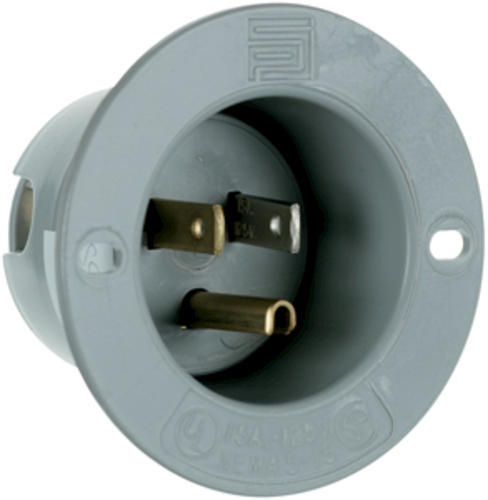
You need an inlet in Room A, not an outlet

enter image description here

You'll need an outlet box with an inlet in it in Room A so that you can plug the output of the UPS into it with a proper cord (read: if you have to do weird crap to your cord to plug the output of the UPS into the wall, stop, because that's a sign you're doing it wrong!). From there, you can use a suitable chapter 3 wiring method (assuming the crawlspace is not wet, NM/Romex will do; use UF aka "outdoor Romex" instead if it is wet/damp, though) to connect the inlet box in Room A to an ordinary box+receptacle in Room B.

Harper - Reinstate Monica
  • 313,471
  • 28
  • 298
  • 772
ThreePhaseEel
  • 87,685
  • 36
  • 144
  • 243
5

I have a feeling you will find this to be quite a bit more involved than you originally expected. In addition to whatever other code issues involved in setting up a power "inlet" in Room A (as opposed to the normal receptacle = "outlet"), at a minimum you would need to use approved wiring methods to get from Room A to Room B. That means Romex properly installed - i.e., protected from damage, securely attached, etc. - or wires in conduit. As noted in another answer, regular Romex may not even be an option if the cable actually runs "under" the house as opposed to "through the basement". It means real junction boxes on both ends. It means a lot of work - for relatively little benefit.

My recommendation is "anything else". That includes:

  • If the UPS is relatively small (that's $ and capacity, which basically go together), just get a second UPS for Room B and you're done.

  • If the UPS is relatively large then you could run a heavy duty extension cord. That isn't ideal - extension cords are supposed to be for temporary use. But indoors (at least no problems with weather and wild animals, etc.) and with a heavy duty UL-listed cord - e.g., 12 or even 10 AWG instead of the cheap 14 or 16 AWG that you find in the dollar stores - it would run just fine. But any time you use an extension cord you have to be aware of any possibility of damage - the cables buried inside your walls are safe, the cords outside your walls can be damaged by: kids, pets, furniture (e.g., rolling chairs), doors (I've seen people put extension cords under a door and not think about how it can get into the edge of the door and then get pinched with every open/close), etc. There are reasons extension cords are not supposed to be used for a permanent installation - but it is better than a non-compliant "permanent" installation.

manassehkatz-Moving 2 Codidact
  • 139,495
  • 14
  • 149
  • 386
5

Yes. You are allowed to use standard practices for in-wall wiring to build a "runt circuit" that goes A to B to C to D and does not actually go to any service panel.

You fit standard outlets in all locations but exactly one. Since there are no other inlets, you fit one inlet capable of taking an extension cord.

Every circuit needs some number of outlets and exactly one inlet. Normally the inlet is direct wiring to the service panel, but not today. If for some reason you want to have 2 possible inlets, you still install one inlet and simply move it as needed.

Harper - Reinstate Monica
  • 313,471
  • 28
  • 298
  • 772
1

To use a UPS located in one room for equipment located in another room, you need a UPS designed to be hardwired.

This is called a Structured Wiring UPS, and they are typically prohibitively expensive. They have internal wiring connections that an electrician would connect circuit breakers and then outlets to. They do not have normal outlets on them that you're used to seeing on a UPS.

An extension cord plugged into a normal UPS is the most you can do, and even that is against code if it's always going to be connected that way instead of just temporarily.

Putting outlets in the wall and connecting them to a normal UPS is not allowed as far a I know.

Dotes
  • 4,869
  • 11
  • 17