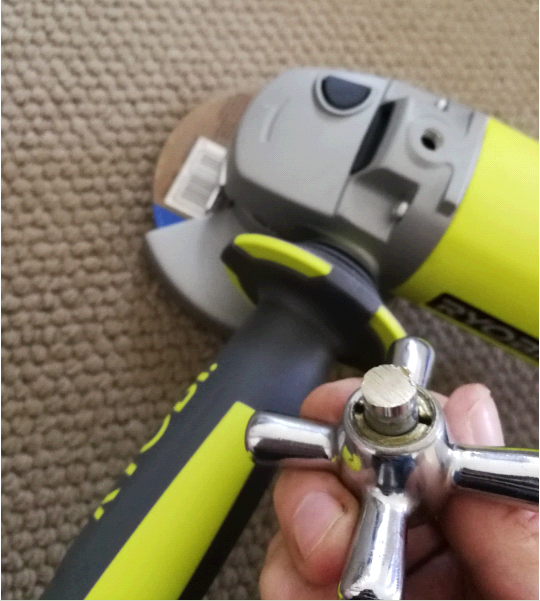
Most of the taps in my new house are fitted with so-called "anti-vandal" screws in the tap heads, as shown in the image. These screw into the tap head to tighten them onto the stem.
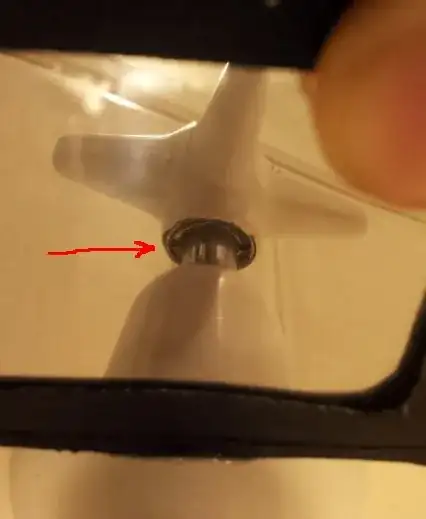
I can't remove most of them because they are stuck. I suspect they've been overtightened and haven't been removed for years. I'm looking for suggestions as to how I can remove them so I can replace the tap washers. And yes, I know which way they need to be turned to tighten or loosen them ;-)
I've already tried:
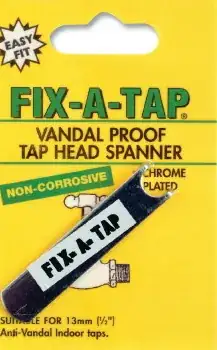
- Using an anti-vandal tap head spanner (shown below), but the prongs bend/break, as the screws are quite stuck.
- Using a hair-dryer to heat up the ring before using the spanner.
- Adjusting the rings to tighten, then to loosen. I simply get no movement at all.
- Applying WD-40 to the rings. This hasn't worked either, perhaps because of their orientation; I can't immerse them.
I also have a pair of needle-nose pliers, but they're just a bit too big for the notches in the rings to get a good grip.
Any other suggestions?
UPDATES
- UNECS's suggestion (below) was certainly a good one, but unfortunately it didn't work out.
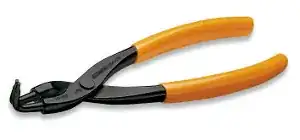
- I now have my hands on a small pair of 90° circlip pliers which I'll try later. Hopefully I don't break them (or anything else) in the process!
The anti-vandal tap head spanner:
Circlip pliers:
This finally worked:
- Clear any crud out of the threads using vinegar over a few nights (see Wayfaring Stranger's answer, below)
- Give the rings a good blast of Loctite Freeze & Release for a few seconds, and let the stuff do it's magic for a few minutes
- I used the circlip pliers again, and the rings broke free, although not without a bit of force. I felt like I might still have bent the prongs of a tap head spanner like the one pictured above.
n.b. I'm told that any "freeze spray" like CO2 would also have done the trick instead, which works to contract the ring away from the thread of the tap head. Because the Loctite was expensive, it might be worth trying this instead as a first shot. I believe the same kind of principle is behind heating the parts up, which, when cooled rapidly, also causes the contraction which separates them, but I wasn't prepared to bust out the blowtorch for this one...
Finally, if you're going to do this, be careful you don't spray yourself if you're spraying upwards onto the ring, sheesh!