15

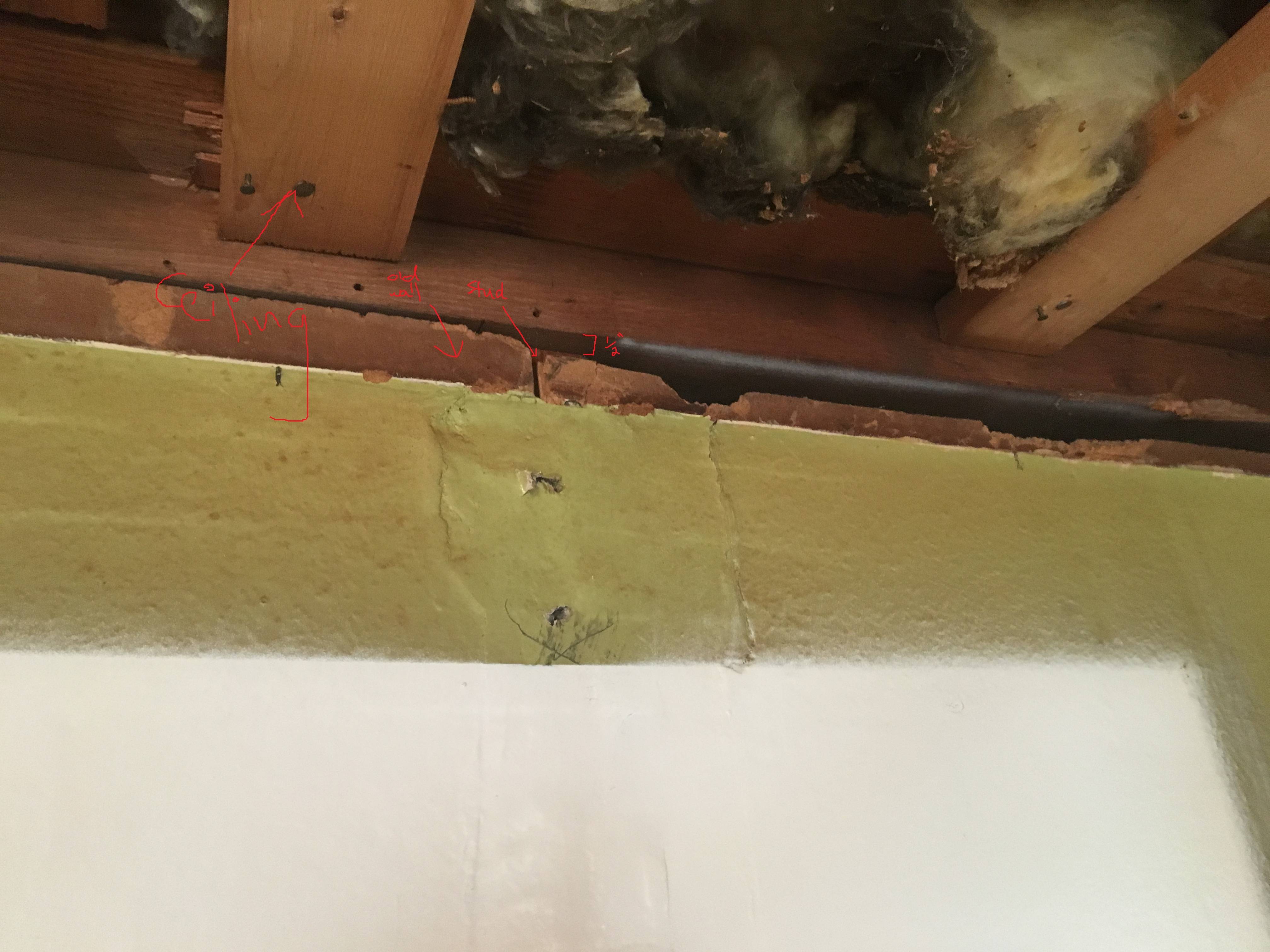
I’m demoing a kitchen and discovered that the top plate sticks into the room a half inch farther than the studs. The current drywall is attached to the studs and therefore is even with this top plate which leaves the problem of how to drywall the seam where the wall meets the ceiling properly.

Option one is to leave the current drywall and drywall over it including the top plate.

Option two is to remove the current drywall and reframe the wall so it is even with the top plate.

Which is better and why? Other options?

enter image description here

MonkeyZeus
  • 17,328
  • 2
  • 27
  • 64
Rob Sampson
  • 153
  • 1
  • 5

5 Answers5

44

Leave a gap and use a cornice(crown) molding to cover it.

Machavity
  • 26,498
  • 8
  • 44
  • 100
Jasen
  • 26,920
  • 1
  • 24
  • 46
14

If it is not too large of wall I would recommend removing all the old drywall and its fasteners. Then I would shim out the studs with extension strips that even out the wall with the top plate. You may find that not all of these shims are uniform in dimension of any of the studs are bowed or out of plumb.

The shims are easily ripped from a 2x4 or 2x6 using a table saw. Then nail them in place with ring shank nails for good holding strength. (Some folks may even suggest running a bead of construction adhesive under each of these shim strips).

Removing all the old drywall allows easy access to any electrical boxes in the wall along this stretch so that they can be remounted to provide proper projection through the new drywall that you will install. If you go over the existing drywall you will have other work to extend the electrical boxes. I dislike most box extenders because they can make the inside dimension of the box face narrower and would probably not be compatible with the newer style of smart switches, dimmers and GFCI outlets.

Michael Karas
  • 67,833
  • 7
  • 68
  • 153
9

If there is nothing wrong with the pre-existing drywall there is no way I could justify removing it. The ceiling joists look like 2x4's turned on their side? I've never seen anything less than 2x6 upright on the ceiling of a house with drywall. I'm also not sure if my eyes are processing the picture correctly. If it's what I think it is, I would nail/screw new 2x4's alongside the pre-existing ones, but upright, creating a "L" shaped joist. This will bring your nailing surface down to meet the wall while strengthening the ceiling joists so the ceiling is less likely to sag in the near future.

JohnnyB
  • 211
  • 1
  • 4
8

The cornice molding a la @Jasen really is a good answer, and has to be the easiest. But if you don't want to do that, this is probably the second easiest. (Before you dismiss me as a hack, know that I've done this lots, with good-looking results that have held up for years.)

I'm assuming you're going to drywall the ceiling.

Get a big roll of fiberglass mesh tape, and use lots. Run one course of tape all the way on the wall, butted up to the ceiling. Another course all the way on the ceiling, butted up to the wall, and a third in the usual position tucked into the corner, halfway on the wall and half on the ceiling. Tape right over the wood, drywall, and any gaps that are left. Make sure the tape extends at least half its width past any possible gap and onto a solid surface. Err on the side of using extra.

Get some Durabond (or similar) setting-type joint compound. Mix a bit of it. Smooth it down over the top of the wall, embedding the tape, covering the wood and drywall, and filling in any holes and gaps. Make sure to get it smooth, because that stuff is basically not sandable. After that sets (45 minutes or whatever) do it again along the ceiling, meeting your first layer at the corner.

Now, instead of a hodgepodge of wood, drywall, and holes, there is a smooth layer of a concrete-like substance that you can just mud over normally, and you're done.
3

Simple. Take the drywall off then take a nice sharp !" chisel and split that 1/2" off and drywall over it. Bam! Done! Is that the prettiest old school way of doing it? Nobody will see it again for 20 or 30 years. Quit trying to complicate it.