4

I have a Ridgid angle grinder and a metal cutoff wheel.

On page 7 of the manual it states:

Use ONLY Type 27 depressed center grinding wheels (such as the one provided with this product). NEVER attach a Type 1 straight or cut-off wheel to this angle grinder. Use for any other purpose is not recommended and creates a hazard, which will result in serious injury.

enter image description here

After reading some online forums, asking some contractor friends, and watching YouTube videos it seems that everyone simply uses a Type 1 wheel to cut metal and move on with their life.

PS: I won't acknowledge the countless people that use an angle grinder without the guard. I will absolutely be putting the guard in the correct position.

As far as I can tell I just have to reverse the clamp nut and it securely holds the Type 1 cutoff wheel in place.

Am I using the wrong tool or wrong cutoff wheel or are there simply so many more Type 1 wheel accidents that companies just try to distance themselves from Type 1?

Even the cutoff wheel packaging says "for use with angle grinders" and has a picture of an angle grinder.

Important: I am trying to solicit authoritative answers which can properly explain why one should not use a Type 1 disc. I do not wish for polling answers such as "I've done it so you're fine".

MonkeyZeus
  • 17,328
  • 2
  • 27
  • 64

4 Answers4

5

I think I have enough research to make an answer to this. I believe it comes down to the guard available for this tool and it not meeting the requirements for a "Type 1" cut off disk.

This Ridgid forum has what is supposed to be a quote from Ridgid:

The RIDGID R1001 Angle Grinder has an included type 27 guard and is certified to Underwriters Laboratories (U.L.) product safety standards. U.L. requires only type 27 depressed center grinding wheels be used with type 27 guards. Type 1 straight or cut-off wheels have no depressed center posing a safety concern to the operator when connected to a type 27 guard. In no circumstance should a type 1 straight cut-off wheel be used with a type 27 guard. Please contact RIDGID customer for further assistance: 866-539-1710.

This is for a different model, but it does show that they do limit the wheels on their tools based on the guards.

I also found this PDF from an abrasives saftey site that shows an enclosed guard is used for cutoff wheels:

Angle grinder guard types

I also found a Makita manual that shows an optional enclosed guard for cut off wheels (#13):

Makita diagram

And here is that product sold seperately:

cut off guard

So, all of that points to the guard being the "breaking point" for the type 1 disc support. This is probably because the company had some legal issue in the past so they have decided to officially not support that type of disk with their tools while other brands are happy to sell different guards (speculation alert).

I guess what it comes down to is trusting the included guard to contain the explosion of a cracked type 1 disc.

JPhi1618
  • 28,377
  • 5
  • 56
  • 93
3

You can, and I have done so to cut hundreds of masonry pavers. The problem is that the nut cannot be adequately tightened to ensure safety, and you'll flex the blade, potentially damaging it and causing injury. If you can avoid those issues with solid backing and positive centering there's no reason you can't use flat blades.

One solution would be to install a washer (or stack of them) to fill the recessed cavity behind the blade, then tighten the nut. If it's a high-quality steel blade, and not fiber, this probably isn't necessary. As I mentioned, I wore through several diamond masonry blades in my 7" grinder with no issues.

isherwood
  • 158,133
  • 9
  • 190
  • 463
3

Just found that the Milwaukee 43-54-1090 guard is the exact fit for (at least 18v R86041) 4.5" Ridgid angle grinders. The 43-54-0920 is similar, but the hole is smaller and the cutouts are only on top.

They run about $15-$20 + shipping/taxes. Flange nut provided works for depressed and non depressed disks. Reverse and mount. The flange nut design has a recessed center on the flat side to act as the seal for thin blades (like my Type 1 .045 thick cut off discs) as it can securely clamp them in without any other movement.

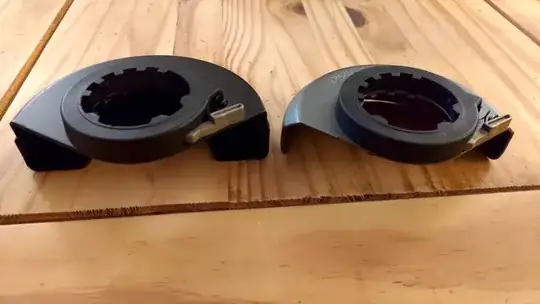
1090 on left, OEM Ridgid on right. 1090 on left, OEM Ridgid on right.

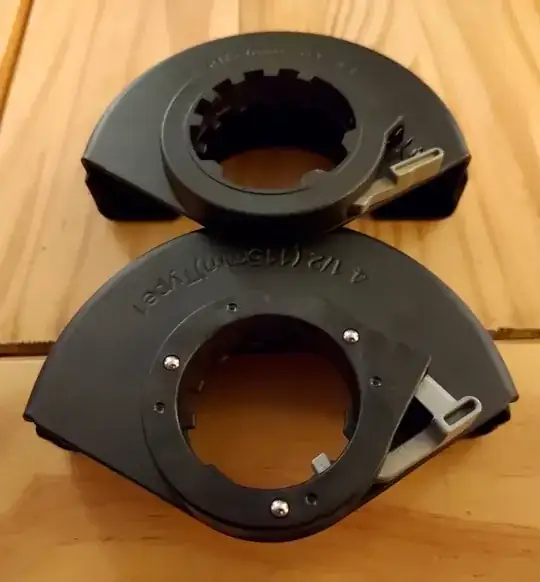
1090 on top with top+bottom cutouts, 0920 on bottom with bottom cutouts only and smaller diameter hole. 1090 on top with top+bottom cutouts, 0920 on bottom with bottom cutouts only and smaller diameter hole.

Timothy
  • 31
  • 2
1

A flat cut off will work but the user is at serious risk of injury... because IF, for ANY REASON the medium you are working on causes that thin, brittle disc to break apart while spinning at high R.P.M., it is now shrapnel. Better hope your guard is between the tool and your face- OUCH! (I have seen E.R. pictures where chunks even penetrated full face shields). IF a decent size piece hits a finger you will probably loose it. Dont believe me? google it OR dig out your dremel grab a disc see how easily it breaks it to dust in your fingers. Yes, it's much smaller and the larger ones are usually reinforced but it's still the same concept. Yes, it will work but straight wheels are not designed for lateral stress and IF it fails, your screwed

Tom W.
  • 11
  • 1