24

The longest drill bit I have is 23.62 inches and apparently the thickness of the concrete I need to penetrate is 27.5 inches. I don't wish to buy another drill bit, is there a smart solution?

The hole is for a gas pipe to go through, so the diameter of the bit is ~1.5 inches. I am drilling into the foundation, other side ends with a thin layer of plaster.

Blerg
  • 343
  • 1
  • 2
  • 6

5 Answers5

50

A 1.5" hole (38mm) in concrete is beyond any conventional drill. You might get away drilling empty block, but not a foundation.

I'd suggest renting a big rotary hammer drill driver for this job. Most rental places are happy to rent you a suitable bit for the task as well, on the basis if you didn't have the tool you're unlikely to have the proper sized cutter.

It might also be a coring hole saw instead of a masonry twist drill, potentially with a water feed for keeping the dust down. The bigger ones come with a base that you bolt to the wall or floor to maintain tracking and not risk bending your tool's shaft.

Either way this is going to be a heavy tool to hold that is enormously loud, and will have high vibrations to the user and the structure into which you're drilling.
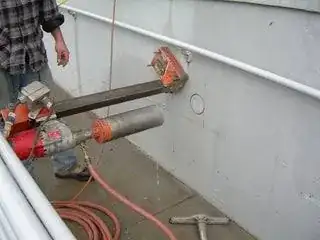
From https://www.instructables.com/community/How-to-drill-a-4-inch-hole-in-concrete/

More info at https://www.instructables.com/community/How-to-drill-a-4-inch-hole-in-concrete/


Also, consider that you risk running into reinforcing rod (rebar) in a foundation, so your cutter will have to deal with steel as well as concrete.

Once the hole is done, you will absolutely have to clear it of dust and then seal the fresh surface - cut steel will need rust protection and the concrete will need silicon of some sort.

Consider also what other concrete holes you might want to prepare while you have the drill in your hands.

There's no shame at all in getting a contractor to drill your hole too - they will have the gear and probably cost not a lot more than a rental.

Criggie
  • 11,950
  • 2
  • 26
  • 79
22

If you are using a core bit with a shaft for which there's an extension, you'd probably have thought of that already. As far as I know there's no extension available for SDS plus or SDS max shanks. There are extensions for the "rope" threads and for the 5/8" and 7/8" threads on diamond core bits.

The John Henry method is to drill as far as you can, then smash around the hole with a ball peen hammer so you can put the chuck in the hole another 4", then drill the rest of the way through. This comes out as pretty as it sounds. Actually if you need another 4", you might need a chisel, or a chisel attachment on the rotary hammer to take out what you need to. Before you start, check the chuck end of the drill and make sure you don't have to take out an excessive amount to get the drill in another 4", really depends on the shape of the drill.

If you are using a core bit with a pilot bit or pilot rod, another way to go is get a 3' long 1/4" bit and drill all the way through, then drill as far as you can from one side, then drill from the other. The pilot hole will keep the core in line pretty well. This doesn't always work as planned, sometimes it doesn't follow the pilot hole closely enough, but it usually does. (The reason for this method is a long 1/4" bit is a lot cheaper than a long 1-1/2" bit.)

Kat
  • 275
  • 1
  • 11
batsplatsterson
  • 25,515
  • 1
  • 34
  • 83
12

I have extended drills for one-off jobs by soldering (or welding / brazing) a piece of pipe (of a suitable diameter) to the end of the drill and putting an old drill into the other end of the pipe for the drive end.

Need to go slow as they tend not to be perfectly straight :) but have got the job done...

Solar Mike
  • 30,038
  • 2
  • 34
  • 69
4

You could drill another hole from the other side. It takes a bit of careful measurement to get the starting points lined up, and you have to make sure to keep the drill straight...

To make sure you're lined up, you could drill a small pilot hole with a drill bit slightly over 4" long. If your pilot hole connects with the hole from the other side, you'll feel the resistance fall away and you're good to go with the large drill bit. If you're off, well, a small pilot hole is easier to fill than a large one.

Hobbes
  • 582
  • 2
  • 11
1

For a hole that diameter in concrete I'd strongly recommend a diamond core cutter. If it's a one-off operation, you can hire one, or you may even find a tradesperson who specializes in drilling such holes for builders and DIYers, using the right tool. Google is your friend.

If it were brick or block, I'd look at buying a "longest" small diameter drill (cheaper) to drill a pilot hole, and then widen it with the fat drill from both ends meeting in the middle. This also makes both external faces neater (no "crater" around the pipe). The technique will work with concrete. It's just the amount of noise and vibration it will cause that makes me dislike the idea. (Also the possibility of getting a broken wrist, if the drill snags on a steel rebar and the clutch is imperfect. But I know a foundation is usually just poured concrete without reinforcement).

If your fat drill were almost long enough you could try drilling all the depth you can from the side where cosmetic appearance matters. Then insert a mild steel rod to the full depth of the hole and whack it hard with a club hammer. If you are lucky a chunk of masonry and plaster will fly off the other side. But again, its more of a (somewhat bodgey) technique for brick or block walls.

nigel222
  • 866
  • 4
  • 6