I am in the planning stage of a table project and have a question about a piece of acrylic. I intend to use a 3' x 3' square piece of acrylic that is 0.236" thick as the center. Would a 1" lip on all edges be enough to prevent this large acrylic sheet from sagging in the middle? Is there any way to calculate the thickness I need?
Asked
Active
Viewed 1.6k times

2 Answers
4
Commenters are right: Everything sags under its own weight. The question is how much you'll tolerate.
There are simple formulas for the deflection of simple structures like this. For a uniformly loaded square plate with simply supported edges,
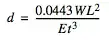 .
.
And for a plate with clamped edges,
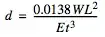 ,
,
where d is maximum deflection, W is the load, L is the length of a side, E is the elastic modulus and t is the thickness.
Your acrylic is uniformly loaded by its own weight. For now let's ignore extra deflection caused by poking fingers. Since you might attach your acrylic square to the rest of the table somehow, its actual deflection will probably be between these two numbers.
Let's do the worst case, where there is no overhang and you're supporting the acrylic right at the edges:
W = 1.18 g/cc * (36 in)^2 * 0.236 in * 9.81 m/s^2 = 58 N
L = 36 in = 0.9144 m
E = 2.6 GPa
t = 0.236 in = 6 mm
For supported edges d = 3.8 mm, for clamped edges d = 1.2 mm.
To a decent approximation, leaving a one-inch border just changes 36 in to 34 in:
W = 1.18 g/cc * (34 in)^2 * 0.236 in * 9.81 m/s^2 = 51.8 N
L = 34 in = 0.8636 m
For supported edges d = 3.0 mm, for clamped edges d = 0.9 mm.

ArgentoSapiens
- 2,465
- 12
- 33
- 43
2
Until you get to very thick small units, or goods more rigid than plexi (such as glass, which also flexes and sags) you will have some deflection. It also depends on whether there will be any weight on it.
If 1/4 inch (with no load) is not a problem (this is a guess) then you may be ok. If you are putting a 10 lb. plaster statue on it, it will flex. If it can't flex more than .001 inch, no matter what, it won't work.
It also depends on how you affix the edges. The more captured they are, the less flex. Touching the middle of a 3x3 acrylic sheet, less than 1/4 inch thick, that is not tightly locked around the edges, will likely flex significantly.
Manufacturers may offer specs on how much their plastic flexes over certain distances.

bib
- 33,975
- 10
- 68
- 102