29

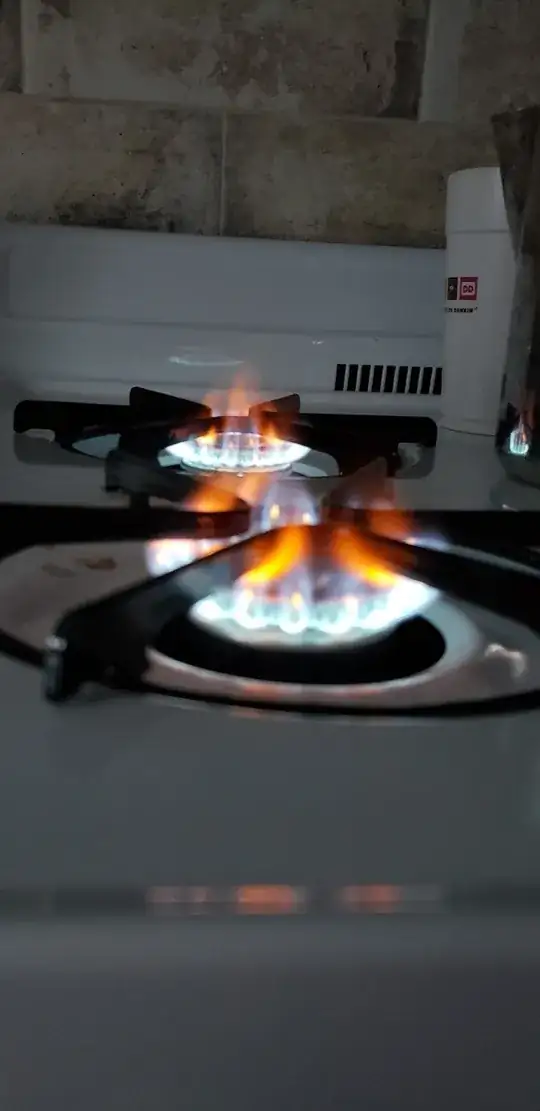
So here's the deal: about 1.5 to 2 weeks ago, our generator started backfiring like crazy and our cookstove, water heater and heater are throwing yellow orange flames intermittently as well as producing soot blackening the ceiling and range hood.

We did call the propane company, and they have been out 3 times and changed both regulators, which didn't fix anything.

The symptoms appear to happen about 10 to 15 minutes after running each appliance. They start up fine and run fine until about this point.

The propane company now wants to do warranty work on each of my appliances and have me call the appliance company to get them fixed under warranty. They also told me that they think the generator is a separate issue. The problem I am having is that all four malfunction at the same time.

I'm really frustrated and have not broken down and called the appliance companies, since I feel it's unfair and not an issue with any individual unit.

Any recommendations on what I should look at? We're avid DIYers living off the grid.

  • The heater is approximately 3.5 months old
  • The cookstove is approximately 3 months old
  • The water heater is probably 20 years old but was serviced only 3 months ago and working fine
  • The generator is 18 years old but has been recently serviced as well and working fine up until the day everything started malfunctioning.

We rely on our generator for water and showers and run it once a day for one hour. During this time we fill up all our water, take showers, do laundry and do dishes as well as charge our batteries.

I'm generally not an online / forum type person but I am at my wit's end!

Thanks!

Here's a quick photo of the stove burners. Also it may be helpful to know we're running on a 500 gallon propane tank which is showing 70%.

enter image description here

Kat
  • 275
  • 1
  • 11
Vermonter802
  • 293
  • 1
  • 3
  • 6

10 Answers10

29

Let's learn about energy: BTUs.

Put 1 pound of water (just shy of a pint) on the stove and stick a thermometer in it. Turn the stove on, and watch the water warm up on the thermometer.

You're watching energy in action. Every 1 degree of temperature rise means you added 1 "BTU" (British Thermal Unit) of energy into the water. So if it's 62F and you're going to 212F, it takes - can you guess? 150 BTUs to raise that pound of water 150 degrees.

And time this. You can figure out how many BTUs per minute your stove can input into the water (at that flame setting). Right?

So how many BTUs does it take to get to 213 degrees, i.e. boiled off water vapor? It's only one more degree. One more BTU, right? Nope.

In fact you can time it. You know how many BTUs per minute the stove puts out. How many minutes to boil off all the water? That will tell you how many BTUs it takes. It's about 1000 BTUs. That converts water from 212F liquid to 212F vapor.

What's the deal with that? That is called the Latent heat of vaporization aka latent heat of enthalpy. It's the energy required for the state change from liquid to gas. You have to pump that 1000 BTU into the hot water to make it boil.

By the way, when a heater or A/C specifies BTUs, it really means BTUs-per-hour. This is a rate unit, indicating power (like watts) not energy. A true BTU is what you just did on the stove.

And... Propane has that too

Think about how liquid propane works. It's delivered as a liquid. It sits in the tank as a liquid. But you use it as a gas. So what's happening? When you open the valve, some of the propane boils to produce the gas you are using.

But wait. Doesn't it take a bunch of energy to convert from liquid to gas? Like 1000 BTU per pound? Yeah. Yeah it does. About 1/5 of water: 184 BTU/lb which is still significant. So where does that energy come from?

The propane absorbs it from the propane in the tank. So if you started with 80 degrees F liquid propane (say it's summer), you soon have 70 degrees F liquid propane. Then 60 degrees F propane as you use more and more... 50 degrees F... 40 degrees F... and by the way, you just discovered how air conditioning works :)

Meanwhile, the tank is being warmed by the environment. Heat transfer rate is decided by the difference in temperatures (propane vs outside). In the summer, that's easy - A 40 degree difference (80F vs 40F) absorbs heat twice as fast as 80F vs 60F. It reaches a balance at one point or another. In the summer.

But when you do it in winter, say it's 0F outside... you run the propane, and it gets colder... -20... -40... Now your temp difference is 20 degrees... then 40 degrees and heat transfer doubles... Except, something happens at -40. That is the boiling point of propane naturally (like water's 212F). Below this temp, it doesn't want to boil at all. So what comes out the pipe is either liquid propane (which you Do Not Want) or far too little propane. Either way, the propane supply has broken down.

And because the outside temperature is so low, the propane tank has very little source for heat. As a result, it can produce very little gas.

But of course, that's exactly when your demand is the highest, isn't it? Your furnace is running hard, the generator is working hard, you're cooking, using hot water...

Fixing it

As you discovered, you can put warm water on the tank, and that will temporarily inject some heat, to get the propane able to boil more gas. But it certainly won't last. Worse, that propane tank is going to freeze any water that touches it, so additional water will just be wasted, as it won't even melt the ice that has crusted onto the tank from previous pours. So that strategy won't really extend.

Your best bet, short term, is simply to reduce draw. Reduce cooking, hot water use and generator load. Can't do much about furnace load obviously. You could even put a thermometer on the tank proper, and just know to cut your gas usage when the tank gets too cold.

You can also try to keep the tank topped up. When the propane is only touching the bottom 1/4 of the tank, that means heat is only transferring through 1/4 of the contact area with the outside. (Plus a little bit of conduction down the steel tank sides). More propane means more thermal mass in the propane, too, which helps with short term bursts of usage.

Keep snow cleared from around the tank. The bottom of the tank is the most reliable surface since it works at all fill levels - you can't afford to have it out of commission. You want the wind to whip freely across the underside of the tank; if it's blocked by snow that takes away much of your heat source when it's near empty.

It seems super weird to see 0F or -10F ambient air as a heat source, but for keeping a propane tank above -40, it does work.

You can try heating the tank. For instance they make heat tape designed to prevent water pipes from freezing; you could wrap it around the tank, focusing on the bottom. Or you can plumb the generator's antifreeze out there on a couple of insulated pipes, and have some steel tubing strapped to the bottom of the tank to warm it. Just make sure it is a low-heat source that does not exceed about 200 degrees F and has no open flame. It might be good to discuss options with your propane supplier.

You could also try strapping "cooling fins" onto the tank; the goal being to absorb heat rather than radiate it. You want to increase the thermal surface area of the (bottom of the) tank as much as possible.

You can also increase surface area by getting a larger tank. You want a thin, narrow tank, not a short plump one, to maximize surface area.

Don't insulate, much

And you don't want to insulate the tank; at least, don't insulate any more than the area around the heater. The steel tank's free contact with the air is how it works normally.

Some tank heating solutions insulate the whole tank. But this is due to a wrongheaded notion of the problem, and the effect is to make you 100% reliant on the heating solution! If it breaks down, your propane delivery fails because the tank can no longer absorb heat from ambient.

Let's follow the bouncing ball. We need to keep propane temp well above -40. Suppose ambient air is 0F. We use a system that heats 5% of the tank's surface to 150F, giving very good heat transfer, and that immediate area is insulated so our 150F source doesn't heat the world. With convection (self-stirring of the liquid) we get the propane warmed up to -5F even while gas is being drawn. So we are holding even at -5. The worry is "oh no! With only 5% of the tank insulated, it's heating the world through the uninsulated 95% of the tank!" Actually, no, it's not.. The propane at -5F is colder than the outside at 0F, so heat is moving from the outside into the tank still. Outside is helping, not stealing. Of course, a warming system could install some intelligence to ensure the heater never runs unnecessarily, by comparing internal and outside temperatures, and only operating when outside absorption is insufficient.

Insulation only makes sense when you're dealing with extremely bitter Siberia/Valdez/Nuvanut cold, where ambient air being -20 or lower is a regular thing.
Peter Cordes
  • 103
  • 1
  • 4
Harper - Reinstate Monica
  • 313,471
  • 28
  • 298
  • 772
28

Kris' comment is likely a good reference. Consider to perform a test by operating only one device. If the duration of normal operation increases, or normal operation continues throughout the test, it's an indication of too-low temperatures preventing the tank from allowing evaporation.

The backfire of the generator is another indication of insufficient evaporation. A generator takes a substantial amount of propane compared to other devices, increasing the cooling on the remaining liquid.

If you can operate appliances other than the generator, you may discover the evaporation level to be sufficient to continue.

Pouring warm or hot water over the tank will improve conditions inside the tank, but I don't have the math to determine how much heat has to be applied to accomplish continuous running of the generator and other devices.

Because the propane gets colder as it evaporates during use, the amount of heat you can apply will improve the circumstances of operation. If you can manage really hot water, you'll come out even farther ahead.

I can envision a "camp fire" environment, with a kettle of water. A hose running from a water source to a set of coils inside the water kettle will create hotter water for the propane tank. One does not really need the kettle, if one constructs the coil directly in the fire but hat may raise the temperature too high for safety's sake.

Using water as a means of increasing the tank temperature reduces the risk of overheating the tank to an overpressure release.

The mention of ice freezing on the tank shows you how cold the propane is (and of course low ambient temperature doesn't help!) One very good reference mentions that 60°C (140°F) water is used to assist vaporization of the propane in cold conditions. We used to keep our hot tub at 100-110°F and it was pretty darn toasty, so you won't likely overheat the tanks.

boiling propane

According to the article on the linked site, propane boils at -42°C/-44°F, which tells you that the evaporation during use is causing the propane to chill itself below those temperatures!

fred_dot_u
  • 11,958
  • 2
  • 21
  • 35
25

Ask your propane company to check the gas pressure anywhere in the system and then fire all appliances in the system, the low pressure side (after the second stage regulator) should stay above 11 inches of water column on a water gauge. If it goes below 11 inches look for an obstruction in the gas piping. I am a service technician at a propane company and had the same issue a few years ago.

Bill Ball
  • 266
  • 2
  • 2
9

As an HVAC technician, some of these answers you're getting are really bothering me.

Do not wrap anything around your tanks, especially anything electrical.

They are designed the way they are for a reason. You don't want those tanks holding extra heat in the summer. They need to be able to "breathe".

I live in Canada and use propane as a heat source myself. Those problems can arise in colder weather, but having 2 "Bubba tanks" is generally enough prevent those issues until you get into the really cold weather (at which point regs start to freeze up anyways).

Are the tanks sitting beside your house? If so, what side (North, east, etc)? Generally speaking, sun light alone is enough to keep the tanks happy, but if you live in the northern hemisphere and the tanks are on the north side of your home (hidden in the shadow of your house), then they won't get any sun on them.

Perdog
  • 121
  • 1
7

From the look of the burn on the stove it is not to do with pressure. The flame would be short or lazy this is not the case. With this going on all at one time it is something in the gas. Propane CO use alcohol in the gas in the winter to keep things from freezing up. This will cause some deep red in the flame but this would not make them to soot up that I have seen. I have seen this with people doing projects is the home that fumes from painting, staining or a cleaner getting on the burner. If none of these have taken place there is something in the gas, this can be heavy ends from pumping out other tanks. I would ask for your propane supplier to bring out a small tank and purge your gas line and then run your system on the small tank this would prove that it is or is not there gas. With you being at 70% and assuming this started after a fuel delivery this should show a clean burn.

3

Have a. Water column gauge installed after second stage regulator make sure you maintain 11’’ of pressure with all appliances running. Start appliances one at a time if you see Pressure dropped below 11” With 50% of appliances on line is undersized. If pressure drops after approximately 1/2 Hour you don’t have enough storage for Demand Rule of thumb 400lb of storage for every 100000 btu of appliances Another problem you could have to much Butane in your propane With to much butane you will not get Enough vaporization in cold weather. This has happened in the past when it is made at the refinery. When you’re supplier gets a rail car of Propane he is supposed to do a freeze test to test quality of propane. Check line size Check WC with appliances on Check storage tank for proper btu output

Dannie
  • 31
  • 1
2

Sounds to me like you got some shity propane from your propane company bit what do I k now I only have 19 years in the propane industry

andy nowak
  • 47
  • 1
2

Are you running a humidifier? If you are, turn it off for 12 hours and then check your flames. Humidifiers put minerals in the air that cause flames to turn orange. Easy fix if this is the problem. Go on YouTube and search " humidifier and orange flames" .

1

I don’t have a single answer to explain or fix all your problems, so I will make a series of comments and suggestions in the hope of helping you solve your problem. It’s possible that there are multiple unrelated causes.

STOVE – Nice photo. It looks like the flames on the stove were burning for quite a long time, because the grates seem to be glowing red hot. That means the enamel coating on the grates is also red hot. The enamel is a form of glass, and glass contains sodium, which adds a yellow color to the flame when you get it red hot. Note that the flame is yellow only in the immediate vicinity of the grate. I bet if you have this condition and remove the grate with a pair of tongs, the flame will go back to normal blue. Right? So the answer is don’t run the stove for a long time unless you’re actually cooking something. If you are tempting fate by using the stove for room heating, remove the grates first.

OTHER FLAMES INTERMITTENTLY TURNING YELLOW – Have you been using a humidifier? Perhaps a “cold steam” or “ultrasonic” humidifier? If there is any sodium at all in the humidifier’s water supply, all the flames in the house will start burning yellow / orange a few minutes after you turn on the humidifier and for several hours after you turn it off. Sodium can get in your water supply if you have a water softener of if the water is from a well in a region where salt is spread on roads in winter.

GENERATOR – Propane engines are notoriously finicky about supply pressure. Find the generator’s engine manual and look up the required propane pressure. (If you’re a true DIY-er, install a permanent pressure gauge in the propane line that feeds the engine.) Check to verify that the engine is receiving propane at the required pressure when the engine is running at full power. If not, find out why.

MTA
  • 15,038
  • 1
  • 22
  • 53
0

There is a simple solution if you have a situation as I've seen before. This involves an humidifier that uses filtered water which comes from a reverse osmosis (RO) system.

If the reverse osmosis system is placed in the water treatment scheme after a water softener which uses salt, then the water may have high levels of salt which it will place in the air.

Such a situation will guarantee yellow flames.

Since a humidifier requires filtered water, either distilled or RO water is necessary. So you may have to move your RO system into line before the water softener so as not to capture the increased salt from the softener.

Searcher
  • 71
  • 1
  • 4