No.
For a receptacle to be rated for 15A, it must be able to handle 15A at either outlet. For example. If you plug one item that draws 15A into a receptacle, the receptacle must be able to handle that current.
Receptacles are actually designed to handle 150% over their rated current (or something like that, I'd have to find the specification to be sure). A 15A receptacle should be able to handle 22.5A, so your breaker should trip before the receptacle fails.
Consider this image...
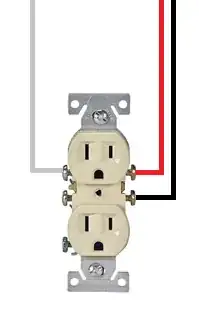
Assuming the tab between the hot terminals is removed, and the red and black wires are each connected to separate 15A breakers. This is a valid configuration, and would allow 15A to be drawn at each outlet.
However, It's usually not a good idea to tempt fate, or stress test electrical components. So in theory, it will not fail. In practice, it should not fail.


