Installing a GFCI on a refrigerator basically disregards the use-case for GFCI. It's a well-grounded, all-metal box, with all the mains electric gear in the very bottom back of the machine, totally inaccessible in the vast majority of people's installations... and you are unlikely to drop it in the sink.
As such, there is no practical safety benefit to putting a fridge on GFCI, unless the branch to the fridge is totally ungrounded.
What the "Take your shoes off at the airport" gang cannot wrap their minds around, is the concept that dueling safety systems makes safety worse. Consider a remote warehouse with a big Cat diesel fire pump. Some epsilon-minus decides that every diesel on the property needs a low-oil-level shutoff, to keep people from running forklifts etc. a quart low. Well, there's a fire. The fire pump trips out on low oil, and the warehouse burns down. That's dueling safety systems, and you don't want that.
The fridge has One Job: keep food safe. It's not a big shock risk, so GFCI won't save any lives. GFCI gets in the way of its One Job. It's bad enough with a dedicated GFCI, but with a shared GFCI, the GFCI could trip, someone could reset it to get a different appliance back up, the fridge would re-chill after bacteria had its way with the food, and nobody would be the wiser.
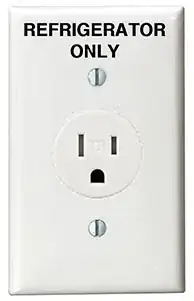
The above receptacle is legal in any kitchen. It is also legal in any garage, basement or other place you might put a refrigerator that normally requires GFCI, if you get a waiver from your AHJ: the local inspector. This is a perfectly sensible setup, and there's no good reason not to grant it.
Why is it tripping? Because like lots of fridges, it has some small leakage between hot and earth, perhaps when a compressor cycles off: there's a big inductive spike because inductors are trying to keep current constant, and they spike voltage until insulation breaks down somewhere to sink it. It really is a ground fault, but it's a trivial and unavoidable one. Fridges do this.
In the DC world you'd put a freewheeling diode on that inductor. In AC a VBO (Voltage Breakover) would the job, being "insulation" that breaks down at a specific voltage e.g. 200V before regular insulation fails. MOVs can do that too. That would be placed between hot and neutral, arresting the spike to neutral instead of to safety ground; as a result currents would be equal and the GFCI would ignore it. A capacitor might also help, being able to absorb some current from the inductor.


