3

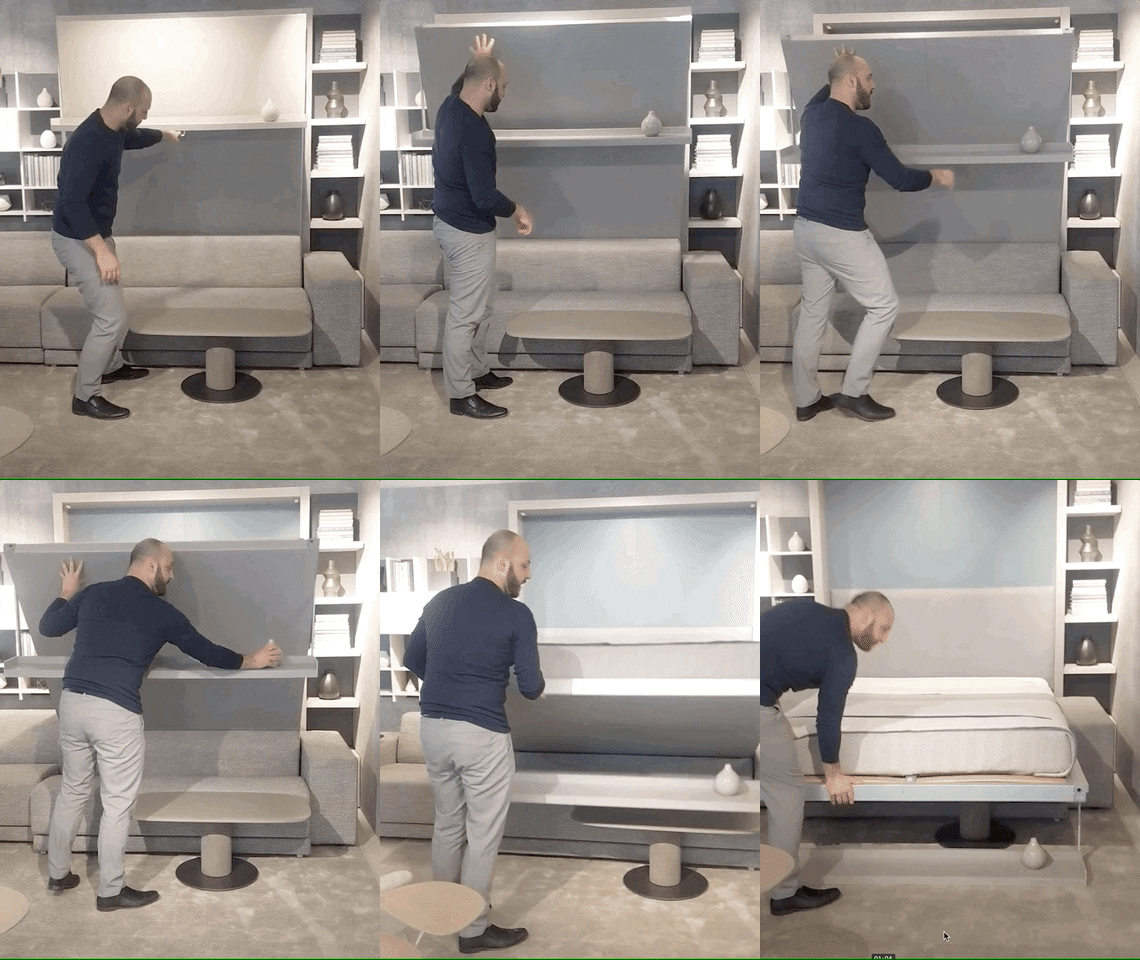
I want to know what's the mechanism to maintain this shelf stable even when they tilt the wall-bed:

https://player.vimeo.com/video/400690985

I would like to build something similar myself (not for a bed though).

I researched about gimbal + shelves but I didn't have luck.

Can someone point me in the right direction? Does this mechanism have a name? What are the physics laws that make it possible?

Note: GIF is from the video of the Oslo Bed from resourcefurniture.com

Mikel
  • 139
  • 1

3 Answers3

10

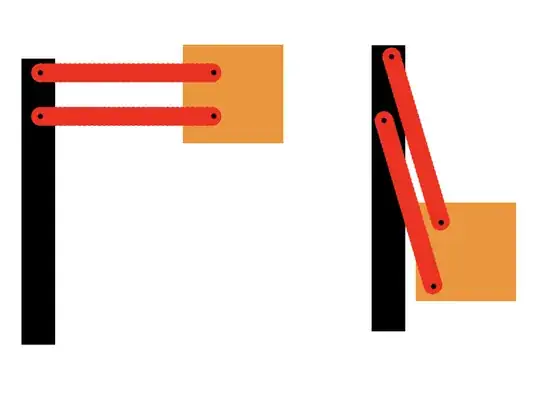
The general term for a hinge that allows something to move but keep the same orientation is a "pantograph hinge". The general term for that type of bed would be a "Murphy bed".

The pantograph mechanism takes many forms, but the trick it uses is to have parallel connecting rods that pivot together so that the door or shelf that it is connected to can swing out, but maintain it's orientation because the pivot points remain parallel.

I know that is a bit abstract, but that will give you a starting point to research the topic more. This is not a "standard" piece of hardware that you can pick up at the hardware store, so there't not a specific product I can link to. I'm sure the design for that bed is custom.
Pantograph

Here you can see the basic concept with two parallel arms that allow the black leg to swivel downward while maintaining its vertical orientation. If this was the "leg" on the bed that held a shelf, you could imagine another red bar connected to the head of the bed to actuate the leg movement as the bed is swiveled down.

The bars of the system can also be replaced by cables and a pulley system which is what could make it so compact and hidden in that Oslo bed. I suppose they could even use a gear driven system with cables and pulleys. Either way, it's custom designed and built just for that purpose.
JPhi1618
  • 28,377
  • 5
  • 56
  • 93
6

The mechanism -

GRAVITY

What keeps it stable -

High quality materials and balanced weighting in the design.

What is it?

It is a high quality metal shelf with an extended arm on each side of the back.

Why does it look cool?

Because the arm rotation is solid yet flowing and they hid the joint inside of the side of the bed. If it stuck out it would still be cool yet clunky.

What's the secret sauce?

Other than creating a joint that doesn't just drop the shelf - some resistance - the secret sauce is actually the shelf sitting flush on the bed in standing position. So the arm of the shelf has to be offset back to counter the distance between the joint and the bottom of the bed. (I am sure there is an easier way to say that)

Below is a more simple example that shows that this is really about creating the arms as part of the shelf than any hinge magic.

enter image description here

DMoore
  • 50,637
  • 16
  • 93
  • 208
1

The shelf has a gearing system within the bed frame. You can see this very distinctly in this part of one of the pictures at the bed web site linked in the question.

enter image description here

(Picture Source)

FreeMan
  • 48,261
  • 26
  • 101
  • 206
Michael Karas
  • 67,833
  • 7
  • 68
  • 153