5

I'll admit I don't get how to compute how much my floor can hold, and probably wouldn't trust my own math, even if I came up with the right answer.

I'm looking to purchase a recording booth. I do voice-over work. There's one for sale in my area that the manufacturer says weighs 2015 lbs for the base model. This one has some extras, so lets call it 2100, or maybe even 2150. I weigh 220, so the package would be in the vicinity of 2400, to be safe. The booth has a footprint of 6' x 6'. The home is in the Chicago area, built in 1988.

The room it would be going in is an exterior room, at the first floor back corner of the house. The first floor is over a basement. THe floor joists are 2 x 12s, I believe; I thought a 2x12 was 11 1/4 high/wide. These are either 11" exactly, or some are even closer to 10 7/8", so I'm a little confused about that. I haven't found one that was 11 1/4". Anyway, if I'm measuring correctly, then right under the interior wall perpendicular to the back wall of the house is a laminated joist made of 2 2x12s with a 1/2" steel plate in the middle. The booth would be resting in the room in the interior corner, where one wall is exterior and the other rests over the laminated joist. That laminated joist runs approx 17' where it ties into the I-beam that runs the width of the middle of the house.

Will my floor safely hold the weight of the booth?

To answer a couple of the questions raised:

Why is the booth so heavy? Because isolation requires mass. If you want to keep sound out, the walls have to have mass. This particular model of booth (manufactured by a leader in the industry) has a double-wall design for increased isolation from outside noise. Each 4' x 7.5' section is two slabs of 5/8" MDF with an air gap in the middle. The windows (2) each include four slabs of 1/4" tempered glass. It adds up.

Is there an option for placing the booth in the basement? No, because the only place for it in the basement is just feet from the furnaces, which defeats the purpose.
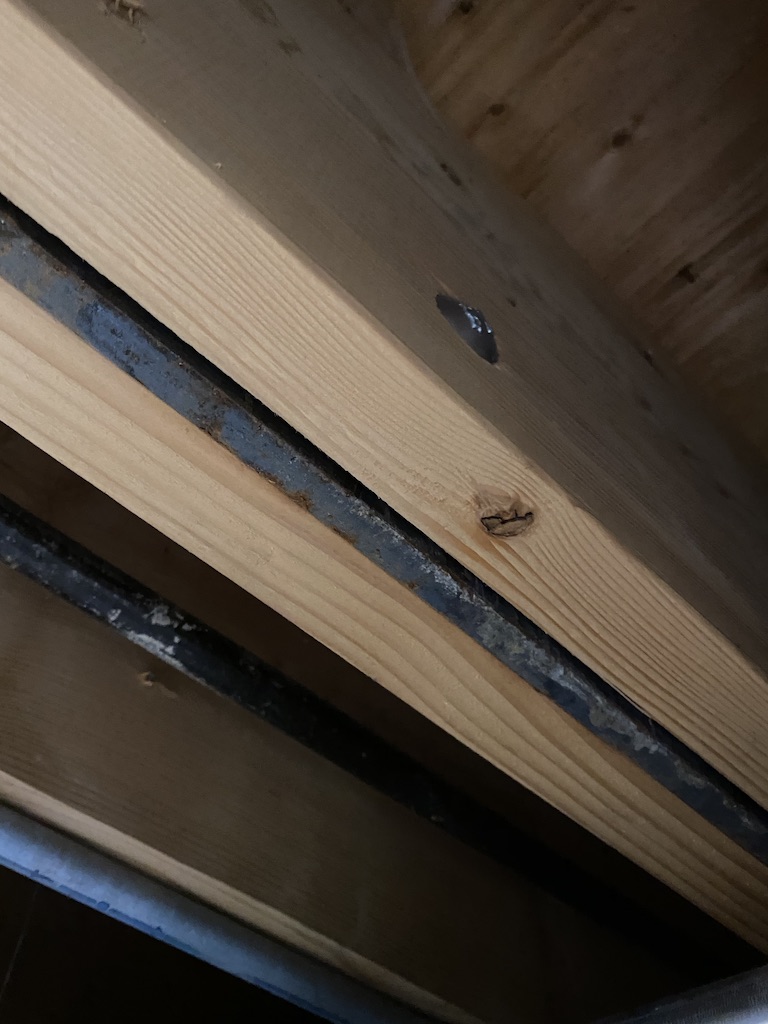
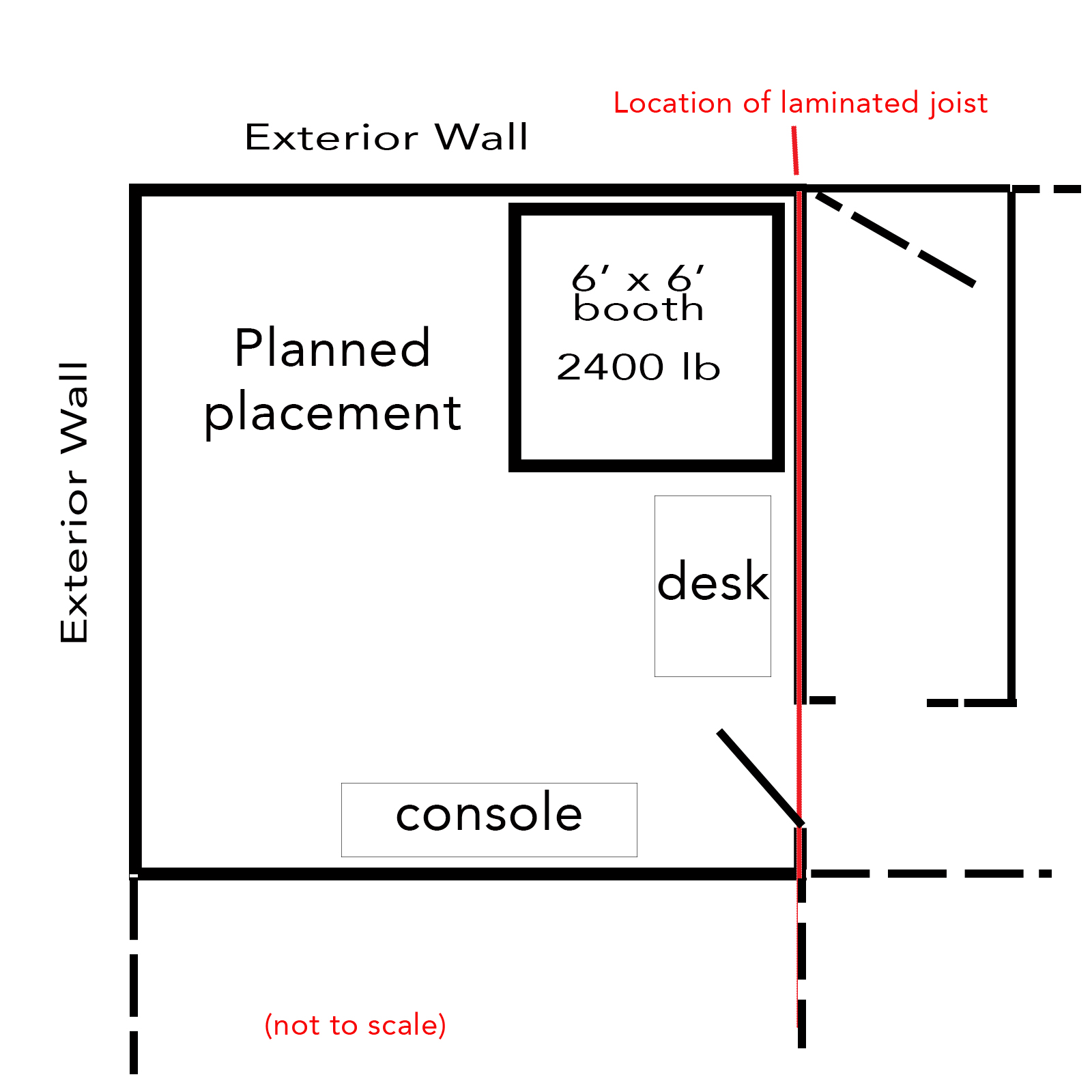
laminated beam

enter image description here

isherwood
  • 158,133
  • 9
  • 190
  • 463
tryingmybest
  • 59
  • 1
  • 1
  • 2

3 Answers3

3

You need a site visit from a qualified person to determine if your floor system can safely carry the load, but given the span you gave and the information here, the answer is no.

However, you may be able to easily install sufficient intermediate support.

To get a line on feasibility before reaching out to professionals, I'd start by calling the manufacturer and talk with their engineers to see if they have a technical manual detailing bearing requirements. Don't be surprised if it's all about commercial floor systems. While you're at it, get the exact weight.

Next, call the city and discuss with a building inspector.

Given the weight you're guessing, at nearly 70psf uniform load (and an unknown concentrated load), it's not just the depth of the joists you need to consider. You need to evaluate the entire flooring assembly against the concentration of the load.

  • Assuming the load has full continuous bearing, not on point loads (ie. supported by feet or by a perimeter bar).
  • Assuming this is piece built.
  • Taking into consideration comparisons of some common residential construction design loads, a 6" thick concrete foundation wall is typically designed to carry a dead load of 75psf. Garage slabs are typically designed with 50psf uniform live load, 1,500 to 2,000 concentrated load, in mind.

Good luck and have fun!

The Ghost of Jon
  • 1,457
  • 4
  • 17
0

caveat: me be mechanical, but not structural, engineer. Even more worrisome: my bass-reflex speaker box hobby.

3 corners of your booth are on foundation walls; check that allowed compression load at joist ends is not exceeded (see https://bct.eco.umass.edu/publications/articles/understanding-loads-and-using-span-tables/)

The 4th corner is near center of room. average psf load on the loaded joists (assuming conservatively that no load is transferred to the unloaded joists and, s.t. caveats, that your occupied booth is the only load on said joists) will therefore be half.

go to the joist deflection tables and determine the L/240 deflection limit will be violated (see https://bct.eco.umass.edu/publications/articles/understanding-loads-and-using-span-tables/)

A simple deflection test: put a cheap water bed in the proposed location and fill it with 2400 lbm of water to confirm you are within the deflection limit by setting up a dial gauge in basement under the joist closest to the 4th corner and/or the next joist in direction of outside wall.

if L/240 is exceeded you can sister, or fish-plate*, or support by a column, the joists cited above and test again.

good luck!

*looks like you already did this

parmstr
  • 11
  • 1
  • 3
-2

I popped off a google search on how many pounds per square foot is typical of a human. The answer in the search results (last entry in the linked pdf) provided 2.5 to 3.5 pounds per square inch, which translates to 360 to 504 pounds per square foot.

If one stands on one leg, the figures would be double, which is rather substantial.

Your booth at 2400 pounds over 36 square feet converts to 92 pounds per square foot. This would lead one to believe that the even distribution of the weight over the floor would be less than that of many humans in the same area.

fred_dot_u
  • 11,958
  • 2
  • 21
  • 35