12

I was up in my attic a few days ago, and I noticed a pretty ugly electrical junction that wasn't in a junction box. Here's the pic: alt text
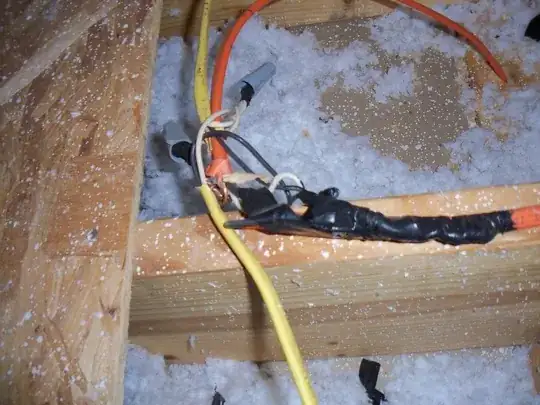
Is this up to code? FWIW I live in north Alabama, outside city limits. However I'm assuming there are general building codes that would govern this sort of thing nationwide.

At first I was horrified when I saw this, but then I remembered the home inspector had to have passed this several times when he was going over the house prior to our purchase. In fact, I SAW him walk right past where it was - I just stuck my head up in the attic while he went tromping around across the trusses. Am I just super OCD and this is a perfectly fine junction, or was it a major oversight on the inspector's part? Unless someone tells me otherwise, I'm planning on installing a junction box tomorrow, but I'd rather not waste my money/time if it's fine how it is.

Doresoom
  • 15,873
  • 32
  • 83
  • 122

4 Answers4

19

At first glance, I see several problems:

  1. The junction should be in a junction box.
  2. Is there even an electrical nut on the live wires? Hard to tell under all that electrical tape, but it doesn't look as if there's room for one.
  3. Is the neutral from the red wire at top going into that tangle of lives? If it's carrying live, it should be tagged to indicate that.
  4. The red wire to the right shouldn't be running along the top of the ceiling joist. If you can, run it along the middle of one of the sides.
  5. Ideally, the yellow wire at bottom would pass through a hole drilled through the joist. Failing that, there should be furring strips either side to prevent you from stepping on it.
  6. The electrical tape on the neutral and ground wires isn't strictly necessary for code, but if it's there, it's customary to have it go around the nut to help hold it in place.
  7. Thanks to @tester101: different sheath colors indicates different gauge wires. Check that your circuit breaker has the appropriate amperage rating.
  8. Staples: if you run wires across the joists, they should be stapled to keep them in place between the furring strips (that you also need; see #5). You'll also need them along the length of the wires that run along the joists, and it might be a good idea to have one near where the wire drops down through the 2x4 header (given the quality of the rest of the job, whoever did this may not have used staples when running the wire through the wall cavity).
  9. It looks as if you might have a lot of slack in those wires. Wiring shouldn't be piano-wire taut, but you don't want enough slack that you can trip over it.

Just because the inspector didn't mention it, doesn't mean it's OK. They're human, so they can miss things, especially in an attic where the lighting isn't good.

Niall C.
  • 20,909
  • 19
  • 95
  • 135
11

I'm amazed that your inspector didn't call this out. I suppose it could be just a random fluke that it was missed, but this is something that even the greenest inspector should have easily seen and noted.

I agree with all of Niall C.'s points, but would add that this looks like nothing a professional electrician would put together (and would certainly not have passed the electrical building inspection), and so is probably something added by a previous owner. If I were you I'd find out where these wires go and check out whatever's at the other ends. You may find a mess there too that needs to be fixed.

Mike Powell
  • 9,394
  • 1
  • 25
  • 43
5

That is an epic goat rope of a splice job. Completely illegal. In a nutshell - any splice outside of an enclosure is a hack. You can debate the semantics of safety if that's just bonding a ground or whatever but that is crappy work regardless.

ALL splices must be in an approved junction box.

2008 NEC®©

300.15 Boxes, Conduit Bodies, or Fittings — Where Required.

Where the wiring method is conduit, tubing, Type AC cable, Type MC cable, Type MI cable, nonmetallic-sheathed cable, or other cables, a box or conduit body shall be installed at each conductor splice point, outlet point, switch point, junction point, termination point, or pull point, unless otherwise permitted in 300.15(A) through (M).

There is such thing as a "concealable splice" kit (made by AMP) but that is a topic for a separate thread.

I'm sure most of you are familiar with the term "code smell" - well this is an electrician's 'code smell'. :)

FreeMan
  • 48,261
  • 26
  • 101
  • 206
kkeilman
  • 3,441
  • 1
  • 21
  • 17
0

There's only one way it could be legal -- if it's wiring for a doorbell or thermostat or other low-voltage circuit. But if it's a regular 110/220v electrical circuit then it's definitely illegal.

Hot Licks
  • 2,103
  • 1
  • 15
  • 16