I found this drain in my basement in the middle of a raised rectangle of concrete. Its supposed to be for a shower the previous owner installed. I have never seen this drain type. Looking for answers for what kind of drain it is and why it would have been installed. 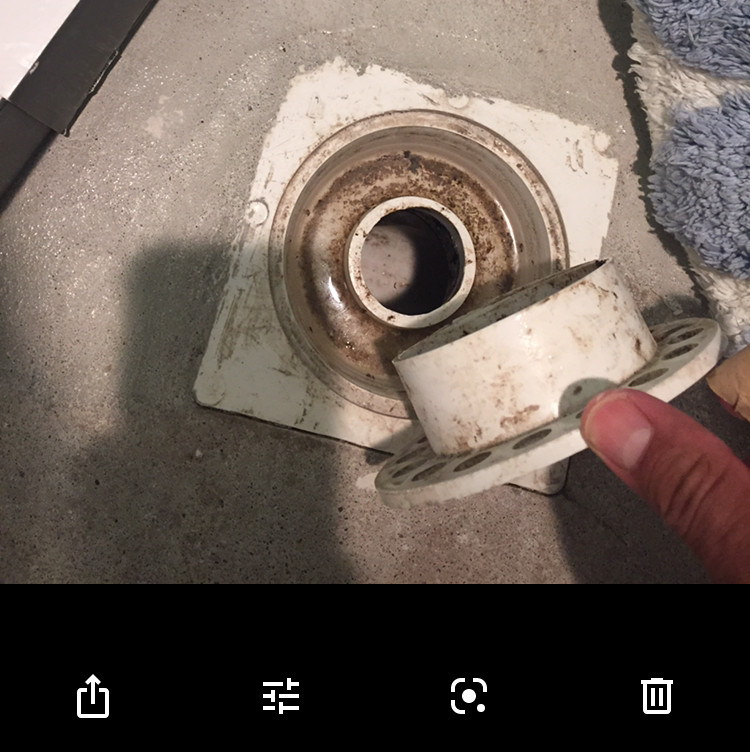
Asked
Active
Viewed 4,249 times
14

Machavity
- 26,498
- 8
- 44
- 100

Eugenio Coronado
- 141
- 1
- 4
3 Answers
24
That is a bone stock "bell-trap" floor drain.
They are illegal for interior use under the IPC (at least) since the trap weir depth is perhaps 1/2 an inch or so; well below the minimum 2" weir depth required, in any case - though in fact the exclusion is for ANY bell-trap, not specific to the depth of the trap, but in this case that is typically about what you'll have. 1002.3, (Prohibited traps) item number 2 (Bell traps)
They can be used for exterior or garage drains (not connected to the sewer) only, as I recall. I just removed one and "de-trapped" another (cut the inner ring seal so it just acts as a collector) and installed an actual P trap (adjusted to 4" weir depth) on its line. Fun chopping holes in concrete, yes indeed.
It probably was installed for a shower. They look like a perfectly reasonable, easy to clean option and the large box store will happily sell them without telling you that they are illegal for interior applications.

Ecnerwal
- 235,314
- 11
- 293
- 637
6
Looks to me like some sort of ultra-low-profile trap. When the top section is in place, the channel will fill up and overflow into the central drain. Water will remain in the channel, to stop nasty niffs.

SiHa
- 3,543
- 19
- 22
1
- This looks like an off-the-shelf floor-drain Bell-trap, and they are popular in tight spaces, where people don't want to break open the concrete to put in an appropriate P-trap, or where there simply is not enough space for a larger trap than a small Bell-trap.
- They are popular, because they are easy to clean out from above, small & easy to install.
- One can buy these at the home depot.
- They are not per code in most areas, because their "water reservoir" is much smaller than a 2"-P-trap.
- Bell-Traps can dry out faster, and then let the smell/stink from the tubes come up.
- The health authorities obviously categorize this as a health risk, but that's the risk: A Bell-trap drying up within 1-2 weeks versus a P-trap drying up within half year, and let the stink come up.
- As soon as one flushes water down that drain, the Bell-trap's "reservoir" is full again.
- So, if this is in a shower, used quite frequently, then there's always water in the Bell-trap anyhow, should work just fine.
- If it's used as a floor drain, which does not get much drainage, then just poor down a quart of water every other week, should be fine.
- It's probably not per code, but works just fine as all traps work, as long as it has water in its "reservoir".

user396029
- 11
- 1