14

I have been in the house for about a year and the toilet has always had poor drainage. It doesn't overflow but there's hardly any suction at all when you flush it. The tub next to the toilet drains very slowly and will gradually fill up when using the faucet but just running the shower head it drains fast enough to keep up. Both are tied to the same drain line and I figure maybe there's a blockage somewhere. Btw, I replaced the toilet a few weeks ago and it made no difference. (reasons other than just drainage)

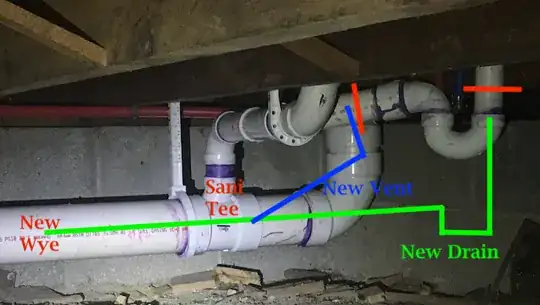
I had a plumber come out and they think that the venting was done improperly. The pipe on the left coming off the T is the vent and goes straight up through the roof. To the right, tying in just in front of the vent, goes to the bathtub.

I was quoted at $1200 plus materials to rearrange this. I'd prefer to keep that money in my pocket to fix other things and have no problem crawling in there myself to do the work. I'm just not sure exactly what their plan was to correct the placement of the pipes.

Here's what they wrote on the invoice:

Remove a section of the four inch main drain line into the crawl space area and tie in the drain and the vent line separately so that it is no longer wet vented and. This conclusion was found due to having the customer flush the toilet while I was on the roof to see what/ if any air was pushed through and it was minimal.

enter image description here

isherwood
  • 158,133
  • 9
  • 190
  • 463
Phaelax
  • 608
  • 2
  • 7
  • 14

6 Answers6

23

It's a common misconception, but blocked vents do not cause slow drains. If you Google it, you'll find lots of incorrect information that completely ignore the physical realities of how a vent operates. The purpose of a vent is to prevent the P-trap from being siphoned, it is not intended to help water go down the drain any faster - in fact, a properly vented fixture will actually drain somewhat slower than a fixture with no vent.

People often talk about a vent in the context of an inverted soda bottle analogy, likening the vent to putting a hole in the opposite side of the bottle so the liquid doesn't slowly "glug" out of the mouth of the bottle. That analogy is nonsense, because there is no such thing as a plumbing fixture with only one entrance/exit like a soda bottle - water going down your pipes does not need to "switch places" with the air ahead of it. Every plumbing fixture ever made has a separate inlet and outlet, and is already open to the air at the inlet side, allowing the air to follow the water down the pipes. Adding or removing a vent does not change that at all - it is not analogous to adding a second hole to a soda bottle, as it's actually adding a third opening to the already two-ended plumbing system. A blocked vent could potentially contribute to slow drainage if the inlet side is also blocked and cannot let air in, but in that case, it's really the blockage in the drainage pipe that's the issue, which is only exacerbated by the blocked vent. I can't imagine a situation where water can go down the drain, but air cannot.

As an experiment, you can pour water into a sloped pipe and watch it drain as fast as gravity will carry it. Now add a T and a vent somewhere along the pipe, pour the water in again, and see that the vent does not slow the water at all. In fact, plumbing without a vent will drain slightly faster, as water accelerating through the pipes "pulls" the water behind it. Although a vent slowing the drain may seem counterintuitive, it makes sense when you consider that the purpose of the vent in the first place to to prevent the pipes from emptying completely! You can watch a video of such an experiment here - in a realistic setup with a drain, trap, and vent, blocking the vent actually makes the basin drain faster.

Any air that needs to be pulled into the pipe can be pulled in from the inlet - a vent would only help in draining a toilet, for example, if the lid forms an airtight seal around the bowl. The vent is just there to prevent a suction effect that would siphon the P-trap. Your venting may be done improperly, and it may cause different problems with your plumbing, but it is not the primary culprit of a slow drain. If anything, a blocked vent would result in a drain that is faster and smellier (due to the siphoned P-trap). Look for a blockage in the drain pipe, not the vent.

Nuclear Hoagie
  • 1,390
  • 1
  • 9
  • 25
14

Unless something is clogged, this should work fine (assuming appropriate slope on all lines.) The vent should be 2" for a 4" line, and is only draining the tub (2DFUs) which is half the permitted load wet venting. The vent loading (shown) anyway) is at most 8 DFUs (depending on toilet flush size) and while that could (easily) use 1.5" on that basis, it can't wet vent more than 1 DFU at that size and it's also not "at least half the size of the drain pipe" so it would be undersized/illegal. There is an error which your plumber failed to mention, however.

When you are not showering or draining the tub, that is a dry vent (yes, it's technically a wet vent all the time, but in practice, it's dry except when the tub drain is flowing water.)

If you (or plumber) have not already snaked the tub drain all the way to the main line, do that. Snaking the vent is also advisable, as it may be clogged away from the tub connection or on it's way to the roof. Snaking the main line to whatever point it appears to work well is also advisable. Unless something was done that you/your plumber did not mention, I see no sign that it was actually checked to be clear in what you have reported - just that the plumber stood on the roof and observed it not working.

The thing that is VERY wrong with it (not mentioned in your quote) is that a sanitary TEE is being used incorrectly to join a horizontal drain - that should be a WYE, and if you are replumbing, you'll want to fix that. You can use a "combo WYE" or a "WYE and a 45" in that orientation, or you can use a wye in the normal (to the side) orientation for the drain connection.

Under IPC rules it's generally accepted (or not forbidden) to use a sanitary TEE that way FOR A DRY VENT ONLY. Some dispute that use being acceptable, and other codes may actually prohibit that use - IPC prohibits that use for a drain or wet vent connection. A WYE is always acceptable - for a dry vent, pull the WYE up to at least 45 degrees above centerline, or run it right out the top.

If you wanted to change this around and separate the functions as proposed (which I doubt will help, unless one of the pipes you cut and replace is full of gook that you should have gotten clear via snaking) you're in for a signficant bit of work - dropping a new fitting into a main line means getting upwards of two inches of motion on it, and under IPC rules "saddle tees" are illicit (don't know what rules you are under, code-wise) though you can use PVC repair couplings (and pray they don't stick before they are in the right place) or rubber couplings to have a "removable section" to give you the working room. Here you might just yank the toilet and unscrew its flange to get the working space you need.

The other distinct possibility is that the main line is not properly sloped all the way to wherever it goes off to the left side of the picture - a low (or high) spot in the line can cause all sorts of trouble with proper drainage. A competent plumber should have noticed that, but I question your plumber's competence (or perhaps honesty) if everything did not get verified as clear by some means (snake, drain camera, whatever...)


If seeking to "separate the functions" (or simply make it "correct to code", at least IPC) the most minimally invasive method I would envision is (after thorough pipe cleaning):

Cut off (leave stubs) the tub trap. Under IPC rules the distance from the fixture outlet to the trap weir "cannot exceed 24 inches" vertically, which means you can be that far, if needed. Extend the tub drain down to reposition its trap weir (the waterline in the trap) 1/4" per foot it's away from the main line higher than the centerline of the main line where you will connect it. It looks like you probably can do that within 24" vertically of the tub, by eyeball. You're looking to run it under the vent line, which you will leave alone other than throughly cleaning it.

Cut in a 4x2x4 WYE (i.e. a 2" sidearm from the 4" line) rolled just enough above centerline to meet that trap (ie, rather than set the WYE dead level, set it so that it connects at the right slope for the drain.) Connect a 2x2x2 (or 2x1.5x2 if the tub is 1.5") WYE "more than 4 pipe diameters downstream" (8" for 2" pipe) from the trap exit on the new drain line and plumb that to the (now dry-vent only) former tub entry to the dry vent line - that vents the tub trap directly, since you have the connection sitting there. Wet venting it via the main line back to the dry vent is likely acceptable, but this is better, and costs very little in time, effort, or parts.
Drain Reconfig

Ecnerwal
  • 235,314
  • 11
  • 293
  • 637
7

Run some water in the tub until the problem shows, then get under there and slap that pipe to see if it's full of water it should be mostly empty and sound hollow.

If it's full there's a blockage downstream somewhere.

Jasen
  • 26,920
  • 1
  • 24
  • 46
2

I see that nobody has bothered asking about the performance of your septic system. Do you have a gravity system, or do you have a lift pump? If you have a lift pump, that means there is a filter inside one of your main septic tanks, that is supposed to only permit grey water to pass through a horizontal pipe leading from your main septic tank to the smaller (typically 300 gal) lift station tank. At my place, that filter can get gunked up with long hair, just like a shower drain, and this leads to very slow flow of water from an overfilled main tank to the 300 gal lift station tank. This gets to a point where my downstairs toilet and tub drains too slow. If left unmaintained long enough, grey water will backup up into the downstairs shower.

Also, a friend of mine bought an older home, and the previous owner was in the practice of pouring bacon grease down the drain for years. Over time, this had the same effect as cholesterol in your arteries - the size of the 4 inch (gravity system) drain pipe going into the first septic tank shrank to about 2 inches before the new owner finally had a plumber out to his house that actually found the root cause for his slow-draining system. You could pour all kinds of liquid acids into his system, and would not have penetrated deeply enough, because by the time the acid reaches the blockage, it is too diluted. The fix estimates were crazy. He fixed it himself by digging down the side of his foundation wall to the pipe, and digging all of that out enough to go about cutting out a section of it to clean it all up and then ended up replacing that 4 inch pipe between the house and tank. A dirty, nasty time consuming job indeed which is why the estimate was so high. My point is, before you go about replacing pipes and rerouting, be sure that the real issue is not with the tanks and final lines. Prove that you have really good drain volume at another tub in the house first. It could take dumping 2 or 3 5-gal buckets of water into the pipe as fast as you can to discover if the problem is just an "almost full" tank, or clogged septic system filter.

Darrin
  • 121
  • 1
0

A properly installed venting system is a critical component to your overall plumbing system. This is why it is required in nearly, if not all municipalities to achieve code compliance at all levels of building code enforcement. It's not just so you have to buy more pipe and fittings. An earlier post stating that all drain fixtures are open to air is incorrect. The trap remains full of water and seals off your open to air toilet bowl from your drain line that carries the waste to its final destination. As the wastewater flows down the drainpipe it leaves a void behind it that creates a vacuum.It has nothing to do with the air in front of it as long as the path is unrestricted. This vacuum wants to equalize. A properly placed, open to the air vent allows the vacuum to equalize without affecting the water in the trap or toilet bowl. Absent a vent the vacuum will pull air from the next path of least resistance. Unless there are leaks in the lines that path will be thru the trap. This is why your toilet gurgles after flushing as the air is being pulled thru the water in the bottom of the bowl,to fill the void, that follows the waste, traveling down the waste pipe. In extreme cases this vacuum will pull the water out of your trap as it seeks 0 psi or neutral pressure. Point is it's going to get that air somewhere. Why pull it through the trap water slowing down the entering air as well as the leaving wastewater? A vent supplies the needed air without the water restriction resulting in a better flowing drain that is less likely to clog without the gurgling and slow flow that occurs when the air has to be pulled in thru the trap water. The key to remember is the entire drain system should not be under any positive or negative pressure. It should be pressure neutral (0psi)and allow gravity to do it's work. Industry standards as well as code dictates the proper way to achieve this is by use of a vent. Also important, the vent can't be placed "somewhere" in the system as suggested in the experiment. Location and size of the vent is critical to proper drainage. Lastly, not all drains that do not have a vent will show noticable symptoms for multitude of reasons. I recently replaced severely restricted cast iron toilet drain with larger diameter PVC pipe. It didn't have a vent installed at construction. With the new drain allowing the wastewater to travel faster and no vent to fill that void it began pulling air thru the toilet trap at a rate that caused the water in the bowl to gurgle. The old restricted pipe drained so slowly that it wasn't noticable before. Installation of a vent stopped the gurgling and solved the problem. This is one example where symptoms of no vent were masked by an already slow drain caused by restricted waste pipe.

-2

Does my toilet drain poorly because of bad venting?

no

I replaced the toilet a few weeks ago and it made no difference.

remove toilet, place outside about a foot off the ground, with its drain unrestricted. Dump a 5 gallon pail of water into the bowl and observe the flush. If it's still terrible you purchased a terrible toilet... buy a toto. Otherwise your drain is blocked, get some FlowEasy cleaner from a plumbing store. For just that one 3" toilet drain I would get a quart and use the whole quart poured down the open drain when the toilet is off. Wear gloves and a long sleeve. Then replace the toilet. Maybe consider getting the gallon of Floweasy and do all your drains. Odds are your tub drain is also blocked which is why that is slow.

ron
  • 2,049
  • 10
  • 14