3

I have read that you can support a granite overhang (such as a bar) using 1/4" steel bars below or embedded in the rough top.

The purpose of this is to support the 16" overhang without using corbels or posts which get in the way of barstools.

However, given the 3/4" MDF rough top, I find that the 1/4" steel bars are more flexible than the MDF.

My intention was to use a power planer to cut channels into the rough top, then to epoxy the steel as bracing into the MDF, as shown in this example photo (not of my actual install):
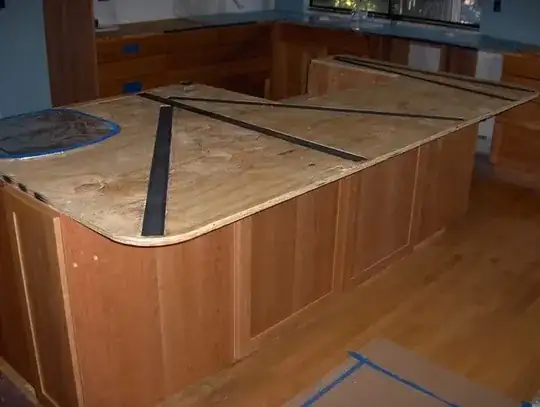
Steel bars in subtop

But will this actually give me any more support? Am I just gaining tensile strength for the MDF?

Tester101
  • 133,087
  • 80
  • 327
  • 617
Matthew
  • 10,823
  • 23
  • 64
  • 109

4 Answers4

3

Based on the flexibility of the flat bar stock, I decided to use square 1/2" tube stock.

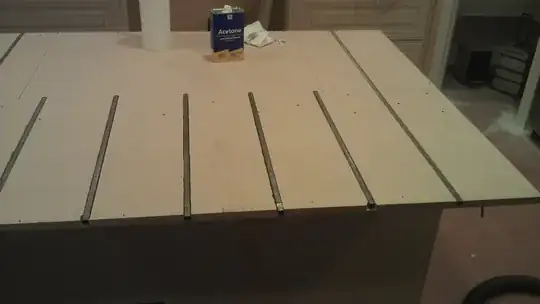
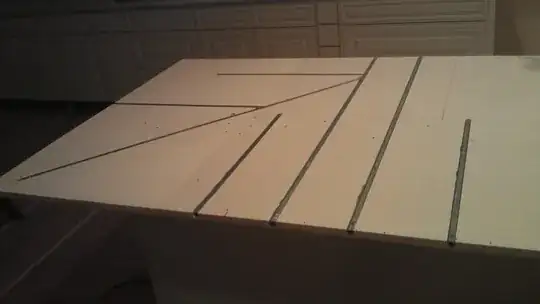
Using a 3/4" MDF subtop, I routed channels 5/8" wide and 9/16" deep. I then filled these channels with polyurethane glue, set in the steel bars, and finally I used a drywall knife to spread and flatten glue over the top of the bars.

Here are pictures of my actual work:
The cabinets are backed by a 2x8 pony wall. The MDF is glued and screwed to the pony wall and all cabinet frames. The steel bars span everywhere except the sink cabinet.

Sink side routing Corner side routing Glue applied

Matthew
  • 10,823
  • 23
  • 64
  • 109
2

How much of an overhand do you plan on having? The spec I saw was that 10 inches were allowed with no supports. When the granite guy came to measure mine he told me I didn't really need them even at 12. I had alread put in corbels which look good, but do get in the way of knees. If I did it again, I would consider going to 10" and not having any bracking.

If the steel is epoxied to the granite, it will help, but I don't see the strips as shown doing that much good.

I have seen examples of granite on knee walls where a 1/4 inch plate spanned almost the entire granite slab.

BrianK
  • 5,475
  • 8
  • 30
  • 38
1

The photo in the question shows a superior approach to adding steel for granite support. Yes the 1/4" square bar will add rigidity but a 1/2" x 2" flat bar would roughly be the equivalent of 16 1/4" square bars. 1/2" x 3" would be like 24 1/4" x 1/4" bars. Hollow tubing and angle is only an application to get the most strength from the least weight. A solid bar with the same overall dimensions will be much more rigid. Do you really think that filling in tubular steel with solid steel will somehow magically weaken the tubular stock. Lastly, adding the rigidity to the sub-section is perfectly fine. For the granite to move it has to move the sub-structure. Yes it's true that technically, having the plate on top of the granite would be stronger since with the granite not being easily compressed, the steel at the top would actually have to stretch which would take more force than for it to flex. However that conversation in this application is just a distraction and a waste of our time. Craig Director Mechanical Engineering Gables Engineering

1

I don't know much about countertop weights, I've never done one, but I can tell you that flat steel is strongest along it's smallest edge. It's not supposed to be too rigid when flat. For example, if I have a quarter inch thick piece of steel, 3 inches wide and 1 foot long, if I put it down flat on 2 end supports and stood on it, it would bow. If I braced the sides and put my body weight on the quarter inch thick part, it wouldn't bow, there's 3 inches of steel supporting me instead of quarter inch.

I would recommend angle steel for you here. Route it, not plane. Angled steel is strong along both sides. You can get angle iron at most home improvement stores, just route out a deep channel for the other leg of the steel. Another thing that's pretty strong is hollow round stock, that may be easier for you to work with, and the arches help a lot.

kavisiegel
  • 2,286
  • 5
  • 26
  • 45