14

I am getting ready to install a new bathtub and shower.

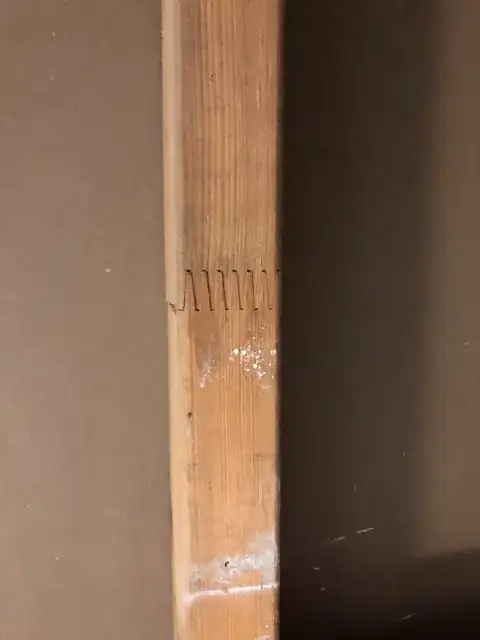
After ripping everything out I noticed all the studs behind the original bathtub wall have cuts. See photo.

If anyone can explain why the studs are pieced together this way I would appreciate it very much.

[image of studs connected together with a zig-zag joint1

isherwood
  • 158,133
  • 9
  • 190
  • 463
homegrown
  • 253
  • 2
  • 6

5 Answers5

23

Those are called "finger jointed studs". These joints are weaker than regular 2x4 or 2x6. I do a lot of woodworking and when gluing boards together (for like a table top) the glue joints are actually stronger than the wood itself. But for some reason, that's not the case with finger jointed studs, they are just much weaker than the intact 2x. That and the alignment issue between the pieces make this product junk if you ask me.

The contractor that built my house started using them for interior walls. Some of the joints were off by as much as 1/4", which would have made sheetrocking much more difficult. My plumber said he hates them because unless you brace the stud when drilling, they'll break at the joint. To demonstrate, he got a short length (about 4') with a joint in it, elevated one end on a 2x and then proceeded to kick down on it. It broke right at the joint.

After a few interior walls were built with that crap, I inspected and found many cases where the joint wasn't at all even. I told the contractor to tear those walls and not use that crap anymore. He didn't like me for it, but later, when he used them on a project for himself, he admitted they were crap.

To answer, since they are already in place I wouldn't worry about it. The vertical load capacity isn't affected, esp. not an issue in a non-load bearing wall.

Sorry for going off like this, but finger jointed studs are just not a good product.
George Anderson
  • 23,304
  • 5
  • 41
  • 83
10

That is a join between two bits of timber.

The ends are machine cut and glued.

Solar Mike
  • 30,038
  • 2
  • 34
  • 69
6

As others have said, this is "finger jointed" lumber. The quality of such lumber varies from quite good to kind of piddlin' poor. The purpose of the joints is to allow knots and other bad spots in the lumber to be cut out, producing a piece that is straighter and easier to work with than it would otherwise be (and of course allowing longer pieces to be produced from a given tree).

The care taken in cutting the joints plus the amount and quality of the glue used determines how straight and strong the joints will be, though the quality of the original lumber is also a factor.

And note that similar joints are commonly seen in wood trim, particularly in exterior trim. In exterior trim eliminating knots and splits is especially important, so the use of the technique definitely improves overall quality without running costs sky-high.

Hot Licks
  • 2,103
  • 1
  • 15
  • 16
0

Finger jointed studs are used because they can carry more weight without bending once you nail the plywood. They will always be straighter than regular studs; no bends means it takes more to break when bearing weight.

Glorfindel
  • 1,187
  • 2
  • 14
  • 20
Caz
  • 9
  • 1
-1

I would prefer a solid stud if they were true #2 as they were in the past. Today, a lot of #2 lumber would be tossed aside in the past. There have been millions of homes built with finger-jointed lumber with no issues. They are more straight and offer the same amount of structural integrity in compression as a solid stud. There are even finger jointed rafters available. One of the reasons is fast growth timber, making it difficult to find long solid boards. You can refer to ICC's testing labs for an in-depth analysis of FJ lumber.

Zenhowie
  • 7
  • 1