The part that interests me is marked in the picture. I have no tool that utilizes that part of a bit and I cannot find any clues on the net... In fact, all of my bit holders have better grip on bits without that indentation. So what's that indentation for?
4 Answers
Impact (or hammer depending on your region) drivers have a locking mechanism which holds the bit in place:
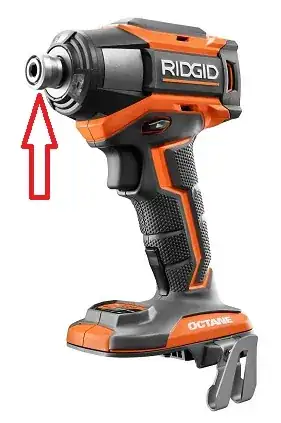
Usually the drill bit will just snap right in. To remove it you need to pull the collar forward and the bit will pop out.
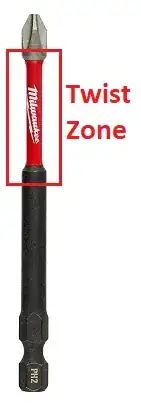
Typically you would buy impact-grade bits such this one which are designed to twist at a specially designed weak point so that the phillips end does not fail and break.
A hammer drill is typically used to drill holes in concrete as it exerts a hammering action to break up the material which it drills into.
You can get a dedicated hammer drill or lots of standard drills have a hammer option (not as effective as a dedicated hammer drill but good enough for small-ish holes).
An impact driver does not exert a hammering action. This can be confusing depending on the terminology in your region.
Not to be confused with an impact wrench which natively accepts sockets for automotive work.
Milwaukee also produces a 6 inch locking bit extension which will hold the bit in place using the same principle as the impact driver's collar:
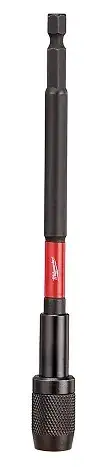
So you could attach this to a regular drill and always have the convenience of a locking collar for quick bit changes.
- 17,328
- 2
- 27
- 64
It sounds like the bit holders you have are magnetic. Magnetic bit holders are really only suitable for light duty.
Most professional level bit holders employ a quick release system, whereby you'd pull (or occasionally push) a retaining ring. This ring releases a holding mechanism which slots into the groove on the bit. This prevents the bit or drill bit from falling out during use, potentially causing injury.
- 3,421
- 13
- 19
I am late to the party I am afraid. Anyway. Those indentation or groove is the place for the balls to fall to, in the quick release collet type chuck usually found in impact drivers. These type of Chucks have a arrangement of small steel balls (the same kind found on bike bearings) on the inside of the slot hole around the bit that you insert. They are usually pushed radially in, by the collet due to its spring pressure. When you pull the collet against the spring pressure to insert or remove the bit, it moves away from the balls allowing the balls to move radially out and make way for the bit to go in our out freely. Once the bit is in place in the slot, the balls will be directly over the groove on the bit so that when the collet is released, the spring will push the collet over the balls and the balls will move in and sit on the bit's groove, locking the bit in place.
The indent is to allow the jaws of your drill chuck to firmly tighten onto whatever driver you are using.
A dills chuck usually has 3 jaws that are able to raise (tighten) or lower (open). If you look at the inside section (the one that contacts the driver) you'll see they have an oval like profile. This gives the jaws more grip onto the bit and locks it into place.
Also, I've found that 1/4 inch shape at the driver/bit bottom fits perfectly into any bit extension. So if you need to drill a deeper hole with a spade bit it will hold nicely in an extension bit holder.
- 11,108
- 3
- 14
- 36


