12

New here, please go easy on me:)

I have a few outlets that we’ve never used because furniture was in the way. Just started moving stuff around and I’ve come to realize that 2 outlets just don’t work, with known working items.

Tested with volt meter and I get:

0 across A&B

120 across A&C

120 across B&C

I get completely opposite readings at a known working outlet. Is this a case of just replacing the outlets or tracing a bad wire in the wall? There are 3 outlets on this breaker and only 1 of them is working.

enter image description here

6 Answers6

18

Welcome to the Magic 8-ball: receptacle tester
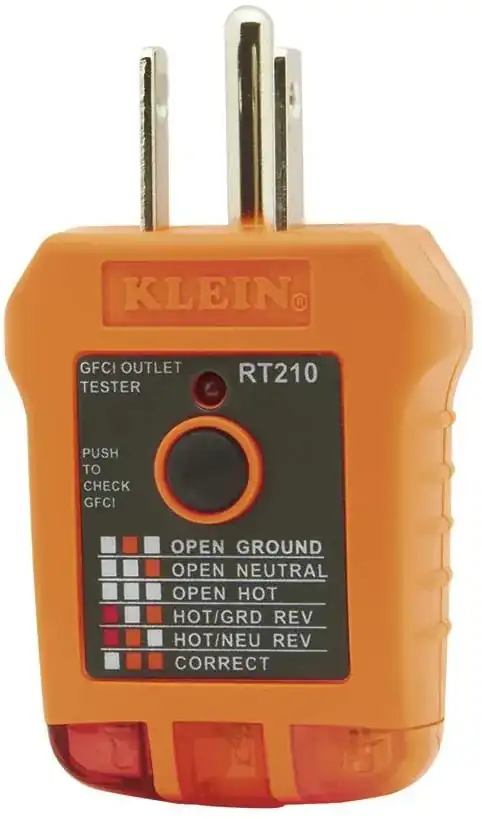
Harper calls these the Magic 8-Ball because they sometimes produce meaningless, seemingly random, results. But for straightforward wire swaps they are exactly the tool to use.

These testers make what you found out the hard way a bit easier - i.e., you can plug them into each 120V receptacle to very quickly find out what is going on. What you have would be described by one of these testers as Hot/Ground reverse.

The normal setup is:

  • A (wide slot) = Neutral
  • B (narrow slot) = Hot
  • C (hole) = Ground

You normally have:

  • A-B = Neutral to Hot = 120V
  • A-C = Neutral to Ground = 0V
  • B-C = Hot to Ground = 120V

There are a lot of different things that can go wrong. The most common things are simply wires connected in the wrong places. If Hot and Ground are reversed then you will get:

  • A-B = 0V (Neutral to Ground)
  • A-C = 120V (Neutral to Hot)
  • B-C = 120V (Ground to Hot).

With this specific combination, 2-prong devices will not work but at least will be safe (no voltage, so no current) and 3-prong devices will not work and will not be safe.

To fix:

  • Turn off breaker
  • Check color of wires going to breaker, neutral, ground (they will all be "together" either in one cable (Black = hot/White = neutral/bare = ground) or in conduit (color = hot, white/grey = neutral, bare or green = ground or no ground if metal conduit). If the colors don't seem right here (white to the breaker or any color other than white to the neutral or anything other than green or bare to the ground bar) then stop and upload pictures before continuing.
  • If the breaker seems OK, next step is to open up each receptacle on this circuit and check the wiring. In each case, black or other color (not white or green) should be to the brass screws, white to the silver screws and green or bare to the ground screw.

You will likely find at least one receptacle wired incorrectly. Fix it and then test with a multimeter, though in this case using a Magic 8-Ball tester will speed up the process as this is right on target for that type of tester.

FreeMan
  • 48,261
  • 26
  • 101
  • 206
manassehkatz-Moving 2 Codidact
  • 139,495
  • 14
  • 149
  • 386
13

The tall one is neutral, and should be near ground. Of course, Neutral Is Not Ground :)

It's possible the outlet is miswired.

It's also possible that it suffered a neutral wire break somewhere between here and the panel. Ground is ground, hot is hot, as intended... but neutral is floating. In actuality it's being pulled up to hot voltage because a load connects hot and neutral with a high resistance path.

Most wire breaks are in fact problems at terminations (where the wire lands on a receptacle for instance). Most of those are problems with backstab connections. We dislike them for this reason.

The problem would be at the last good outlet on the onward line, or at the first bad outlet at the supply line.

Harper - Reinstate Monica
  • 313,471
  • 28
  • 298
  • 772
6

So, I fixed this today. I went to Home Depot and picked up 3 new outlets. The one that was working had the downstream neutral and hot wire flipped. That fixed the issue and I’m getting correct readings on all outlets and everything works perfectly.

Glad it was something small and not a wire trace or something in the breaker box.

Thanks everyone for your help!!

3

Looks like someone has wired in a hot wire to neutral, or you have a disconnected neutral leg somewhere. You need to trace the neutral side with the power off. I highly recommend getting a professional in, because mainly for liability/insurance reasons. Other reasons also being that it seems likely that it's DIY work gone wrong and there may be other faults beyond your skill level, so if you fix something then something else may not work because it is all connected.

binaryOps20
  • 460
  • 2
  • 5
2

Those outlets are miswired. Since household outlets are "daisy-chained" inside walls, it only takes miswiring at one outlet nearest the breaker panel to make it and the remainder of the chain all wrong.

Please DO NOT plug in any three-prong appliances to those outlets as part of your testing, as their frames (internally connected to the third prong) will be "hot" with respect to any ground point. (Both your measurements involving "C" produced a voltage reading; this told me all I needed to know to issue such a caution.)

0

From what I gather, It seems the outlets are wired wrong. And because you have indicated that there is power at the ground " C TERMINAL ", then my warning to you is definitely do NOT plug in anything like an appliance in that outlet. For example, the entire outside frame of a washing machine is steel, and use a 3 prong grounded plug to a 3 prong grounded outlet. Which means the frame is suppose to be grounded. Having 120 volts at the ground c terminal that you indicate, in this case means that if you were to plug anything that uses its frame for ground, into that outlet, and then you touch the frame , you WILL be electrocuted.

lilome
  • 1
  • 1