3

I have a 240 V dryer which when measured with an ammeter has 24 A on one leg and 22.7 A on the other. If the ammeter is kept in place, one leg drops to 13 A, and the other leg drops to 4.5 A.

Because my home has the neutral landed on the ground, I believe that the delta between the two legs when they are in the 13/4.5 A mode is lost to ground. Regardless whether that's the case, should this dryer have vastly different current measurements on the two legs at the same time? Seems a bit hinky to me.

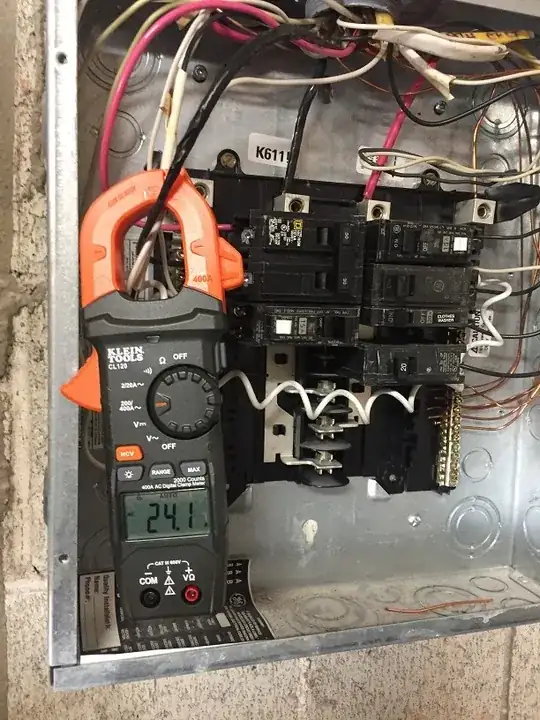
As you can see from the pictures, I'm measuring the same wires with different currents (24 A on the black conductor, and then 13 moments later. 22 A on the red conductor, and then 4.7 A at the same time the black wire drops to 13). I checked the connections on the back of the dryer. Everything is copacetic there. I had an appliance technician come out, and he says that the dryer is 100% operationally correct from his perspective. I am very interested in hearing people's thoughts.

Enter image description here

Enter image description here

JACK
  • 89,902
  • 21
  • 80
  • 214
Allen Stanion
  • 41
  • 1
  • 3

4 Answers4

10

Dryer connections have 2 hots, and neutral, and often a safety ground.

Anything since 1990? 1996? requires neutral and ground as separate wires.

Dryers do NOT connect "2 hots and ground", if you thought that, that's incorrect unless you're dealing with a Philippine-model or 5-continent model dryer made for 230/400V.

(the Philippine model dryers are typically North American dryers reconfigured to run on 240V-only, by adding a transformer to support 120V loads and using a 240V tumble motor. The Philippine government requires people in the former American-built districts stop using neutral; to harmonize the whole country to Euro-style 230/400V power.)

Those numbers

24A - 1.3A - 22.7A

That's perfectly normal draw for a dryer. The 22.7A is the heating coil, and the 1.3A is the tumble motor and miscellaneous 120V electronics.

13A - 8.5A - 4.5A

Exceedingly improbable on a dryer circuit. 99.9% of dryer circuits are dedicated circuits that serve only the one 30A receptacle. (mind you 30A circuits are allowed to supply as many 30A receptacles as they please; just 99.9% of the time, they do not).

Now, 13A@120V + 4.5A@120V is 2100W, which is a lot of heat - about 1-1/2 hair dryers going full tilt. So the point of loss will be rather warm.

We can cross off the dryer. First, there's nothing in a dryer that could possibly draw 8.5A of imbalance current (tumble motor stalled and pulling LRA???? It would burn up quickly) and nothing that would draw only 4.5A of 240V that wouldn't also burn up from lack of air movement. (I assume you'd hear the blower running?)

So job 1 is chase that circuit and find out what else is on it. Other 30A receptacles are allowed. Sockets of any other amperage are not allowed. Nothing hardwired should be there either (because it with the dryer would overload the circuit - and why isn't that happening, by the way?)

I don't see anything wrong with your ammeter reading methods. Klein is a perfectly respectable vendor, and the "dryer on" readings are right in line.

Also, get rid of that Square D breaker.

It doesn't belong in a GE panel and will burn up the bus. GE breakers only (or Eaton CL type not BR). The correct GE "THQL2130" is $10.

Ditto that Murray breaker at bottom right, again a THQL1120", $5-ish.
Harper - Reinstate Monica
  • 313,471
  • 28
  • 298
  • 772
8

Those numbers seem fairly reasonable -- dryers often have a mix of 120V and 240V loads, and the exact current draw on each leg at a given time probably has a lot to do with the dryer's settings and place in the cycle. Typically the heating elements are 240V and the tumble motor is 120V, and each of those might use more or less depending on the heat and speed settings. 240V loads will appear evenly on both hots, whereas 120V loads will appear on only one of the two.

Nate S.
  • 6,458
  • 16
  • 34
8

Dryers (in the USA/Canada) typically have 120V and 240V components in them - otherwise they would not need a neutral wire.

For ANY 120V-0V-120V (240V with neutral) connection on this type of system, be it a dryer or a sub-panel, the hot wires (120V from neutral, which is grounded) carry the power. The neutral wire carries only the imbalance between hots. So:

If you only had 240V components, current in L1=L2 and neutral current = 0 Power is that current (once) times 240V (or that current twice, times 120V which is the same.)

Since you don't only have 240V components, you have an imbalance equal to the 120V draw on one line that is not matched by an equal 120V draw on the other line. That current is carried on the neutral. Given that a dryer switches various things during it's cycle, the current imbalance may vary. The power is L1 current * 120V + L2 current * 120V. If the dryer is not sucking down vast amounts of current when it's switched off (it would get quite warm, even hot if it was) it's not your "mystery power hog load" and it's very likely that your mystery power-hog load will be something blindingly obvious once you notice it.

tldr: An imbalance between hot leg currents is perfectly normal and in no way a smoking gun for 37MWh/year.

Ecnerwal
  • 235,314
  • 11
  • 293
  • 637
1

This seems out-of-balance to me. As previously stated, there is the heater circuit which (for a traditional dryer) is either on or off, and controlled by a thermostat. This circuit is across both hots, and should not even have a neutral connection. The tumble motor is on one hot leg. Its current flows through the one hot and neutral. When the heater is switched off, you should have zero current in one hot leg, and only the tumble motor current flowing in the other.
So I would expect with the heater on: Heater current in one leg (22.7A), Heater current plus motor in other leg (24A)
With heater off: No current in one leg (0), motor current in other leg (1.3A)
Perhaps try disconnecting the thermostat and see what readings you get. You should only see the motor current in one leg. There may be a small amount of current in one leg or the other, whether it's a computer controller board (from a transformer) or a timer motor on the dryer.

pwrgreg007
  • 123
  • 5