2

Let's say I have a 1"-thick piece of wood. A 1 1/4" screw is driven through the wood, resulting in 1/4" of the screw protruding out the other side. What type of drill bit would I use to grind that tip down just beneath the surface, leaving a dimple just the right depth to be filled in with wood putty?

I do not want to extract the screw. I want to grind it. It would be a wood screw, not something as brittle as a drywall screw.

Edit: I called Home Depot and they suggested that I use my oscilating tool to cut off the tip and then use a regular drill bit to grind it beneath the surface. This makes sense. Should I go that route?

oscilatingcretin
  • 5,932
  • 53
  • 99
  • 114

7 Answers7

4

A protruding screw head is made of steel, so it will be moderately hard. If the screw is brass, it would be easy to grind down. You have several options.

  1. With 1/4 inch remaining above the surface, I might first cut it down rather than grinding it all down. A piece of hacksaw blade will suffice, held in my hand flat against the surface to avoid damaging the wood. Leave a little stub that can be dealt with easily.

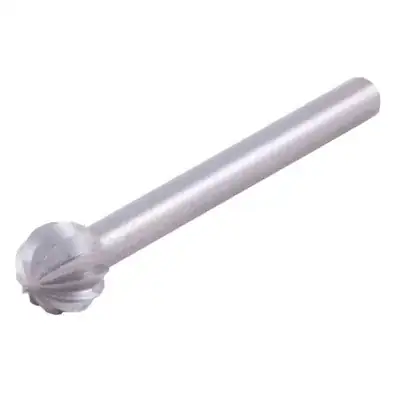
  2. A grindstone bit, for use in an electric drill. This can be found in any hardware store, probably made of aluminum oxide, and possibly a 1/4 inch shank. Smaller ones for a Dremel tool will have a 1/8 inch shank, but I'd get the larger one. It will last longer, and fit in any electric drill, so no Dremel required.

  3. You can use a high speed steel or carbide burr to do the grinding too. But aluminum oxide is harder than steel, and far cheaper than carbide.

  4. Use a bimetal blade in an oscillating multitool. While I have found many uses for this tool, the blades are incredibly expensive and will wear out quickly when cutting steel. (There are titanium coated bimetal blades that will last longer, but they are not at all cheap, and may not fit on every model multitool. For example, no titanium blades are available for my Porter Cable tool.)

  5. Sandpaper on a sanding block, as suggested by one answer is an option, but sanding down a 1/4 inch steel stub will take some time and probably tear the paper into shreds (as well as the sanding block.) So I would definitely shorten the stub using a hacksaw blade first. A belt sander will also do the job here, again be careful as it might tear the belt.

4
  1. Back the screw out.
  2. Cut off the tip with 4 1/2" grinder.
  3. Screw it back in.
  4. Fill the hole!
Niall C.
  • 20,909
  • 19
  • 95
  • 135
Robert
  • 39
  • 1
1

I second the use of a dremel with a round grinding bit on the end. A drill bit will just slip off the pointed end of the screw.

enter image description here

BrianK
  • 5,475
  • 8
  • 30
  • 38
1

I've always used a 4.5" side grinder. Very carefully.

Bob
  • 2,611
  • 16
  • 10
0

Remove your fastener. Cut 3/8" off with a hacksaw. Screw it back in! Simple!

You can't "grind" with a drill bit. To "grind" involves an abrasive wheel or stone. You also don't "cut" with a drill bit. You only "drill" with it.

Niall C.
  • 20,909
  • 19
  • 95
  • 135
0

A regular high speed steel bit will cut softish common wood screws. Depending on how big the shank diameter is at the cut will determine how hard it will be to center punch and drill out without the bit slipping off the metal and gouging a good hole in the neighboring wood.

I suppose there's now no way to back the screw out and cut it to length, or substitute a shorter screw?

bcworkz
  • 11,578
  • 21
  • 19
0

How many do you need to do?

If it's not that many, just get a sanding block with some heavy duty sanding paper (the kind with the material backing) and just run a few passes over the screw head. I would take a bet that this is easier than any Dremel. :)

Niall C.
  • 20,909
  • 19
  • 95
  • 135
Hightower
  • 3,422
  • 6
  • 20
  • 38