14

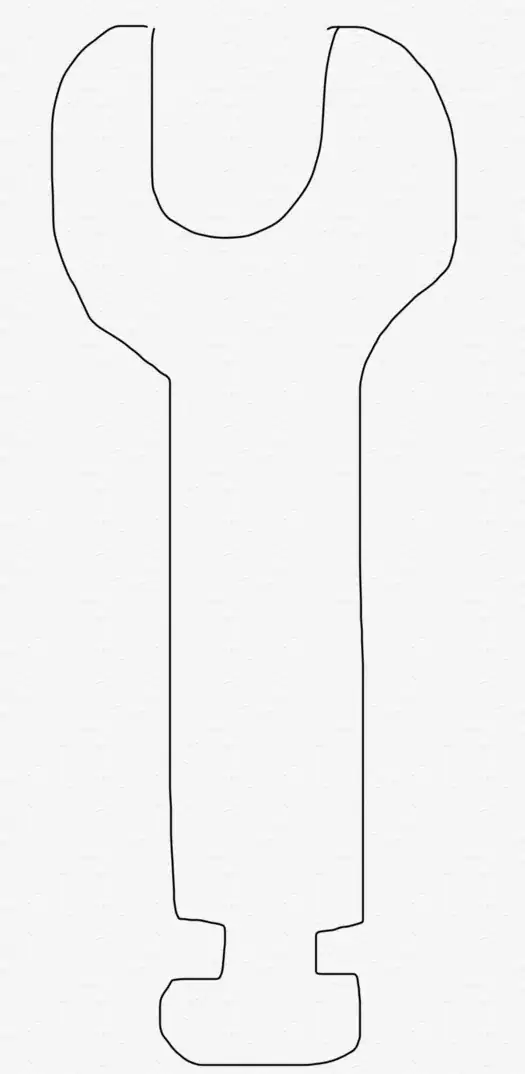
I have a couple wrenches that came with my mini air powered die grinder. I want to put a hole into the top so that I can attach a wire or string so I don't lose them.

I used a punch to put a dimple into the wrench. I am trying to drill a pretty small hole maybe a bit bitter than 1/8". I put a cobalt drill bit into my drill press but it just doesn't seem to make any progress. I don't have a cutting liquid - was thinking of getting one. The wrenches are probably 1/8" thick.

Any other thoughts? What are the best bits for drill metal? What type do they use in heavy industry to drill through hard metal? Carbide? I probably have the drill press going too fast but I got it used and have never adjusted the speed. Given the size of the hole I am trying to drill it just seems like I shouldn't need the perfect setup to get a hole.

I adjusted the drill press speed to 620 rpm ( the slowest it can go - it was set at 3100 ) and I tried using a new cobalt bit with some spit on the wrench I had not previously tried to drill but it didn't seem to make any more progress than my previous attempt. I have some cutting oil and the HI-Molybdenum M7 Drill Bit Set on order so either I'll give those a try or next up I might try diamond or carbide bits.

I tried cutting oil - oatey 30201 -, setting the drill press at 3100 rpm, using a new cobalt bit, using a new spot and apply significant downward force - ending up breaking the bit.

I used my MAP torch to heat one of the wrenches to red hot and let it cool over night. The next day I used the same 3100, new cobalt bit, cutting oil and similar force. The drill bit went through ! You can see the line of the heat on the wrench. I didn't get around to trying a few of the other options yet. I'll probably give the diamond option a try on the wrench I haven't heated. Nice to have more than one trick in my bag.

Thanks for all the suggestions! I feel like I used a bit from each answer.

small wrench in drill press

success drilling

Fresh Codemonger
  • 14,459
  • 3
  • 24
  • 57

11 Answers11

26

With a sharp drill, oil and patience, or with carbide. But Why make a hole?

enter image description here

bobflux
  • 11,121
  • 29
  • 35
15

A challenge at home. Good tools are hardened to near Rockwell C hardness 40. Cheap tools can be much softer. A professional machine shop can drill up to HRC 40 , so they could slowly do it. You have a chance with a new HSS bit , high sulfur cutting oil ( you will probably need to find some old oil as likely it is now illegal) , low RPM , pressure . If the bit turns a few times without cutting , it is been made dull - get a new bit. Start with a small bit like 1/16 , then a large one for final size. You can not drill in a spot where you have made a mark by another try- the steel in that spot will be work hardened to much higher than HRC 40. You can hope the tools are not very hard , a reasonable possibility.

blacksmith37
  • 8,401
  • 2
  • 18
  • 33
13

Without cutting fluid chances are you melted the cutting edges of your bit. Use a sharp bit and any oil you have lying around, along with a slow speed.

isherwood
  • 158,133
  • 9
  • 190
  • 463
9

Anneal The Butt of the Wrench First

When you view this question in the general since of "how to I drill steel that is too hard to drill with the tools I have", annealing it first is one possible solution.

Depending on how steel is cooled, it can form different kinds of crystalline structures that give it its unique properties. In the case of the steel in your wrench, it was likely heated and cooled to different temperatures and at different speeds in a kiln until finally being quenched to give it that nice combination of hardness and toughness that makes it so good at applying force without breaking. The hardness part that you are having a difficult time overcoming comes from that final quenching where it is cooled quickly in oil or water (depending on the exact alloy).

So, to make the steel softer, you just need to heat the butt of the wrench with a blowtorch until it glows a bright red. If it gets too hot you risk decarbonizing and/or melting the steel which will ruin it; so, be careful not to let it get to being white hot. You also do not want to heat the head or neck of the wrench as this may ruin the original temper and make your wrench bend next time you try to use it, but since the butt experiences the least amount of stress in use, softening that steel will generally not be a problem. Then you want to let it air cool. You don't want to cool it in water as this will just re-harden the steel. You also don't want to fully anneal it by kiln cooling it either as you only need it to be soft enough to drill... not soft enough to bend in your hands.

... or if you just want to solve the actual problem (hanging metal tools that are otherwise hard to hang), you could just try a magnetic wall strip. If cost is an issue, you could instead put two nails in your wall that are far enough apart for the handle to fit, but closer together than the width of the head. Then you can hang the wrench upright between the nails instead of upside down on 1 nail.

These methods requires no actual modification of your tools, just your work space.

enter image description here

Nosajimiki
  • 206
  • 1
  • 4
6

Magnets

Get a pack of magnets. Each one can hold a wrench to the side of a toolbox, refrigerator or other steel surface.

manassehkatz-Moving 2 Codidact
  • 139,495
  • 14
  • 149
  • 386
6

If you have the chops and some electrical equipment, you can use EDM to put a small hole in the wrench with a relatively quick pace.

enter image description here

There is a popular YouTube video with a simple methodology here

While the application is very niche, I figured that I would post it because it is by far the fastest method to remove material at home, and you don't have to (possibly) ruin any drill bits.

tuskiomi
  • 163
  • 6
5

Have you considered wrapping them with paracord?

enter image description here

Matthew G.
  • 51
  • 1
5

Reality check: Drilling does not make heat.

NOT drilling makes heat! :) if the drill isn't cutting effectively, it's sitting there getting hot (and work hardening the metal and dulling the drill).

Once I was drilling holes in mild steel on a mill, working fast - drill, index, drill, index, drill. I was making nice long chips that came off like noodles. Immediately after the last hole, I grabbed the drill bit by the flutes and loosened the chuck, and put the chamfer bit in there to chamfer the holes.

How did I know the bit would be cool to the touch? By the chips. In this material, the nice long noodles said I was drilling, not making heat.

And that worked because I had the "feeds and speeds" correct: I got the "speeds" by looking up in a table the correct RPM (itself derived for me from the surface feet per minute ideal for that material). I got the "feeds" by touch and feel: when I got happy chips, I knew the feed rate was correct. This worked because with speeds known to be correct, I only had to explore for one variable.

Do the same and you'll be starting on the right foot.

And if the drill even starts to get hot, stop immediately. You are not drilling, you are in a hole so stop digging!

A drill bit that has gotten red-hot is now irreparably damaged.

For a 1/8” drill bit I would expect a correct speed very coarsely around 3000 RPM,

Reality check: slower is not better

A lot of novices go "I'll just err on the side of caution on feeds and speeds". Wrong. There is no 'caution' in that sense in machine work. Feeds and speeds are not maxima... they are correct values, and other values are wrong.

Granted, there's a lot of tolerance - but think of it like water skiing... or flying a fixed-wing airplane. Too slow means you are not doing "the thing" at all!

"Too slow" typically means "work hardening", which makes it only harder to get started again, whilst dulling and heating the bit.

Reality check: oil does not cool

Cutting oil is for cutting. That's why they call it cutting oil. As discussed, cooling doesn't help drill because if you're making heat, you're not even drilling. All it will do is forestall the hot drill's destruction a little bit.

Water will at least boil at 212F, and take away tremendous amounts of heat via the "latent heat of boiling". Oil won't do that (unless you're on the verge of ignition), so its ability to remove heat is very limited and you'd have to use very messy amounts of it to gain appreciable cooling. Larger manual machines have a cutting fluid collection system on their bed, a pump, and a "bendy snake"-like nozzle which can be aimed at the work area. CNC machines have a liquid-tight enclosure, and they just blast the cutting area with multiple streams of oil/coolant.

Drill quality is not the deciding factor

I see you reaching for the "top shelf" drills, thinking they are required. Not in this case. It's about techniques far more than tool quality, i.e. top shelf drills won't save you here, you're just throwing money away.

What "better" drills generally do for you is give you longer service life... giving you, say, 200 holes until dull, instead of 100. In my experience the drill is far more likely to suffer some other casualty long before that, due to the high variability of hand-drilling, say.

To actually get to where the drill reaches its service life, you'd have to be under controlled conditions with a big machine, such as the high-rate work I was doing where I had my technique "dialed in". Or better, using the auto-feeder (where the machine advances the bit for you). In that case, you set it from the "feeds" data from the machinist's tables.

Harper - Reinstate Monica
  • 313,471
  • 28
  • 298
  • 772
4

Another option I've gone with is to weld a loop onto the tool. That said, for extremely hard metals you can work your way through pretty much anything with a diamond bit and patience if specialized drill bits and cutting oil don't work. If you can stand a 1/4" hole a diamond hole saw will probably do the trick. There are also ball head type diamond bits you can get for a dremel, but these aren't great for drilling straight holes because of the low velocity at the center of the shaft. I use that type of bit to engrave hard tools, but I cut with the side of the ball, which is at high velocity.

If you have a significant number of tools you want holes in, you could consider getting quotes from laser or water jet shops if there are any near you.

Diamond doesn't require a great deal of pressure to cut and as long as you lubricate well and don't overheat you can spin the bit at fairly high velocity to help your cutting rate. it helps to drill horizontally to help clear the gap.

K H
  • 2,298
  • 9
  • 15
4

Your explanation that it's to attach a mini grinder wrench to the tool so they stay together made me see the problem (the shape of the wrench is not conducive to attachment) and also a fairly simple and obvious solution

It doesn't actually have to be a hole. Take that mini grinder and use it to grind two slots in either side of the handle so there is a narrow spot, then tie a wire around that spot

enter image description here

Caius Jard
  • 1,347
  • 7
  • 13
2

According to https://carbideprocessors.com/content/drill-speed.pdf you should be using 3,000 rpm and cutting oil.

The oil doesn't have to be fancy. Just grab some motor oil and a spray bottle or a spoon and keep things lubricated.

MonkeyZeus
  • 17,328
  • 2
  • 27
  • 64