5

I am trying to wire an outbuilding with the equivalent of a 15-A circuit from 300-400 ft (90 - 120 m) away.

What gauge wire do I need? Also, does the full length need to be a constant gauge or can the thickness of the wire taper at it approaches the load? For example, 100 ft (30 m) of 10-gauge wire from the source leading to 100 ft 12-gauge leading to 100 ft 14-gauge, etc.

Peter Mortensen
  • 335
  • 2
  • 8
gothicsurf
  • 51
  • 1
  • 1
  • 2

6 Answers6

14

You'd use aluminum

That is the main takeaway. Continuing to "bump" copper wire larger and larger and larger is just crazy. Because there are 2 costs to wire: the insulation and jacketing which is complicated stuff, especially for outdoor wire; and the metal of the wire. Above about #12, the biggest part of wire cost becomes the metal, and that's where aluminum's 12:1 cost advantage over copper really comes into play.

You can buy #2 aluminum (90A nominal) for the same price as #10 copper (30A nominal).

In 120V-land it would be wise to bring a fourth conductor

It will cost 33% more at most, but give 4 times the practical power. It will allow you to bring over both poles (phases) of 120V power, giving 240V also. Instead of 15A@120V you have 30A@240V. Keeping the neutral wire allows you to place loads on either phase, and if you balance them, you could run four 15A@120V loads for the same voltage drop as 1.

Alternately, use transformers

If aluminum wire doesn't bring price into line, you would be better off using 2 transformers to step up the voltage to the highest the wires will permit for the long-distance transmission. For instance, bumping 120V to 600V (5x) will result in 25x improvement on voltage drop, i.e. 1/25 the conductor cross section will provide the same drop.

Also, because you are carrying only one phase, you only need 2 conductors + safety ground. That allows you to derive 120V and 240V at the far end, since the transformer can be tapped for that.

Crunch the numbers, sometimes this makes sense.

And you bet you can taper.

You'll have to, because the switches, receptacles and breakers intended for 15-20A circuits will not take #2 or #4 wire, and many are not rated for aluminum either. So you will need to splice down to smaller wires as appropriate. If you are computing voltage drop, you need to then compute voltage drop on each segment individually, although very short runs under 10' aren't worth calculating.

For splices up to #6 wire size, use "MAC Block Connectors". Above that you need to move into the more expensive Polaris connectors.

Harper - Reinstate Monica
  • 313,471
  • 28
  • 298
  • 772
6

Answering one part of your question:

... can the thickness of the wire taper at it approaches the load?

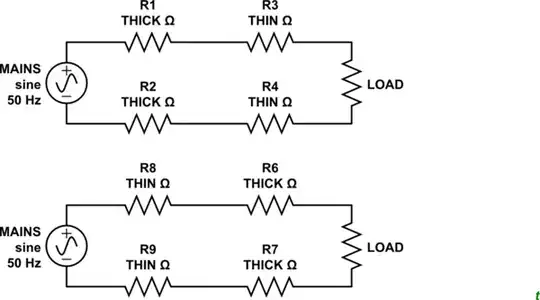
The same current runs the full length of the wire. If you had tapered wire it wouldn't matter which way around the tapered end was connected. You would just get most of the voltage drop at the end with the smaller wire gauge. The load end voltage would be the same no matter which end was fatter.

You would only reduce wire gauge if the cable was powering loads along its length - say various houses on a street. The further down the street you go the less current will be required beyond that point and a smaller wire gauge would suffice.

schematic

Figure 1. The voltage drop will be the same regardless of the order of the resistances in the circuit.

Transistor
  • 1,077
  • 6
  • 12
6

4 gauge aluminum. Or larger gauge, if local odd market forces make some larger size less expensive (i.e. 2-2-2-4 "mobile home feeder cable" is sometimes stupid cheap due to volume.)

Or, a pair of transformers and smaller wire (but you are probably not quite at a distance where that pays off.)

Ecnerwal
  • 235,314
  • 11
  • 293
  • 637
6

As noted in other answers, going with large aluminum wires can make a lot of sense compared with smaller, "just big enough" copper wires. That takes care of the voltage drop. But two more things to consider:

Conduit vs. Cable

Inside buildings we (most of us DIY that is, as opposed to professionals) normally think "cable". But you can't use the usual cable (NM, aka Romex) for connections between buildings. You have to use more expensive cable rated for buried (and wet) locations. Plus once you are burying cable, you have to bury it deep to protect it.

The alternative is conduit. With conduit, you don't need to dig as deep (varies depending on the type of conduit), and you have the possibility to upgrade by adding wires (if you originally ran 3 (hot/neutral/ground), you can add a 4th (2nd hot for 240V)) or upgrading wires (replace 12 AWG with 10 AWG, or whatever). So running conduit may give you more options later, if you don't make exactly the "right" choice now for wire size.

Subpanel

It sounds like you want just one circuit - 15A for lights/convenience receptacles. That may be fine now. But what if you later want to have a separate circuit for high power tools? Or an electric vehicle charger? Or HVAC? If you use large enough wires now (e.g., 2-2-2-4 aluminum as suggested by others, based on pricing) or can upgrade later via conduit, then you have the option of switching from a single circuit to a subpanel. That will allow unlimited possibilities, up to the total power available.

There are some additional requirements, particularly in terms of separate grounding (typically two ground rods) at the outbuilding, but the costs will likely be less (especially with a 300' run) than adding an additional separate circuit the full distance. The "taper" issue goes away - you need to use the "big" wires the entire distance, including the last foot, because you are relying on the full capacity available end-to-end, but the connections are not a problem because the breaker in the main panel and the subpanel will both be able to handle the large wire size and aluminum (unlike a typical 15A receptacle that can't handle either the large size or aluminum).

manassehkatz-Moving 2 Codidact
  • 139,495
  • 14
  • 149
  • 386
4

There are three things you have to take into account, and not necessarily in this order.

  1. Heat due to I²R
    Every part of the wire has to be of sufficient gauge so as not to overheat with the current. If you wire some parts of the run in heavier gauge, you gain no benefit, it won't stop the thinner parts overheating.

  2. Voltage drop due to IR
    The total run has to have sufficiently low resistance so that you don't have an excessive voltage drop at the end. If you wire some parts of the run in heavier gauge wire, this will reduce the total voltage drop, so is beneficial. If you are buying new wire, then you get the lowest voltage drop per cost by using the same gauge for the whole run. If you happen to have some heavy gauge wire for free, then go ahead and use it for part of the run.

  3. Local regulations
    These vary with locale, purpose, and from decade to decade. Install something non-conforming, and it would likely invalidate your insurance, which could make for a very expensive problem if you need to claim, even for something unrelated to your outbuilding.

Pete Kirkham
  • 511
  • 3
  • 9
Neil_UK
  • 583
  • 2
  • 10
2

It's all about resistance and it depends on the voltage drop you can withstand. If you are starting devices that have a large starting current like a compressor motor, you'll need larger gauge wire as the motor may stall while starting. The following graph will give you an idea of voltage drop versus wire diameter. Conductor resistivity is for annealed copper wire.

enter image description here