9

I have a convection microwave oven that has a normal 15A 100V plug. I can only conveniently access a 20A 250V outlet, which looks like this: The outlet. (I am located in Taiwan).

Are there any safety issues with finding a way to connect them? What should I look for in an adapter?
By the way, as a layperson, how does this this kind of thing even work in theory? Is it that 20A of current comes out of the wall, and so it'd be dangerous for a 15A appliance to handle it, or is it that the the appliance draws up to 15A of current, and the wall can provide up to 20A? How does the voltage come into play?

Machavity
  • 26,498
  • 8
  • 44
  • 100
lifeformed
  • 201
  • 2
  • 4

6 Answers6

32

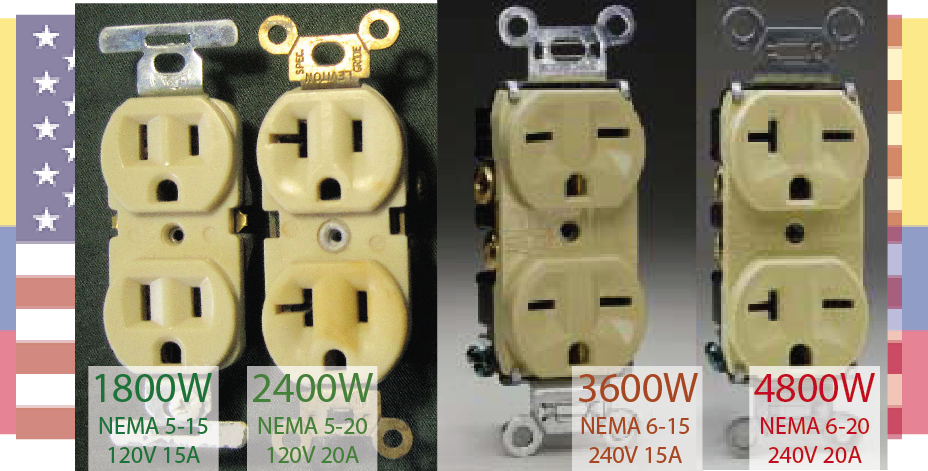
No. That is a NEMA 6-20 receptacle. Your NEMA 5-15 appliance is specifically designed to not plug into it.

Because it would destroy the appliance if you did.

That is why the system of plugs works like it does.

enter image description here

Yours is a Taiwan derivative that does not allow multi-amperage, so it does not have the T-shaped L2 phase.

Anything that plugs into the wall needs a specific voltage. The device automatically draws the right amount of amps that it needs.

Your appliance needs 100-120V. There is nothing available at this socket except 200-240V. There is no affordable way to convert the output here into what you need.

DO NOT use a common stepdown (auto)transformer! This receptacle has no access to neutral. The market is absolutely flooded with "step down (auto)transformers" which will seem to work but will place your microwave's neutral at 120V from ground, a dangerous situation.

If you want to, it's probably possible to have an electrician re-wire the circuit so the socket can be changed to what you need.

Harper - Reinstate Monica
  • 313,471
  • 28
  • 298
  • 772
12

At the moment NO.

You have three choices:

  1. sell that device and purchase one that is rated 230V.

  2. get a 230 to 110 transformer.

  3. replace that supply and socket with one of 110V.

Which of these is most convenient is down to your circumstances.

Solar Mike
  • 30,038
  • 2
  • 34
  • 69
4

The other answers are all correct, you cannot, but they don't address your question of how this works in theory, so I'll take a stab at it.

You can think of voltage sort of like water pressure, and amperage sort of like the velocity of water flowing. Right now in that socket is 250V worth of pressure. Since nothing is connected, no amps are flowing. That 20A is the max amount of amount of flow the socket can support till things in the socket start breaking.

Your microwave is only rated for 100V of pressure, so if you hooked it up to the 250V, it'd be like hooking a garden hose to a fire hydrant: the pressure would be too much and it burst, probably allowing no current through, though it might allowing unrestricted amps until it exceeds 20A worth of flow and the breaker would trip.

The 15A on your mircowave means that it is guaranteed to allow 15A or less to flow under normal voltage and operation. Most devices work sort of like a valve, when off allowing no amps to flow, and under different conditions allow more or less amps to flow. Generally, as long as the amps required by a device is less than the max allowed by your power source, you're fine.

This is all governed by Ohm's law, which if you google you can find far better examples, explanations and analogies than I could come up with.

manassehkatz-Moving 2 Codidact
  • 139,495
  • 14
  • 149
  • 386
yesennes
  • 263
  • 1
  • 2
  • 7
1

In addition to the good accepted answer, please note 2 things:

First:
the ratings of the outlet socket and plug cable are not the most important deciding factors. What's more important is the actual voltage supplied to the socket, and the actual voltage range accepted by the appliance. If a socket is rated at 250V, you could actually have either 220V or 110V wiring connected inside it, so if you have a way to measure it, you might find the voltage to be suitable for the device after all. (But be careful, it could cause serious injury or death if you make a mistake while doing it).
As for the appliance, if it's fitted with a 100V cable, it usually does not accept 220V, but you should not get that information from the cable itself. The machine should have a nameplate similar to the image blow, that tells you what voltage and frequency it accepts.

enter image description here

Second:
Most countries that have 200 to 240 V outlets (like Europe) operate at an AC frequency of 50 Hz, and most outlets that provide 100 to 120 V usually have an AC frequency of 60 Hz (like North America).

According to Wikipedia, Taiwan has both 110 V and 220 V residential voltages, and both operate at 60 Hz, so the frequency should not be an issue of you (but the voltage definitely is).

But for readers in other countries, it is not recommended to use a microwave designed for one frequency in a country that has the other. One reason is that the timer clocks in some microwaves depend in the frequency to count the cooking time. Using the wrong frequency can cause the clock to run faster or slower than it should.
In other words, when you cook for 5 minutes it actually stays for 6, or the other way around.

Amin Dodin
  • 111
  • 3
1

If the outlet is supplying 230V, you cannot connect a device rated for 120V without bad things happening; the device would almost certainly be destroyed, and very likely start a fire.

The 20A rating on the circuit is the most current it can safely deliver to a load; if a load draws more than the rated limit, excess heat will build up in the circuit's wiring which could start a fire. The circuit should have protection against this in the form of a fuse or circuit breaker which should trip before any damage occurs in the circuit. In the context of your question, that's 20A.

The 15A rating on the appliance indicates the peak load it could impose on a circuit; in other words, if the circuit can't deliver at least 15A, you'll probably trip a circuit breaker or blow a fuse if you try to use the appliance.

You can connect a 15A appliance to a 20A circuit, with caveats. There is no issue with doing so for any appliance in good working order. A properly engineered appliance should have internal circuit protection so that any internal fault should trigger the internal protection and not rely on the external circuit for over-current protection. If it's a cheaply-made appliance, it might not have such internal protection, so connecting it to a circuit with a very generous current rating could be risky, but then it could be risky connecting a cheaply-made appliance to any circuit.

Anthony X
  • 1,369
  • 1
  • 11
  • 17
-10

VERY DANGEROUS, but you could in theory connect the 110 hot lead to 1 hot side of the 220, and the 110 neutral to the 220 ground, and leave the 110 ground unconnected" but now the chassis will be floating and there will be current on the ground--BOTH VERY BAD! DON"T DO IT.