Measure the problem
The problem isn't the angle of the ramp, it's the pitch of the chair. Measure it. Even though the short ramp is steep, the chair's pitch remains OK because the lower wheel is on level floor beyond the bottom of the ramp before the upper wheel reaches the top of the ramp. Not so with the troublesome ramp - probably both wheels get onto that transition at the same time, the pitch of the chair matches the pitch of the transition ramp, the chair's center of gravity gets too near the front wheel, and it starts to topple forward.
With the chair unoccupied, and/or with whatever assistance is needed to keep things safe, position the chair straddling the "opposite side" ramp where the chair is stable. Put on your mathematician hat and visualize a triangle connecting the points where the upper and lower wheel contact the floors and one third point in space. Using a carpenter's level and a measuring tape, figure out the rise and the run of the chair's pitch/slope in this position. Do the same with the chair positioned in the unstable place on the ramp-to-ramp. (image from Monterey Institute algebra course)
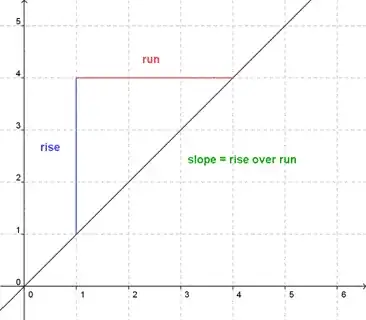
The run is the same in both conditions because the chair's size (wheelbase) is the same. The rise changes -- for the particular wheelchair you have, the rise on the "opposite side" ramp is acceptable but the rise on the ramp-to-ramp is too much.
Now that you are armed with numbers and a method you can start estimating how much change is needed on the ramp-to-ramp to make it safe. You'll be able to confidently answer questions like "if we change X, will that be enough?" or "how much longer does the transition ramp need to taper?" before you start cutting materials.
Fix the problem
The ideal thing is to have no ramp-to-ramp transition at all. In the photo I see three posts interrupting the handrail, making four sections of ramp. Is it possible to raise the high end of the ramp and place shims beneath all or even just some of those posts? It might even be sufficient to raise only the top end of the first section of ramp and leave all the rest alone.
If adjusting the existing ramp isn't an option, a much longer taper on the transition ramp is second best.
Dodge the problem?
One thing you could try is maneuvering the chair through this spot facing the other direction. The center of gravity may not be centered between the wheels; the chair may be able to tolerate a little steeper pitch facing one way than it can facing the other way.
Operators of earth-moving equipment are familiar with this problem and solution. I virtually always load my skid-steer loader into a transport trailer by backing it up the ramps. The engine is at the back of the machine; if I climb the ramps leading with the rear/engine end it's stable. If I climb the ramp facing forward, ie leading with the empty bucket, it feels like it's very close to rolling backward onto its back.


