14

I've been researching for some time how to cover a curved stair riser that had been previously tiled. I wasn't pleased with the look of the tile, so I removed it and sanded back the mastic before veneering. However, the veneer was too thin and it left a significant gap between the tile and the riser. I would like to cover it with a 1/4" or bigger plywood (or some such material) so that I can paint the risers to match the rest of the staircase and cover the grout. You can see there is a very sharp turn on the left side of the riser. I tried kerf cutting some 1/4" plywood and found it impossible to get the plywood to bend along such a tight curve.

Does anybody know of a good way of doing this? I've had "bendable plywood" recommended to me, but I don't know what that is or where to get it. Lauan plywood turns up as a result, but it's not available near me.

enter image description here

CcS
  • 281
  • 2
  • 10

7 Answers7

29

Just about any type of plywood can be bent by cutting slots on the hidden side that leave both clearance for the bend and enough uncut wood on the front to support it. I once made some speaker cabinets that had a "horn" output similar to this:

bent plywood in speaker

Your bend is sharper than the one I did, it looks to be 90 degrees, so you'll need to make more cuts to allow it to bend that far. It does take some work and using Luan is a lot easier but, as you said, there is no Luan where you are.

Here is a photo that gives you an idea how this works:

bent plywood

jwh20
  • 23,628
  • 2
  • 34
  • 65
17

There are plywood products made for radius situations.

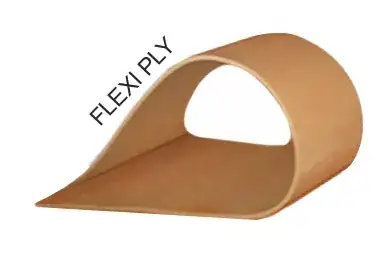
Bendy plywood and Wacky Wood are a few names it goes by. Options are available from several manufacturers like Radius-bending Plywood or Flexi Ply.

The layers are oriented in one direction making it easy to bend around pretty tight radius like yours.

enter image description here

isherwood
  • 158,133
  • 9
  • 190
  • 463
Kris
  • 4,560
  • 4
  • 21
  • 31
13

Take some 1/4 inch plywood, and, with a circular saw, cut vertical slices in the back side ~3/16 inch deep, every half or quarter inch or so in the area where the bend is. This may give you enough flexibility to bend the plywood around the curve. Try it with some scrap wood first, and maybe use a gallon paint can to form the wood.

SteveSh
  • 7,107
  • 2
  • 15
  • 31
7

The problem you have here is you are trying to solve an aesthetics issue. You could tackle this 10 different ways but what can you make look good? This could be done with just plaster or some lightweight concrete blend (how they do a lot of stairs in europe). But can you make that look good?

You can certainly have someone create a piece of wood for you to use too... But can you make it look good? Can you secure it so it won't pop back out? Is it worth it?

Not to be harsh but the whole staircase looks pretty rough while floor above looks nice and floor below so-so. If I were doing this I would reskirt the right side - (you already have a template with the existing one, just extend it. You can get a 1/2" white pine and have this knocked out quickly). Obviously this wasn't made correct and should end at floor - or some kind of trim/transition piece attached to floor. The left side is missing trim too. You can't have a rounded corner to walk on and an exposed wall. You are going to have to custom cut a plinth there. I would then plaster the bottom and use pine board for the other three. I would then paint them all the same color (this could be white like the trim or a color to make it stand out).

That's as nice/cheap as you can get. No way would I put wood/veneer there because it would have matching issues with the other wood. Wood + wood is hardly ever good.

Your other option if you are replacing floor below it to chop off that rounded corner. The bottom step may not be as functional but will probably look better.

DMoore
  • 50,637
  • 16
  • 93
  • 208
3

If it is going to be painted, I would probably do 1/8" or 3/16" tempered hardboard. It will take that curve easily. Just be liberal with brads/staples and use adhesive on the backside. You can fill the staple holes with spackle or your favorite filler. You will need to prime it before painting and definitely sand the smooth side with 150-200 grit before priming.

They also make 1/8" finished veneers for cabinet work like covering kickplates but those are a bit harder to source over 6" wide. Local cabinet makers could help you source the material if you call around.

2

I am going to suggest a coopering approach. Several small pieces cut at a slight angle to make the curve. You might be able to glue them up before attaching for long term stability. Visualize how whiskey barrels are made.

If you wanted an exact match to the curve on the lowest riser, once installed, some aggressive sanding could probably get you there.

You'll need a chop saw or table saw (or a friend with one!) to create the pieces. Use extra caution here because the pieces will be quite short.

This quote is from a simple search I did: "Coopering technically refers to the art of wooden barrel making, but cabinetmakers use the term to describe the process of making curved parts of solid wood without steaming or bending the wood."

IMHO, steam or heat bending would require very thin layers of wood, multiple laminations...quite a bit of work and sourcing very thin wood might be tough.

George Anderson
  • 23,304
  • 5
  • 41
  • 83
1

You mention plywood here but there's another option that you might want to consider which I don't see mention in other answers. Instead of manufactured plywood, you can laminate thin boards around a curve and glue them in place. This is a process usually used in furniture making. You need a bunch of flexible strips of wood that add up to the desired thickness. You could cut them if you have access to a bandsaw but I think you might be able to get away with commercially available veener. Then you take a strip, wrap it around the curve, and then wrap each successive layer around the last, gluing the surfaces together. This needs to be held in place until the glue dries. At that point the curve should hold pretty much on it's own. You could do this on a jig and put it in place after drying but I'd be tempted to do it in place with a little vertical trim on both sides (do this before the straight section is put in place) should clamp it in place. Something heavy (e.g. boxes of tile) might be helpful as well. It might want to relax a little after the glue is dry. Brads or finishing nails should help and gluing the first piece with construction adhesive might be warranted.