2

In another answer it was suggested that Panel Sheathing Clips between sheathing panels in a shear wall "will add a great deal of shear resistance at a minimal cost."

Is this true? If so, why?

I could be wrong and will be glad to use them if it makes sense to do so, but it seems that such a clip would be moot or even detrimental because of the following:

  • This is an indoor wall so shrinkage/expansion from moisture will not matter.
  • The sheathing will be nailed 2" apart all the way around the border and into frame blocking, so the clips will not provide any alignment.
  • The clips might offset the sheathing by their thickness causing a deflection in the sheathing material when pressed against the framing/blocking by the nail schedule.

The clips look like this:
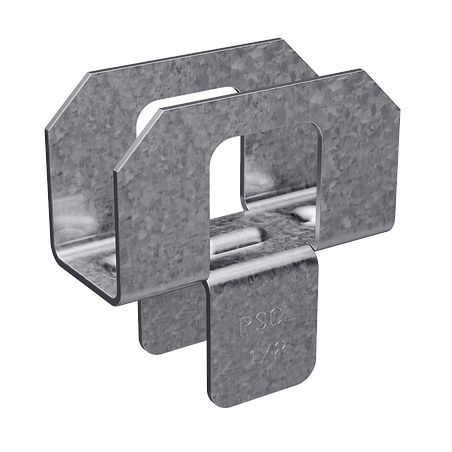
PSCL/PSCA Panel Sheathing Clips

KJ7LNW
  • 1,225
  • 3
  • 16
  • 28

1 Answers1

3

Plywood shear clips are outdated and seldom used anymore. (Most designers can reduce the thickness of the sheathing and use T&G edges.)

Plywood is structurally rated for roof and floor insulation. The code allows roof sheathing to span certain distances based on loading (psf) and span. So for sheathing spanning 30” or 48” the sheathing is acceptable if the edges are supported (using ply clips or T&G.) (See ICC Table 2304.7.3, footnote f.) This states the edges must be supported by T&G or 1-clip for 30” span or 1-clip for 48” span in order to use full structural design.

There is one exception where the clip is added during construction so the edges do not slip past one another and possibly tearing the building paper underlayment.

Also , sometimes the roofing manufacturer requires a certain thickness due to holddown (wind resistance uplift) so the full thickness is required, in which a clip might be cheaper than T&G edges.

Lee Sam
  • 3,836
  • 1
  • 6
  • 14