11

Usually I use a tape measure to do carpentry, but a problem arises when I need to take a precise inside measurement.

Because the tape is longer than the area inside the cabinet (or whatever it is) I can only bend the tape and estimate the distance, but this estimate is only good to about a 1/8" at best. How can I make a more precise measurement of an inside dimension?

Tyler Durden
  • 6,971
  • 13
  • 66
  • 113

7 Answers7

33

Most quality tape measures have the length of the tape measure marked on the body of the tape.

For example, here's the marking on one of the tape measures I own:

tape measure with dimensions called out
Image courtesy of lowes.com. Click to embiggen

  • Put the tab against one inside edge
  • Put the other side of the body of the tape against the other edge.
  • Read the dimension where the tape goes into the body.
  • Add the size of the body to the measured dimension.
  • That is your final measurement.

If your tape measure body does not have this marking, use your other tape measure (doesn't everybody have 3 or 4 tape measures?) to measure the size of this one and use a Sharpie™ or other permanent marker or make some sort of label to write it on the measure so you don't have to figure it out again in the future.

FreeMan
  • 48,261
  • 26
  • 101
  • 206
31

You can make an inside measuring gauge using two sticks. When you get the sticks positioned, clamp them, remove them and measure the distance.

enter image description here

Steve Wellens
  • 7,127
  • 1
  • 28
  • 42
27

I disagree with your primary thesis. It's quite easy* to measure to 1/32" or better accuracy with a standard tape measure, even of the heavy 25-30' variety. As a professional finish and framing carpenter I've done it many thousands of times. It's just a matter of technique.

  • Press the bend into the corner firmly. Even steel tapes are plenty flexible.
  • Tilt the blade to one side. Doing so concentrates the force on the edge, allowing a very sharp bend.
  • Read the measurement at an angle perpendicular to the blade at the center of the bend. This reduces parallax error, that arising from gaps between the blade and the surface when viewed from an angle.
  • When in doubt, cut long, then cut again. Modern miter saws allow for razor-thin adjustments, assuming a quality blade in sharp condition. For a snug fit, intentionally cut just a bit long and flex the piece into place by bowing out the middle.

No need for goofy gadgets or in-your-head addition of complex fractions using the tape body size**. Both introduce error, either in mathematical rounding or in mechanical slop, and they slow you down. This technique works quickly and without a doubt even for hair-fine fitment.
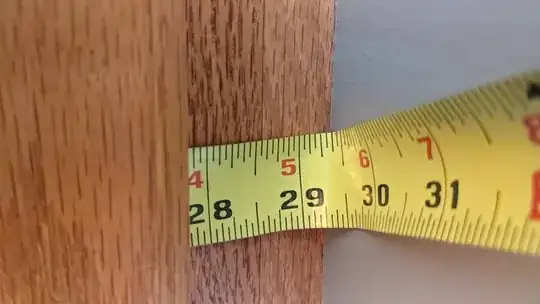
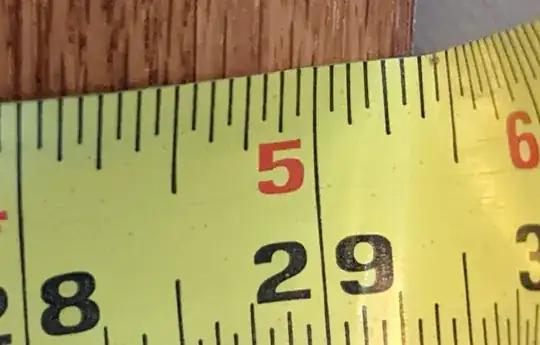
enter image description here

enter image description here

I would read the above measurement as twenty-nine and a shy three eighths, or 11/32 if you prefer.

Fun fact: Most tape measures have a bit of play in their hook attachment. This is to account for the thickness of the hook when used in either a hooked or butted manner.


* Really. It's easy. Once you're aware of this technique, it takes very little practice or effort to use it.

** Assuming you're not lucky enough to have a round-number size. Rightly or wrongly, you'd probably get laughed off a jobsite for backing your tape into a corner to get a measurement anyway. It's half a step from lifting the big end to the top of a wall to get its height.

isherwood
  • 158,133
  • 9
  • 190
  • 463
13

I find this type of measure, called a folding measure or folding rule, to be very helpful:

enter image description here

Note that it has a metal extension that is used when making inside measurements.

jwh20
  • 23,628
  • 2
  • 34
  • 65
12

There are 2 basic ways to achieve this:

  1. Measure from one inside corner to a spot you can comfortably reach with the tape without having to bend it, and best to make it a round number. For example, if the total inside length of the cabinet is 20 1/4", you could measure to 15". Make a mark at this spot. Now measure the other direction, from the opposite corner, to your mark, and add up your measurements. If you don't want to mark directly on the material you're measuring, you can place a piece of masking tape and put your mark on that.
  2. Many tape measure have stamped or written a measurement on the back. This indicates how much you need to add to measurements from the front of the tape measure body to the back of it. So in this case, you would simply place the tape inside the cabinet, with the tip in one corner, and the back of the tape body in the other corner. Now read the measurement where the tape enters the body of the measure, and add the number written on the back of the tape measure to this. There are some good photos of this process on this website.
najel
  • 5,287
  • 1
  • 21
  • 42
5

As others have said, you can definitely achieve this with a standard tape or rule.

However, if you're looking for an technical alternative, consider a small, hand-held laser rangefinder. I have a basic one one from a local hardware outlet that cost less than $100 and achieves millimeter-level accuracy for any distance from a few inches up to about 80 feet. It's a fantastic time saver.

laser rangefinder example

Telescope2334
  • 1,044
  • 6
  • 16
0

I think you all have several doable options for the home DIYer, but have any of you ever considered an inside measure tape measure as an option? I’ve owned mine for almost 40 years, but they probably still make something like it. It’s slim, the tape is metal, but quite flexible, and the best feature is that there’s a clear window on top towards the rear of the case. All you have to do is put the hook end at one edge and run the tape to the other side until the back of the case is flat against it, then read the tape on top. There’s even a little level guide on top as well. The name on the case is Innema B or 6 and it was made in West Germany.