31

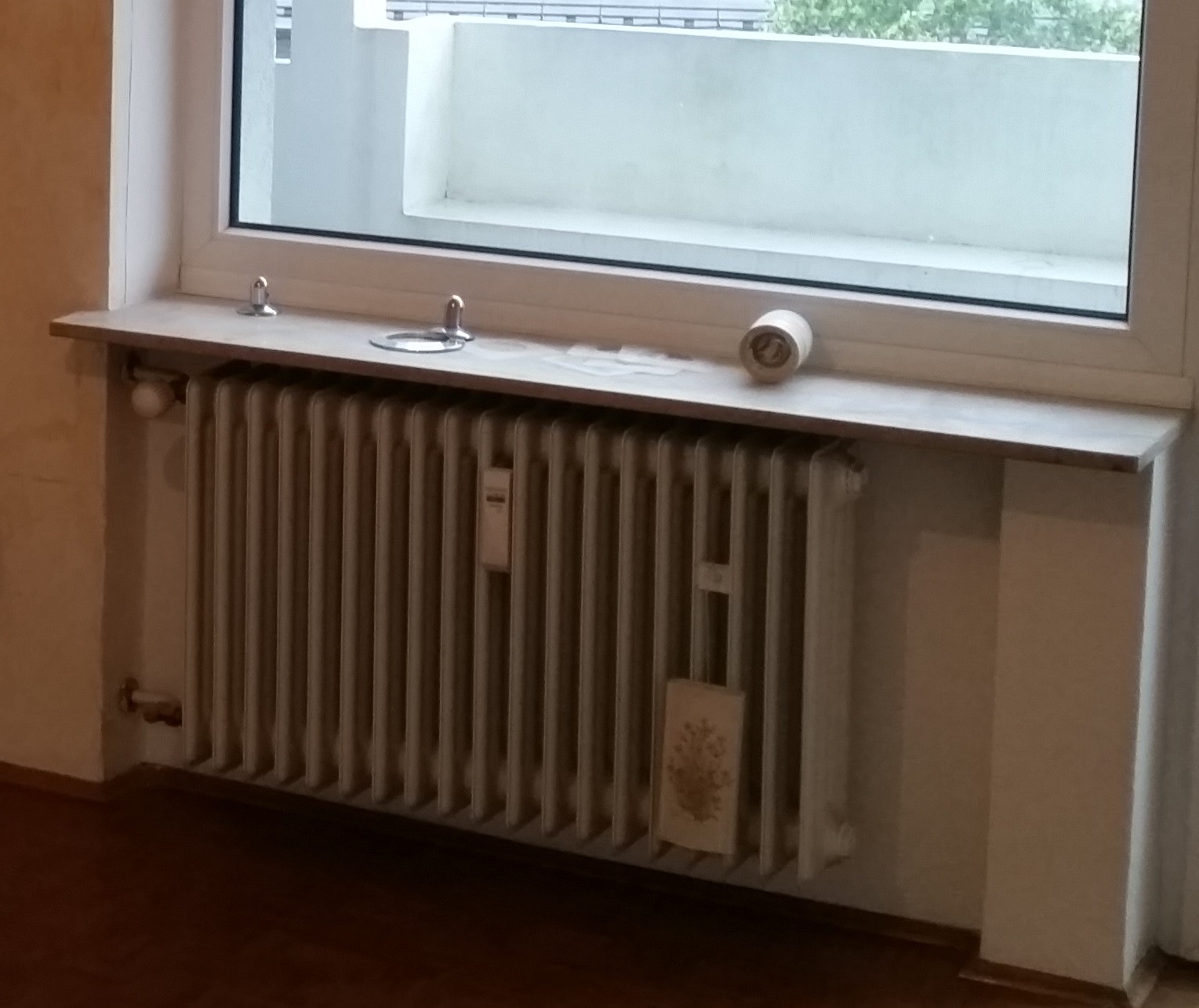
I live in Germany and I always wondered why the radiators in most apartments are installed right beneath a window. The pictures below show an example (this is an older building, but you see similar installations in new buildings as well).

I would expect this to be the least reasonable place to install a radiator, due to the following points:

  • If you open the Window, well.. all the heat immediately flows away by convection
  • If you've heated up for some time, the walls will likely be storing some energy and perhaps the convection could be neglected for some time (if you keep the windows open for too long on a cold day, anyway no heating will help). But then the outer walls are probably the coldest in the building, which means that more energy is needed to heat them up in the first place -- also after closing the window.
  • Most of the central pipe systems are in the building center (I suspect this is the also the reason why many buildings have "closed" bathrooms, i.e. without windows). For radiators beneath windows, most pipes will need to be extended, resulting in more complex systems which are more expensive and will probably require additional maintenance.

Presuming my assumptions are correct, what is the reasons for installing radiators beneath a window? One argument I could think of is aesthetics. A radiator is probably not considered the most beautiful thing on earth by most people, so keeping it under the window sill may be simply a trade-off.
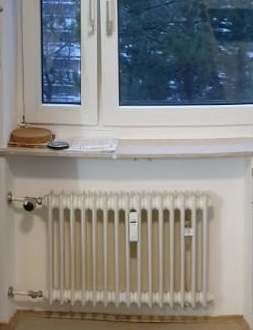
enter image description here enter image description here

isherwood
  • 158,133
  • 9
  • 190
  • 463
André
  • 311
  • 3
  • 3

11 Answers11

50

In addition to the three good reasons from Ratchet Freak and Isherwood, I add that placing the radiator near the window is most efficient.

It heats the coldest air in the room and allows the air further from the window to settle to a similar temperature over time. If the radiator was away from the window, the air near the radiator would have to be heated to a higher temperature in order to create a gradient that heats the cold air near the window to a comfortable level. Occupants would generally raise the thermostat enough for that to occur. Occupants will not generally allow the air around the window to be uncomfortably cold in the name of reducing energy loss through the window.

jay613
  • 49,543
  • 6
  • 70
  • 201
38

Because other wall space tends to get filled with closets, art and random stuff. Below a window tends to remain free real estate.

Windows tend to stay closed during heating season so a window left isn't really a concern.

In general it is more uncomfortable to have a temperature gradient across a room than it is to have a cold room. Therefore it is better to apply heat where the heat is being lost the most which is the outside walls and windows and then let the rest keep stable.

ratchet freak
  • 14,551
  • 1
  • 28
  • 42
19

In addition to what's been said, in extreme climates like Germany* and Minnesota, the window would completely frost over in January. Even modern low-e windows can't overcome -40°F, especially when indoor humidity is a bit elevated. Heat applied via radiator in that case or forced air in my case can help keep those lovely, desolate outdoor scenes visible.

* Apparently Germany isn't quite as cold as WWII documentaries led me to believe, but that doesn't change a thing about my answer. Frost can accumulate at any temperature substantially below freezing.

isherwood
  • 158,133
  • 9
  • 190
  • 463
16

Windows are almost always going to be less efficient than wall assemblies (even triple pane windows will be less efficient than wall assemblies built with energy efficiency in mind — triple glazed has an R value as high 11 for what I can find available while the recommended R values for exterior wall assemblies in cold climates are almost double that number).

By putting the source of heat next to the coldest thing in the room, you increase the evenness of heating and perceived comfort of the room. Since heating a room to the levels that we humans do is primarily about creating a comfortable space, this is an efficient way to create a comfortable space.

Have you considered a Heat Recovery Ventilator or Energy Recovery Ventilator as a more energy-efficient alternative to regularly ventilate a well-sealed home as opposed to opening the windows? Even Nordic countries with colder climates use mechanical ventilation with heat recovery for its energy efficiency benefits and consistent ventilation.

statueuphemism
  • 5,369
  • 13
  • 51
  • 65
13

There are a couple of (german-language) websites easily found that explain why this is the best and most efficient place to put your radiator, e.g.

https://heizoel.totalenergies.de/rund-um-heizoel/aktuelles-tipps/heizoel-sparen/wo-ist-der-beste-platz-fuer-die-heizung-040919/

or

https://www.vaillant.de/21-grad/wissen-und-wert/nachgefragt-warum-stehen-heizkoerper-meistens-unter-dem-fenster/

the short summary is:

First, historically, windows were not as well isolated or tightly closed as today, and near the window most heating was needed or you could've not used that corner of the room during the winter

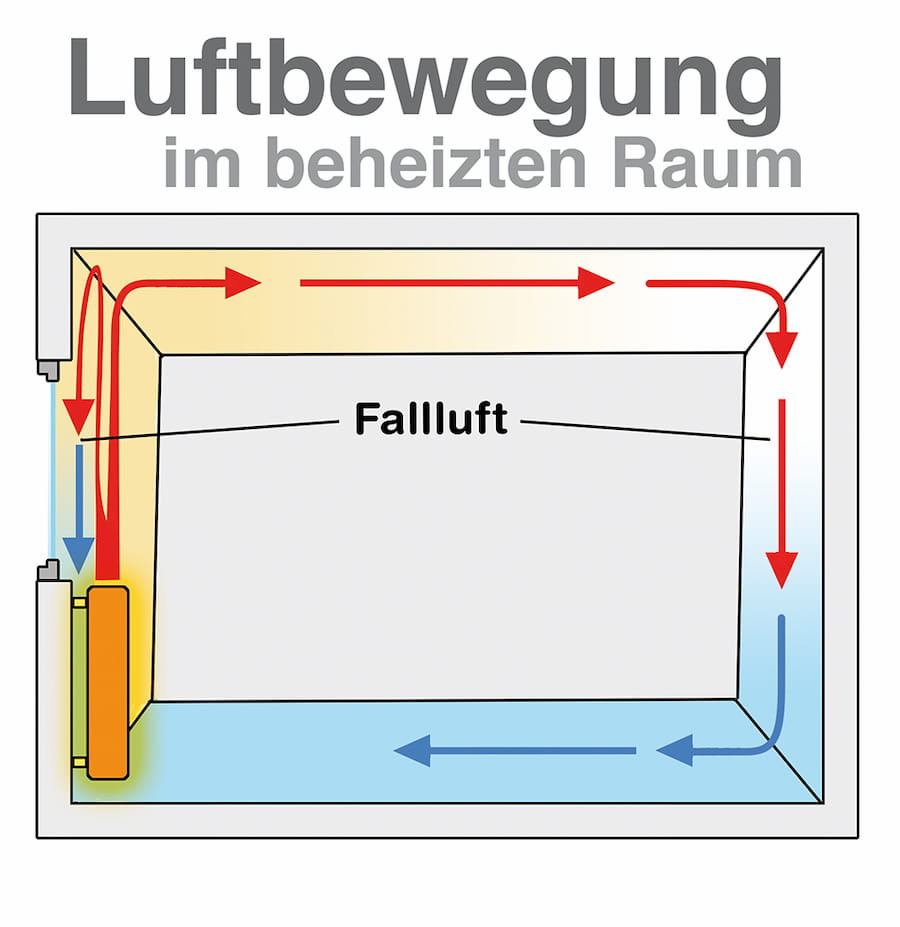
Second, practically, if you put the radiator near the window, you get an airflow pattern like this: enter image description here Now look at the "Fallluft" (falling air) arrows. Imagine that you placed the radiator elsewhere, then the coldest air in the room (from the window, either because it's open or because it loses most heat there) would drop to the ground and flow across the room and your feet would be cold the whole time. Very uncomfortable! While the temperature difference isn't as bad as it was a hundred years ago, you still don't want the cold outside air flowing across the floor. Better have it swept up with the radiator heat and get heated up a bit before it falls down again.

Tom
  • 426
  • 2
  • 6
  • 16
9

This pattern is decades (or maybe a honest century) old and not limited to Germany.

When the central heating started to emerge, energy prices were much, much less of a concern and the modern energy-efficient technologies were yet to develop.

The central heating was neither a way to reduce costs (it did cost more) nor it was aimed to increase the efficiency (it was pretty much the other way round).

Its only goal was to improve the comfort. To a great extent, in fact.

What the heating looked like when you did not have central heating:

  • A single heating appliance in the room, be it wood-powered, coal-powered, oil-powered or electric.
  • The appliance in question had to be away from anything combustible, i.e. away from almost anything.
  • It was uncomfortably hot near the appliance and cold and windy away from it, both because of the convection created by the cold walls and especially windows and because of less than gas-tight doors and windows.
  • Even with rather good doors and windows, the fire still drafted its air from somewhere.

And then, we have a neatly looking modern heat exchangers (also called radiators, even if they didn't work by radiation much). We can put them wherever we want, because the tubing is relatively cheap.

We have new, powerful weapon against the uncomfortable and unhealthy cold convection currents in the room.

Where do these cold currents are worst? That's right, under the windows. Put the radiator there!

Now, you have an order of magnitude less convection in the room, an order of magnitude less temperature gradient and the whole room is usable, including those spaces near the windows.

It was decades later when the energy prices in Europe got to the levels where it is cheaper to pad the walls and install high-quality windows made of special glass allows less heat to escape.

Even in the modern buildings, the windows are still colder than the walls. You can pad the wall with everything you want, but the window has to be transparent, so you are limited to 2 or maybe 3 layers of glass and only the air between them to stop the heat from going outside.

This is why nothing drives the radiators out of their traditional place under the windows (except maybe under the floor where they really belong in 2022).

fraxinus
  • 3,817
  • 8
  • 15
5

If you open the Window, well.. all the heat immediately flows away by convection.

You are expected to air the room once or twice a day by opening the window wide for up to 20 minutes. At which time you also turn off the radiator, obviously. You should never have the radiator on and the window open, for obvious reasons -- this is regardless of radiator placement.

If you've heated up for some time, the walls will likely be storing some energy and perhaps the convection could be neglected for some time (if you keep the windows open for too long on a cold day, anyway no heating will help). But then the outer walls are probably the coldest in the building, which means that more energy is needed to heat them up in the first place -- also after closing the window.

Having the window the coldest point in the room is desirable. Otherwise moisture will condense on the walls instead of the window pane, leading to mold. This is actually a common problem with older houses getting new windows installed without also improving insulation on the walls. Modern windows are crazy well-insulated.

You want to heat the coldest point to avoid / remove condensation, and have convection transport the moisture away from the coldest point.

The less of a temperature gradient you have, the less heat you need to apply, so don't read this to mean that the window is "a very, very cold place". Ideally it's just a degree colder than the rest, which is easily achieved with modern insulated structures.

Most of the central pipe systems are in the building center (I suspect this is the also the reason why many buildings have "closed" bathrooms, i.e. without windows). For radiators beneath windows, most pipes will need to be extended, resulting in more complex systems which are more expensive and will probably require additional maintenance.

Having all the heading clustered in the center of the building, you will experience a heat gradient from the center to the walls. While perhaps more efficient, this is much less desirable from a comfort standpoint (unequal temperature). You'd also be pumping moisture to the windows to condense and be left there to mold.

All this in addition to what ratchet wrote: The place below the window is otherwise mostly unusable. You need to reach the window so cupboards would be awkward, you don't want to be sitting at the coldest and most humid place furthest away from a radiator placed in the middle of the building.

DevSolar
  • 151
  • 4
4

It leads to a more uniform temperature across the room, which helps saving energy. Having lived in an old, poorly insulated house with a gas oven at the central wall, I can confirm that you get an intense temperature gradient across the room otherwise. Not only between inner and outer walls, but also vertically. Sitting close to the window, I often got cold, but once I stood up I realized the air up there is rather warm. Thus, most of my energy was used heating the roof, while I still had cold feet. In really cold days, humidity would condense on windows and outer walls, eventually leading to a mold problem. As a consequence, I decided to place additional electric heaters at the outer walls.

a_leo
  • 41
  • 1
4

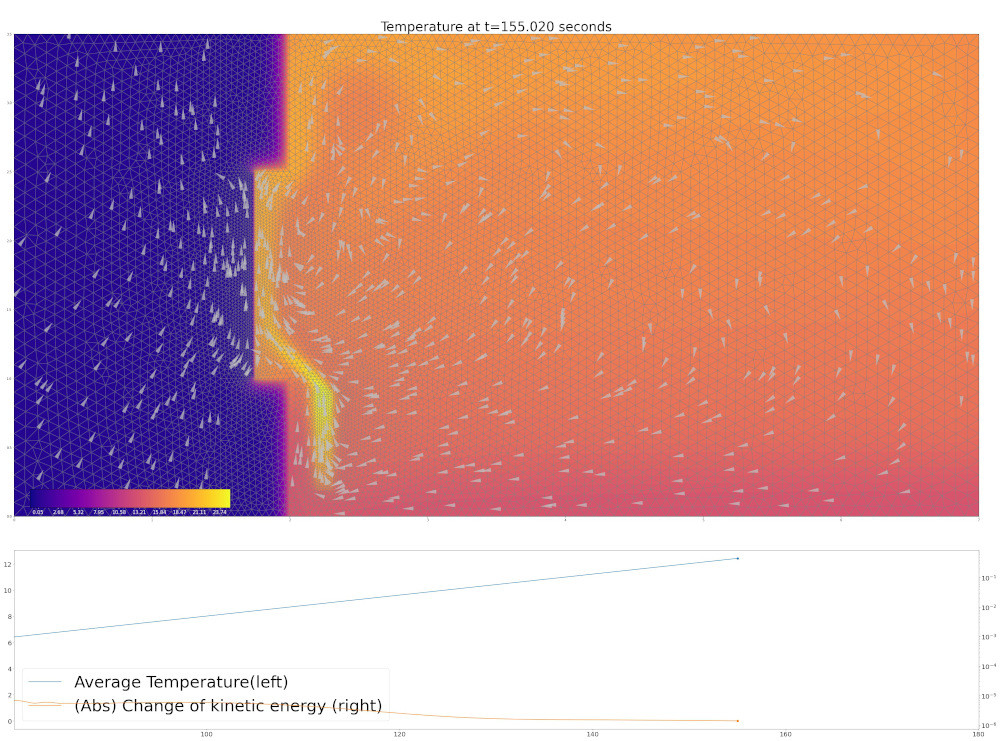
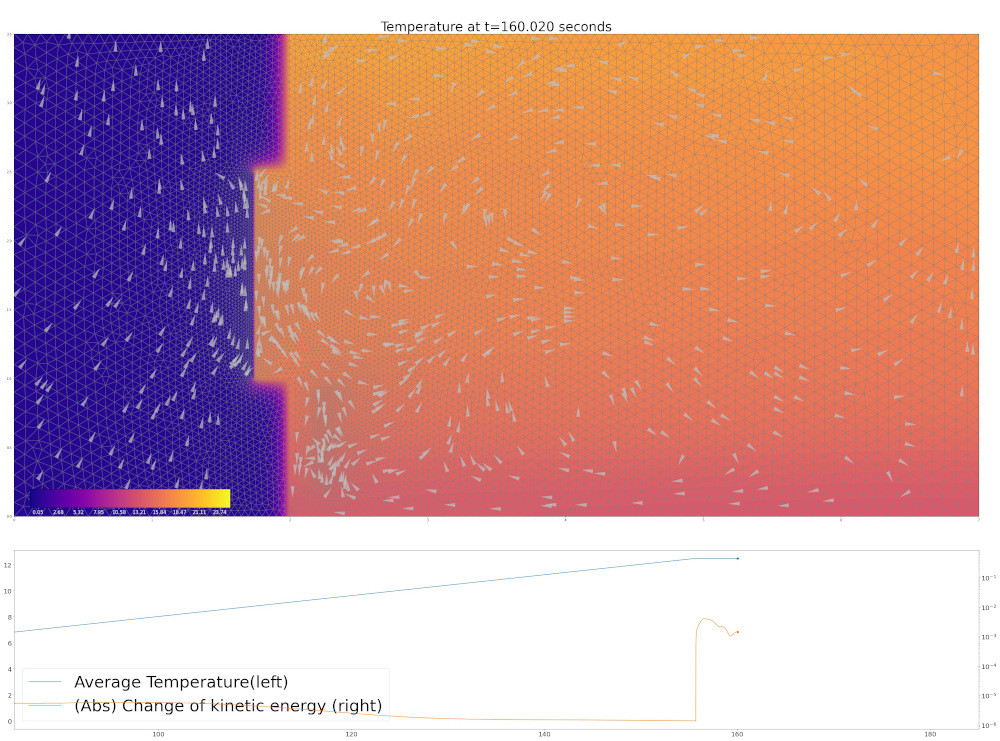
I studied the flow fields induced by convective heating in this exact situation for a university project. In fact it was a situation just like Tom's picture. Indeed I think that heating the air near the window causes the greatest heat transfer, i.e. is least efficient, but avoids the very uncomfortable feelings of a cold draught at your feet by reversing the flow field. I confirmed it by simulating the Navier-Stokes equations with Fourier-type heat transfer laws and a linear (Boussinesq) approximation for buoyancy causing convection. A somewhat long video with different scenarios is available here on YouTube. You really do see (in 2D) how the presence of the heater in this configuration fights the natural convection caused by the window which you see when the heating power is turned off. A heater at the opposite wall would only reinforce the cold-feet airflow field.

If you don't want to watch it then the following pictures give a good idea. The first image shows with the heater on at high power. The second image shows what happens when it is turned off. The small triangles show the direction of the air flow. The left side of the image is the outside (flow direction is opposite because it is being heated.

edit: I would also add that the small ledge over many heaters in Germany will probably reinforce the small circulation loop at the left in Tom's picture, which prevents cold convection currents from directly pouring into the room.

High-Power Heating No Heating

1

Being a plumber all my life who has also studied building and construction, I believe that by reading some of the answers, I find a lot of them have correct elements to them, such as aesthetics, not taking up available wall space, warming the air that is the coldest, etc. But l believe there are two elements that haven’t been addressed.

  1. Although there has been a lot of talk about mildew or mould. Dew or mildew is formed when warm air loses its ability to hold moisture when it cools. Therefore, it deposits moisture when it comes in contact with the cold window. For example, bedroom windows on the south side of a house. (Southern Hemisphere) Pro: no hot sun. Con: lack of light cooler windows and often lack of ventilation. Bathroom windows during and after a shower, steam carrying water cools when it comes into contact with the cold window. When this happens it is called the “dew point”. Without going into any further detail, it is my belief that they are actually fitted off under the window to keep the glass at the same ambient temperature as the surrounding room, therefore preventing the “dew point” occurring inside the room. The dew point would still happen, but it would happen on the outer side of the window preventing water running down the inside of window eventually lifting paint and rotting the sill. The higher the temperature differential between inside and outside, the greater the amount of water deposited.

  2. The other aspect I thought of, which may not be applicable, is it may have something to do with the type of heater. If they are oil-filled, like a lot of the old systems were, then I would imagine there would have to be some form of ventilation for the rising fumes if they had a small undetectable breach. Mind you, this is a guess, and probably not a very good one.

I think #1 is more plausible. Although it has come from my knowledge of material science it is still a guess. Hopefully, a good educated guess.

FreeMan
  • 48,261
  • 26
  • 101
  • 206
0

It might be because there is space near the window. You won't put any furniture in front of the window nor the radiator.

Houští
  • 1
  • 1