27

When turning on high amp appliances like an air compressor or dust fan, the attachment of the ground from the meter box to the water main (pic) sparks occasionally for a second or so. A separate ground from the meter box was also installed a few years ago by an electrician that runs directly to a ground rod outside.

Is this normal discharge, or does it indicate an underlying issue? If it's normal, should I insulate around the ground to avoid a shock?
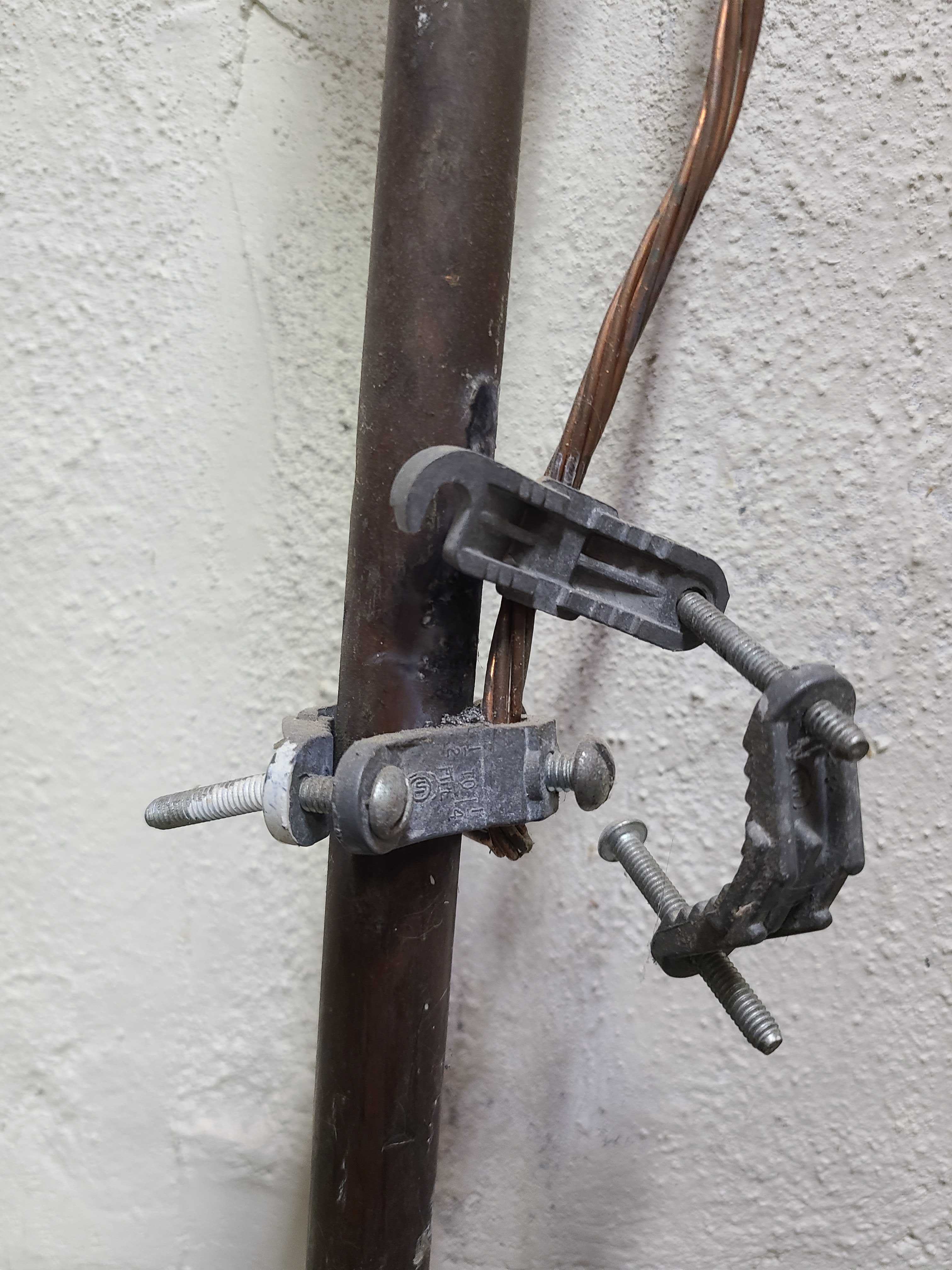
ground connection

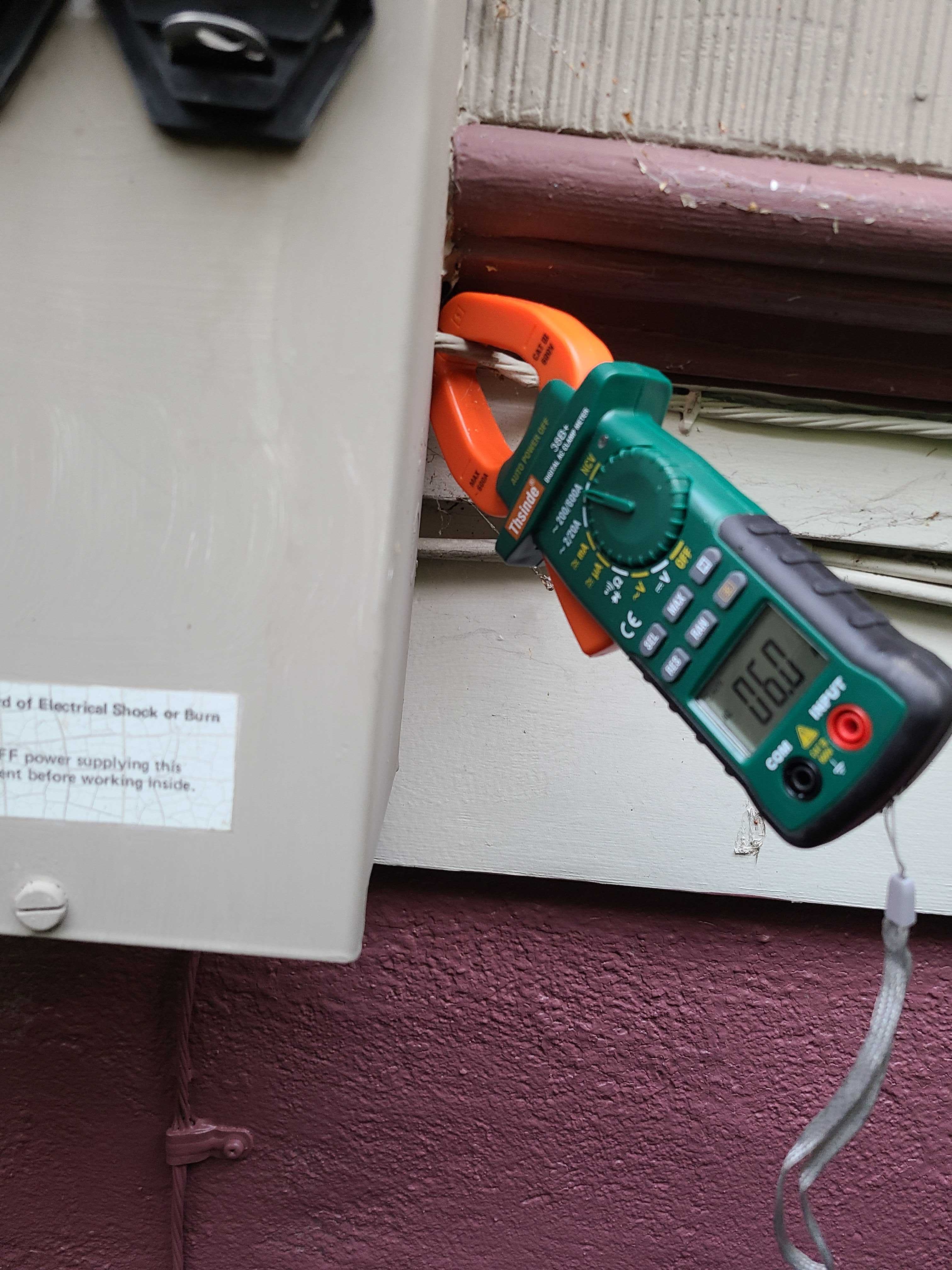
Edit: Ground shows current with certain breakers on. Note: There are two grounds coming from the main box. Only one has current. meter on ground
Update: We're not electrocuted (yet).

POCO came onsite and discovered poorly connected neutral at the city pole byt runnign a load test at the main drop. He reattached it, and the baseline amperage on the ground dropped from 6A to ~.6A immediately. 10x reduction, but still present. Current is now detectable on both the water main and ground rods instead of just the water main.

If I fire up all the power tools, vacuums and heaters at my disposal, I can still measure up to 3A on the ground. This isn't associates with load on any given circuit. It returns to under 1A if I turn off the main and eventually baselines at ~.1 whether or not the breakers are on.

POCO says this is not an issue, but the consensus here and during a 5 min phone call with an electrician says otherwise. Electricians are booked several weeks out unless we pay emergency rates at $770 + 300/hr. Electrician also said all he'd do at this point is repro my circuit by circuit test.

On an editorial note: Thanks to everyone for the suggestions and concern for our safety. DIY has its limits.

Laramie
  • 435
  • 5
  • 7

2 Answers2

51

You lost neutral! This is an outage and an emergency

Your neutral wire no longer connects back to the utility. Out of desperation, neutral is pathing through your neutral-ground equipotential bond, the ground rod and the dirt... to somebody else's ground rod and their N-G bond and neutral. Dirt is a terrible conductor, so this results in crazy voltages.

USUALLY this is the power company's service drop to your house. That is two insulated aluminum wires hung off a bare aluminum carrier wire, which is anchored at both ends. This is both neutral and carrier, and if whips in the wind. Aluminum has no fatigue limit. So the wire snaps!

Often you can walk outside and look at the power company service drop wires and see if the carrier wire appears to be poorly attached or broken. Check both ends.

This wire is the power company's responsibility, and they will repair it fast for free, since it is a legitimate power outage.

What is happening is that without a neutral, nothing keeps 120V at 120V anymore. Now your hot wires are still 240V apart, but your two banks of 120V are drifting all over the place (yet adding up to 240V). This can be hard to detect, but it can also fry your appliances.

If this is at an outbuilding with a subpanel, check your house; if wired old-school (3-wire), then the problem is the subpanel feeder.

You can test this by checking voltages all over the house. A lost neutral is indicated by two groups of near voltages, one group under 120V and the other over by same amount but totaling to 240V-ish (e.g. 105 and 137). If you power up a high-power 120V appliance, this voltage difference changes (e.g. 81 and 160).

Footnote: It is possible that the current on your grounding electrode isn't caused by your own lost neutral, but rather, your neighbor's. However, I doubt that because you switching on large 120V loads has direct effect on the symptom. That wouldn't be so if your neutral was OK.

Harper - Reinstate Monica
  • 313,471
  • 28
  • 298
  • 772
30

If you see sparks at a ground rod, you have serious problems.

Could very well be a lose or weak neutral and a lot of current is returning to the transformer via the ground rod(s). The more I think about it, you almost certainly have a very weak neutral or completely open neutral both of which are dangerous.

Think about how grounding conductors are connected to devices, both plug in and hard wired. If you lose the neutral, the frames of appliances are now energized (i.e. not at ground potential). This is Very dangerous, esp. in bathrooms and kitchens.

A grounding electrode system is not intended to carry any current other than when a defective appliance or device is connected. If you have (or could buy) a digital multi meter with an amp clamp, put it around the wire going to the ground rod. If there is any current more than a small amount of current there (more than 0.1 amp or so), you most likely have an open or weak main neutral.

James Risner
  • 117
  • 2
  • 2
  • 7
George Anderson
  • 23,304
  • 5
  • 41
  • 83