7

I currently have a tankless, natural gas hot water heater on the side of my house. I want to preheat the incoming water using a solar water heater. Is there any concern with having the input supply water being "too hot"? The input supply coming off of the solar heater would be variable in the range of 90 - 130 deg F.

I looked in the Rinnai specifications for my gas hot water heater for such a value, but there doesn't seem to be one. I assume this means it's OK to do.

Jon
  • 181
  • 1
  • 4

4 Answers4

12

A Rinnai tankless gas water heater does indeed have a temperature sensor and regulates the outgoing hot water temp. based on incoming water temp. So the burner in the Rinnai has the ability (and the brains) to ramp up to accommodate different supply water temperatures and will maintain constant (set-able) out flowing hot water temp. Unless the incoming water supply is hotter than the outgoing hot water setting. In this case a mixing valve is required otherwise there is a chance for scalding at showers, sinks, etc.

We use Rinnai tankless heaters in this same scenario (especially for off grid homes). We pre-heat the water with a solar water heater setup (with the solar heater's heating element power turned off). The outgoing hot water from the solar heater feeds the supply to the Rinnai tankless. This setup can serve both domestic water supply and supply hot water for radiant floor heating.

Machavity
  • 26,498
  • 8
  • 44
  • 100
Kyle
  • 4,893
  • 1
  • 7
  • 15
5

The tankless doesn't have a valve to block flow. So the pre-hot water will roll right through it. It'll add heat if it's under-temperature.

This means the water could be scalding!

Tankless heaters are not heat pumps, it's not going to go into reverse cycle and chill the overly hot input water.

This is where complacency gets you. One might think "Since tankless never heat water above 120F, I don't need 'Delta style' thermostatic faucets that control spigot temperature". Surprise. Your solar hot water can and quite probably is scalding temperature. I think 130F is optimistic (i.e. some days it will be higher).

So you will need to fit thermostatic mixing valves (i.e. your basic Delta joystick style faucet) at all your water outlets.

Harper - Reinstate Monica
  • 313,471
  • 28
  • 298
  • 772
3

Since no one else has addressed the question at hand, I will share my thoughts about the equipment aspect:

Is there any concern with having the input supply water being "too hot"? The input supply coming off of the solar heater would be variable in the range of 90 - 130 deg F.

In general, water supply plumbing and equipment is temperature agnostic. It would be silly if a manufacturer used subpar components on the inlet side compared to the outlet side. Think about the instant-hots that people install under their sink; they heat the cold line water until hot water from the tank can make its way to the fixture.

If your plumbing is PEX then just make sure to keep the water temp under 180°F.

Realistically, you should contact the manufacturer and confirm this concern with their specific piece of equipment.

In one PDF I was able to find the flow-rate curve based on inlet water temp but it only addresses 70°F or lower since that would be the major factor in figuring out if you will be able to get enough GPM to suit your needs.
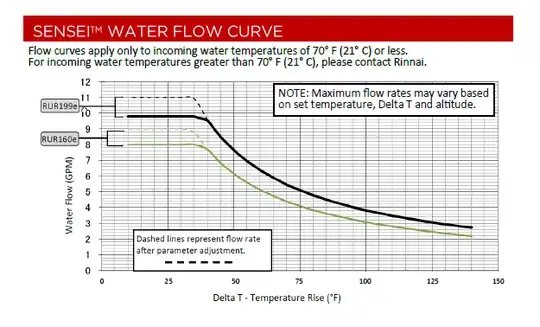
enter image description here

MonkeyZeus
  • 17,328
  • 2
  • 27
  • 64
2

Depending on your solar heat efficiency and temperature setting on the tankless heater, it might not turn on at all.

There can be a scalding problem with solar heaters. If there is no water flow for a while the temperature will rise quite a bit. So the first few minutes the temperature could be scalding, but it drops fast.

Just make sure you have enough flow and pressure coming from the solar heater.

Michael Mior
  • 539
  • 1
  • 4
  • 15
DIY75
  • 20,686
  • 3
  • 23
  • 47