14

The other day I saw a plumber tighten a bolt with what looked like an adjustable wrench. But it seemed like he didn't need to take it off the bolt every time to turn it further. Rather, it looked like the wrench's jaws were non parallel, or perhaps they had some give to them.

It didn't look like it was a ratchet; it looked like the jaws were sliding around the bolt when going back the "wrong" way. And it seemed like the adjusting mechanism was like a crescent wrench's. It was only around 6 inches (15cm) long, give or take, if that helps.

I tried searching for it on the web but couldn't find it.

What is this tool's name?

Criggie
  • 11,950
  • 2
  • 26
  • 79
ispiro
  • 771
  • 1
  • 6
  • 20

7 Answers7

20

Most likely these are self-adjusting wrenches. There are a lot of variations of these, but here's one example:

https://commons.wikimedia.org/wiki/File:Self-adjusting_wrench.jpg (https://commons.wikimedia.org/wiki/File:Self-adjusting_wrench.jpg)

A search on big-box-site-of-your-choice will come up with many different varieties, most of which work roughly the same way.

Joe
  • 934
  • 2
  • 9
  • 20
16

What you saw was a pipe wrench.
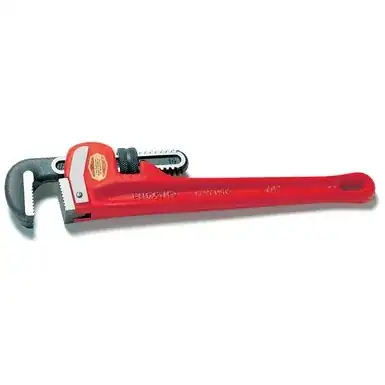
enter image description here

You can see the obvious black upper jaw there, with the adjusting nut on the upper jaw.

Not so obvious: the black upper jaw has about 5 degrees of flex/play, rotating about the logo sticker more or less. This means that leaning into the tool causes the jaws to come together slightly, and going the other way (ratcheting the tool) causes the jaws to come apart slightly.

This is designed for pipe (and pipe fittings made to work with this wrench). They are generally round and do not have flats. The wrench relies on the object being round, and gouges into it. The material must tolerate that.

This type of wrench is not the right thing for other fasteners that provide a hex or other means to lock onto the fastener. A pipe wrench would gore up the hex or other head, possibly crack it, and in any case reflect very poor workmanship.

The concept doesn't translate very well to hex fasteners. If the jaw opens enough to slide past the hex on the backstroke, it will slide past the hex on the forward stroke too! Also for the tool to work, the jaw needs to "dig in" to the material to stop it from sliding.

JACK links an open-end wrench with a notch in one of the faces, so you only need to slide it off about 2mm to allow the hex to slip by. The problem is, when engaged, it only has about 2mm of purchase on the most critical corner of the hex. That works under ideal conditions and low torques, so it looks good in the advert. But if the hex is even a little beat up it won't seat... and if too much torque is used, the 2mm contact point will round over, and then you'll really be up the creek... you won't be able to use other tools either.

Harper - Reinstate Monica
  • 313,471
  • 28
  • 298
  • 772
5

serrated adjustable wrench.

eg: https://nz.rs-online.com/web/p/wrenches/1849011 (google has decided I'm an EE and is giving me EE relevant results) enter image description here

Bhaco's patent on these will have expired recetly beause I first saw this 20 years ago. Now they are available from several different brands.

Jasen
  • 26,920
  • 1
  • 24
  • 46
5

could be these Renovator wrenches I have a set and they work as you described

wrench

mgh42
  • 151
  • 1
4

They are sometimes called open end speed wrenches. The splined open end gives ratchet-like speed for fast removal and installation. I am not affiliated with this company in any way.

enter image description here

JACK
  • 89,902
  • 21
  • 80
  • 214
3

Sounds like a “c” wrench or spanner or plumbing spanner that has the top or finger hinged.

They don’t sound good but since most plumbing fittings do not need to be tightened to high torque settings then they work well.

They also work well in constricted spaces and even are designed so that they can get up to the nuts on the taps used in sinks which can be difficult to get to.

As I have many quality spanners I have been known to use them on plumbing fittings and they work fine, but given the restricted access it is not often they are any use. So the plumbing spanner gets used.

This is one version, there are others: enter link description here

This is similar to mine:

enter link description here

Solar Mike
  • 30,038
  • 2
  • 34
  • 69
3

Could be Robo Grip Pliers although they don't adjust like a crescent wrench. They're spring loaded so when you don't squeeze them they open up so you can move them easily.enter image description here

Platinum Goose
  • 4,368
  • 5
  • 25
  • 34