3

I’m staying a friend’s place for a few days, and being a bit OCD I’ve been fixing the things that I can.

But they have kitchen cabinet doors that lift up, and one has ripped out of the particle board frame.

My first thought was to put some epoxy or gel superglue in the hole before putting in a new screw, and letting that harden—- but I’m thinking that it might not be enough, so maybe I need to put down some thin superglue first to let it soak in and strengthen the area.

And then I remembered watching an episode of This Old House, where Tom Silva mentioned treating rotten wood by scraping way the bad wood and using a ‘wood hardener’. Would something like that work with particle board, and would it be significantly better penetrating than just using super glue?

Or is there something else entirely that I should consider for this repair?

update: it’s two stripped holes, not a whole chunk torn out. (But I’m afraid if I only do a local reinforcement, it might be a larger tear out the next time). I’m limited from using significantly larger screws due to the hardware (needs to fit through the hole in the hinge). And I’m not traveling with my toolbox, and they don’t have a drill, otherwise moving the hinge or going all the way through with a bolt would be great solutions. I may have to ask at the hardware store if there are any tool rental places.

It’s also a rented apartment, but the occupants have said their landlord hasn’t been dealing with repairs at all since they moved in. Including a ridge in the floating floor that they said came from some under floor water leak.

Joe
  • 7,336
  • 2
  • 33
  • 48

3 Answers3

3

Generally speaking, once particle board has gone, it's gone. Your best bet is, most likely, replacement. Especially if there are signs of water damage.

It's not clear whether the damage is to the door or to the cabinet case. Replacing the door would be reasonably straight forward. Replacing the whole cabinet would be much more work and expense.

If it's actually the cabinet carcass that's given up, filling the hole with some epoxy might be worth a shot since that would be cheaper than a full replacement and you're headed toward replacement anyway. I'd assume that the hole is on a vertical side, so you'd need to use a very thick epoxy mixture so that it doesn't run, and you may need to make a dam out of some tape to hold the epoxy in while it cures.

Once the epoxy has cured, drill your new hole(s) for the screw(s). If there is another cabinet on the opposite side, consider using longer screws of the same diameter and drilling into the other cabinet to give them a grip into some actual "wood" in addition to the epoxy filler.

If the damage is to the door, simply lay the door flat and try the epoxy filler.

If this does fail, they were going to have to replace it anyway, so they're only out some time and effort.

Oh, BTW, it's not your place, make sure you have permission before you start! :)


Based on this additional info from a comment on the original question:

The screws in question went up into the top of the frame to take the weight of the cabinet door (which is real wood or maybe plywood with the edges covered).

If the top of the cabinet is accessible, put a thinish (about 1/2" plywood, or short piece of 1x3 or similar) on top of the cabinet, above where the hinge mounts, then using longer screws, mount the screw up through the original hole and into the new wood above.

This might actually be an ideal solution as nothing permanent is required. Since the wood is on top, gravity will hold it in place and tightening the screws down will clamp the extra wood to the top of the cabinet. If the landlord is annoyed with the fix when the tenants move out, they can simply remove the longer screws and scrap of wood and leave the cabinet door, hinge and short screws in the cabinet or on the counter.

It would, of course, be easier to install the screws if pilot holes could be drilled, especially if no powered driver is available, as drilling a hole with a screw while turning it by hand isn't the easiest task in the world.

FreeMan
  • 48,261
  • 26
  • 101
  • 206
3

Depending on the size of the screws and the pullout strength needed, drilling a 5/16" hole in the frame and gluing in a 5/16" dowel rod works for maximum strength. You could also use epoxy for wood and fill the hole and surrounding area. Wood fillers are good too but stay away from the water mixing ones because you don't want the moisture soaking into the particle board. As @crip659 mentioned, toothpicks and wood glue are quick and easy and work.

JACK
  • 89,902
  • 21
  • 80
  • 214
2

Since you have no DRILL, it is all going to be in the screws type.

There are self drilling screws available, that you can use.

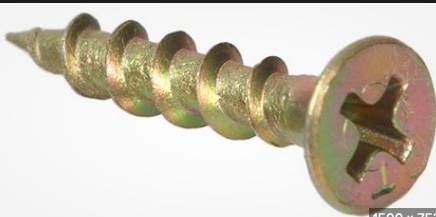
For soft materials also pay attention to the screw tread, look for particle board type.

Example of particle board screw (look at the tread)

particle board screw

Do not use fine tread. use the roughest you can find.

Compare to the drywall screws tread as example.

For filling the striped screw hole, I would use the tong and grove glue, which is more liquid than regular carpenter glue.

Particle boards are very absorbent, so use something that will soak in.

DIY75
  • 20,686
  • 3
  • 23
  • 47