10

I was hoping to replace an old yellow faceplate for a coaxial connection with a nicer white one, but when I took off the faceplate I was greeted with this sight:
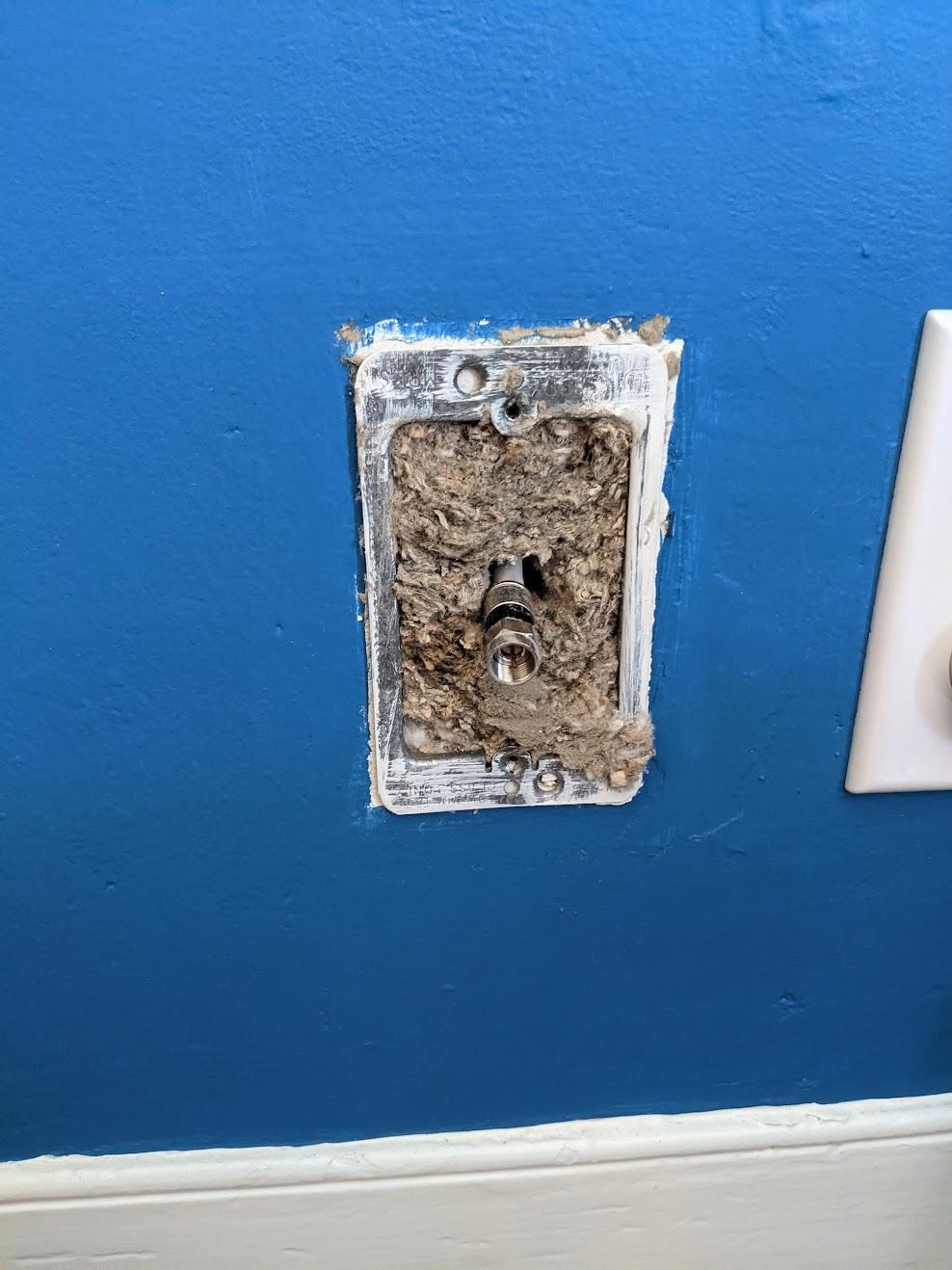
what appears to be a junction box with a single coax cable inside, and bunch of cellulose or dust inside of it as well

I can only imagine that the cable company installed this coax connection using some sort of non-junction box "ring" floating in the wall, and then later cellulose was blown in from the attic and buried the cable.

I would just forget I saw anything and put the new faceplate on, but it doesn't quite line up with the outlet next to it, so I wanted to re-secure this "junction box" so things will line up better. However I'm not sure what my best course of action is here, especially as I may want to pull cat5 to this box in the future as well.

So:

  1. What is this "junction box ring" that seems to be loose, yet doesn't just pull completely off easily
  2. What's inside of here? Is it safe to just vacuum out? Is more going to fill its place and suddenly my wall doesn't have insulation?
  3. Should I secure this ring with drywall screws so it'll stay plumb? There seems to be screw holes offset from the faceplate screwholes.
  4. Should I pull all this out and try to retrofit a proper junction box here if I plan to pull cat5 in as well?

I realize this might be straightforward, but I couldn't really find this situation described online anywhere.

brubsby
  • 327
  • 4
  • 10

4 Answers4

22

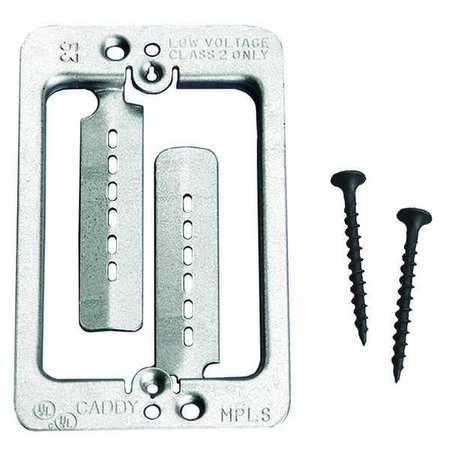
If you feel behind where the "extra screwholes" are, there should be a metal strap with holes in it (that's connected to the metal ring, and will be folded into place behind the wall to hold it.) That is intended to be used more fully/securely by running a drywall screw through the front hole and wall, and getting its point to find one of the holes in the bent-back strap to secure it firmly.

Metal low voltage ring image from Zoro.com - no endorsement implied

You do have to beware of the sharp screw point damaging you (reaching back in there) or damaging cables you are pulling. That, and saving 15 seconds, are two reasons it might not have been done in the first place (the screws come with it, so not having screws wasn't the reason.)

You can reach in and unbend them if you want to remove the ring completely.

Ecnerwal
  • 235,314
  • 11
  • 293
  • 637
21

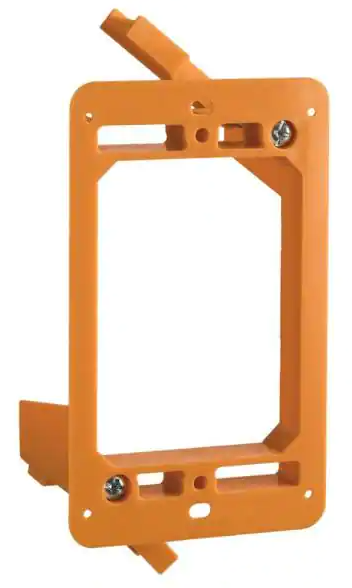
This is likely a low voltage mounting bracket kind of like this one:

orange nonmetallic low voltage bracket

There are fewer codes to meet than actual mains electrical boxes, especially with regard to plugging in and unplugging things hundreds of times over the life of an outlet, so they're far less rugged than the full boxes, which are mounted to studs and enclosed. These low-voltage brackets mount to just a hole in drywall, and are really only there to dress up the opening (you're lucky the cable guy didn't just drill a hole in the wall and shove the cable through it, that's typical in my area).

I don't know if that insulation runs through your whole wall, but if this is an exterior wall it would be best to assume it does and not try to remove it. You can shove it out of the way if necessary. If this low-voltage bracket is loose or positioned wrong, you can replace it. Some have the "wing tabs" like in my image to secure against the back of the drywall and some just have a folding metal tab that doesn't hold as well. You'll need a little bit of clear space to install either, if you decide to move it.

FYI pulling network cables through an insulated wall is not easy, if that is indeed what you have here.

Fredric Shope
  • 4,955
  • 4
  • 22
  • 35
11

Actual boxes are not required for low voltage wiring and both cable service coax and Cat-5/6/7 qualify as low voltage. The “ring” is a perfectly normal low-voltage plate. If it is loose, adding screws or silicone is reasonable.

As for the insulation, it does indeed look like blown in. This will complicate adding additional cables. You can try digging some out. The insulation above may have settled sufficiently to support itself.

DoxyLover
  • 14,216
  • 2
  • 30
  • 56
8
  1. That is a standard metallic low voltage mounting bracket. Completely normal and appropriate. The make plastic ones that are easier to get tight, and I prefer them over the metal ones.

  2. Insulation. You can pull out a small quantity carefully, but don't go crazy. If you go with something aggressive like a vacuum, you run the risk of removing too much insulation.

  3. Replace it with the plastic old-work low voltage bracket.

  4. These types of low voltage brackets are suitable for cat5 data cables.

longneck
  • 21,448
  • 4
  • 52
  • 80