4

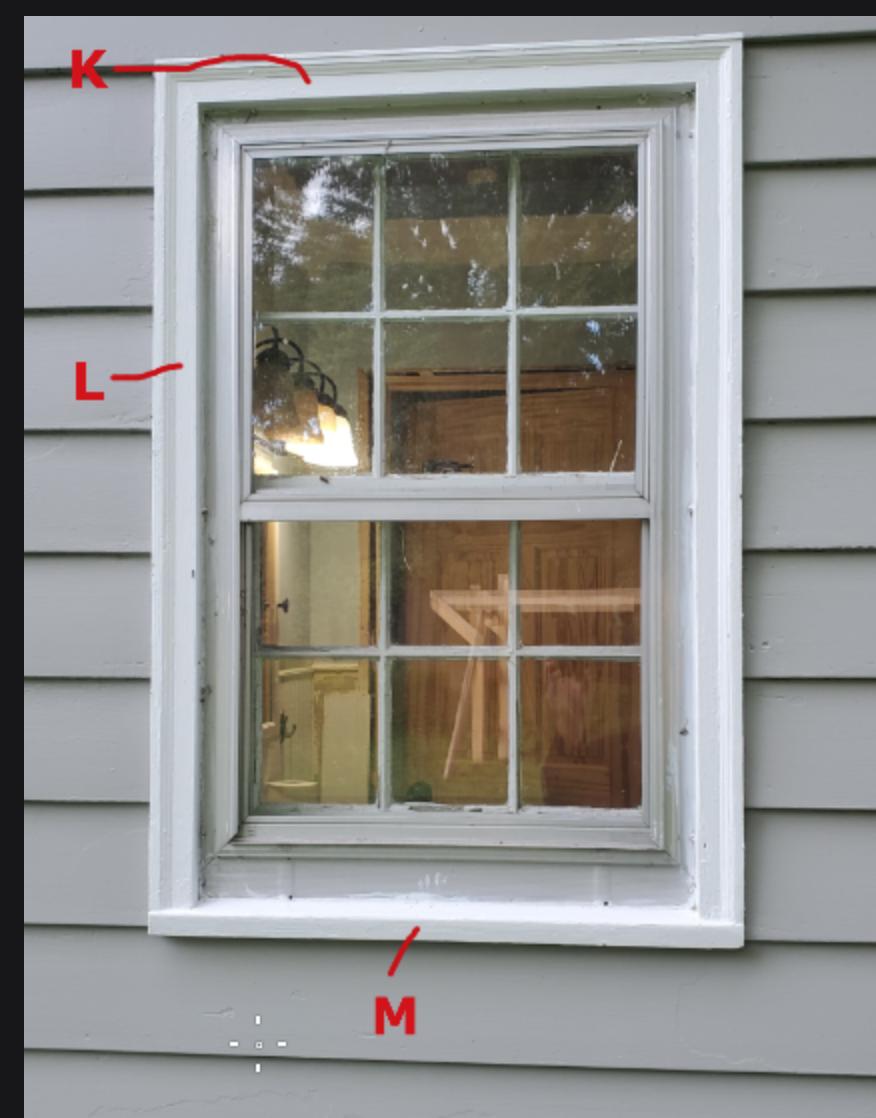
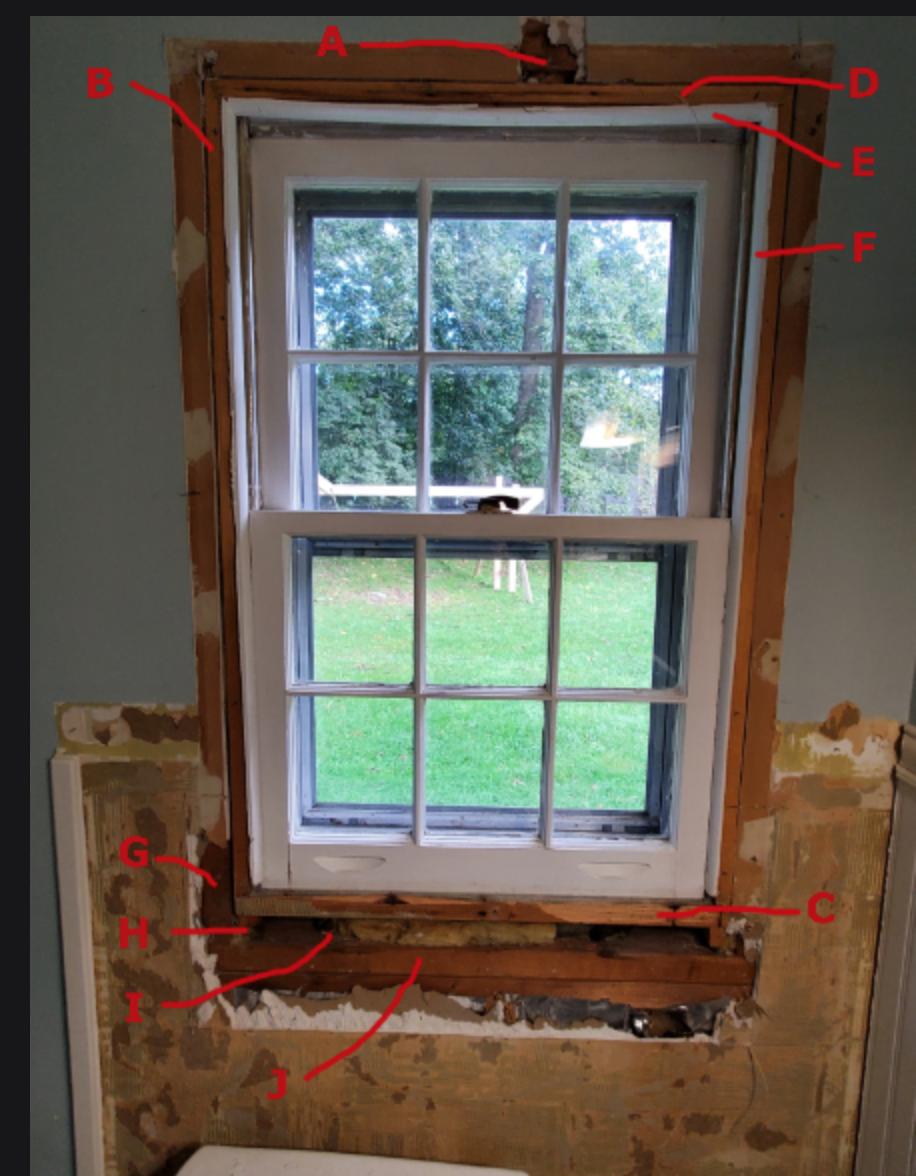
I am in the process of planning my first ever window replacement and am trying to understand the anatomy of a window, inside and out. Here are two photos (inside and outside) with some labels, and I am trying to understand what all of these labeled parts are called, and what purposes they serve:

Inside: enter image description here
Outside: enter image description here

So we have our table of labeled parts:

Part        What it's called        What it does
===============================================================
A           Top Plate (?)           Gives the top part of the window something to nail to (?)
B           Side Plate (?)          Gives the side of the window something to nail to (?)
C           ???
D           ???
E           ???
F           ???
G           ???
H           ???
I           ???
J           ???
K           ???
L           ???
M           ???

Could someone please provide some course correction and steering here and let me know what all these parts are called and what it is that they do? What style of window is this? It is critical that I know this stuff for when I go to research the actual replacement (which is next). Thanks in advance!

isherwood
  • 158,133
  • 9
  • 190
  • 463
hotmeatballsoup
  • 344
  • 3
  • 26
  • 46

1 Answers1

6

This is either a single- or double-hung window, depending on how many of the sashes are operable.

A just looks like the wall framing header. There's often a two-by laid flat along the bottom and members on edge above, but not always.

B is the original window jamb (frame), or an extension. Sometimes window and door jambs aren't deep enough for the walls they're in.

C is the lower jamb, or sill. It's sloped, which is why the side jambs (B and F) extend below at the inside.

D is the head jamb.

E and F appear to be stops, which are what retain the sashes. Sashes are the moveable (operable) or stationary frames that contain the glass.

G looks like a trimmer (or jack) stud, but it's hard to see. They're studs that support the header. Ordinarily they don't stop at the framing sill, but things vary.

H might be a support block. Not sure about that or I. Neither are likely important in your case.

J is the framing sill. It's a horizontal member to which new window flanges might attach, and it supports siding, drywall, and trim.

K and L are brick mold, or casing. It covers the gap between framing (sheathing) and the jamb.

M is the outside edge of the sill mentioned earlier.

isherwood
  • 158,133
  • 9
  • 190
  • 463