5

A friend of mine likes to buy old tools and smilar at car boots, and he picked up a set of bits which neither he nor his friends could identify. He showed me two of them:

mystery bits 1- a '60' and a '10' side by side

They have two tips, one mounted radially outboard of the centre tip but pointing parallel to it, offset by a gap. The gap varies through the set and the bits are numbered, I am guessing they correspond to the gap/offset distance.

Reverse side:

mystery bit 2- '60' reverse side

They look like they have (tapered) square shanks round shanks, but I will double check that with the chap who bought them.

If I was forced to guess, it looks like they are intended for scribing or cutting a circle? My non-exhaustive research didn't show up anything identical; the closest with two tips I could find was the adjustable bit on a DIY FAQ.

Update from the guy who bought them: "They have round shanks and are numbered from 10 to 64 all in a fitted box with the brass hand drill. They are made of steel which appears to be quite brittle as I broke one when I was trying to remove it from the box."

bertieb
  • 457
  • 5
  • 17

3 Answers3

3

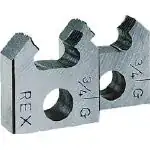
Possibly thread chasing tools. i.e. not drill bits at all. The below image is of a replacement blade (probably two blades, by the look of it) for a thread-chasing tool.

[thread chasing tool blade image from https://th.misumi-ec.com/en/1

If, as it appears, the offset point is sharp and the center point is not, the non-edged point would follow a good thread to permit the edged point to cut and repair a damaged thread, offset by the thread pitch.

A problem for search is that there are many other styles of thread-chasing tools, so that was as close as I found to a similar one.

Ecnerwal
  • 235,314
  • 11
  • 293
  • 637
1

My best guess is an equidistant center-punch.

  1. Strike the rod to make a mark
  2. Place the offset point into the punched divot
  3. Lift the offset point off the material so that you are resting on the rod
  4. Strike the rod to make your next mark
  5. Repeat as needed
  6. Use the brass drill to make holes

The only issue with my theory is that it doesn't hold up well to this observation:

They are made of steel which appears to be quite brittle as I broke one when I was trying to remove it from the box.

MonkeyZeus
  • 17,328
  • 2
  • 27
  • 64
1

They remind me of ACME thread gauges, used to check threads on a production line. Check if the angle is 29 degrees. Being brittle also makes sense as these types of gauges are typically hardened.

user1946891
  • 658
  • 3
  • 5