14

Outdoors, I have some wooden stairs leading up to my front door.

The wooden stairs are covered in high-gloss wood preservative. In winter, snow and ice are deposited onto the stair-steps. The bottoms of my shoes slip and slide on the high gloss varnish.

What can I do to make the stairs less slippery?

  • do you recommend that I nail down rectangle-shaped pieces of carpet on top of the stairs?

  • can I glue pieces of sand-paper onto the stairs?

I have seen steel outdoor stair treads. These steel stair-treads had spikes on the top for high-grip in winter.

Would you recommend putting outdoor steel stair treads over top of the wooden stair treads?


Edits

In the comments section people asked me some things.

Question Answer
Where do you live? the city of Denver, Colorado in the United States
Are you concerned more with liquid water (rain) or solid frozen ice? Are your stairs slippery when wet in warm weather? my stairs are slippery when wet in warm weather. However, I slip more often (relativly speaking) on solid frozen ice in winter than on rain-spattered stairs in summer.
Is white compacted snow more of a problem or is clear water ice more of a probem? both snow and ice make the wooden stairs slippery. A thin layer of perfect translucent water ice is more slippery than compacted snow, relativly speaking. Both had made my shoes slide on the varnished wood
Samuel Muldoon
  • 349
  • 2
  • 3
  • 13

13 Answers13

16

There are a few approaches available. You've already described one of them: add a grippy tread on top of the wood. Another approach is to mix sand in to the next layer of wood finish that you paint on, so that it gives the finish a textured surface. A third approach is to add some sort of textured grip strips that glue or staple on. Any of these will work, it's all down to the aesthetics of what you want.

isherwood
  • 158,133
  • 9
  • 190
  • 463
KMJ
  • 12,940
  • 15
  • 46
11

The problem comes from the high gloss wood preservative. I imagine the steps would be slippery if just wet.

Sand the treads just to knock off the gloss. Then apply a Matte finish with some sand included to enhance grip.

RMDman
  • 52,615
  • 3
  • 36
  • 113
9

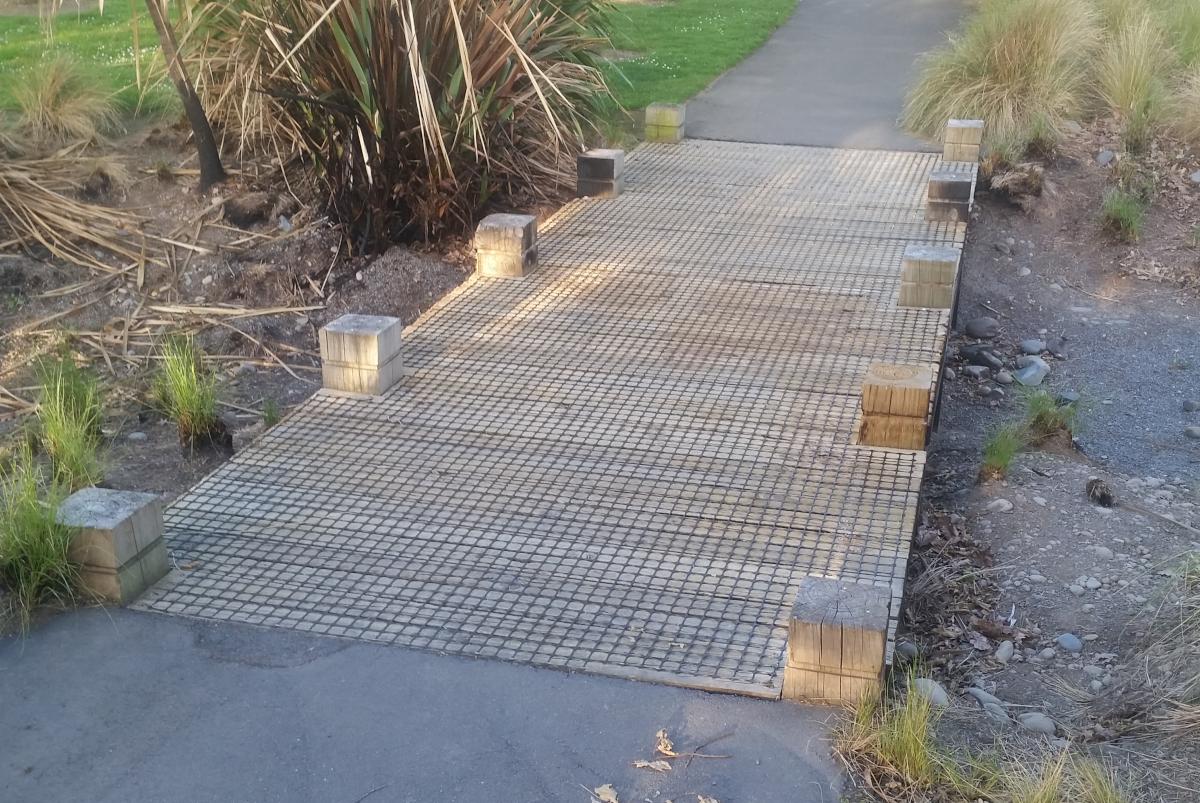
There are a number of wooden bridges in a nearby park.
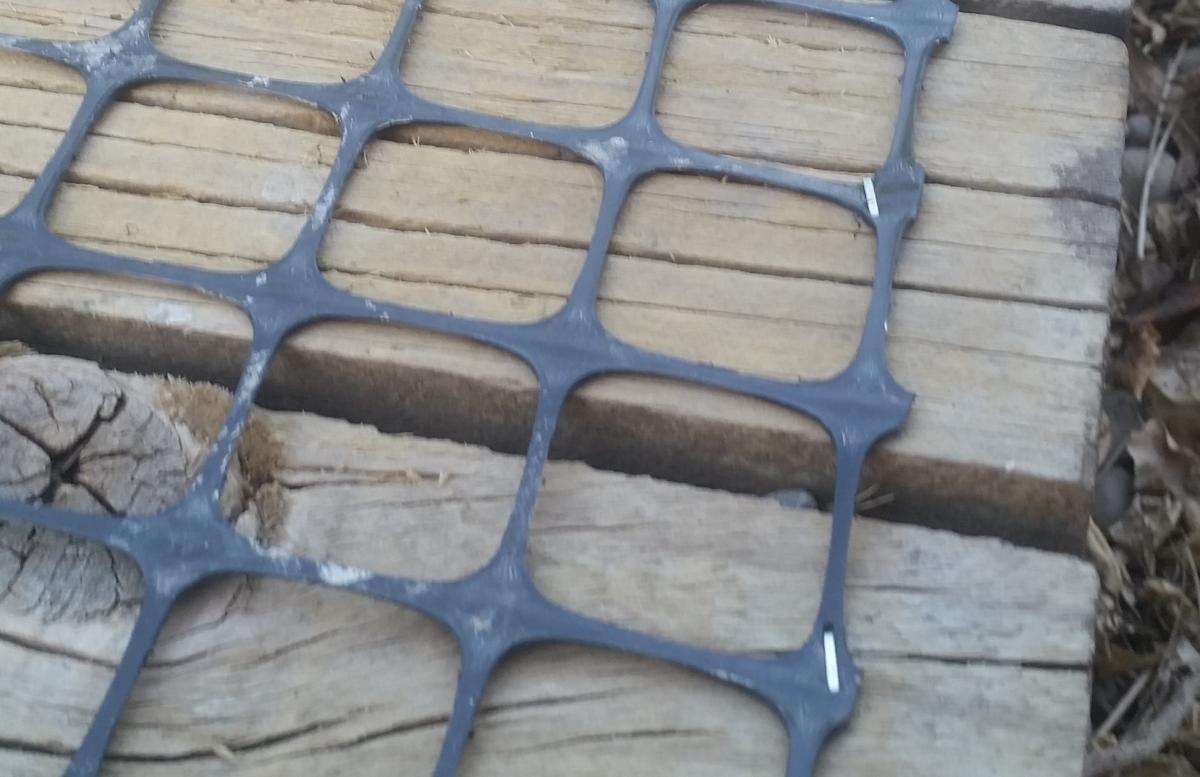
The local council has secured some chunky plastic mesh to the tread areas using galvanised staples, and its far less slippery now.

I've also seen chicken-wire used, in both plastic coated and galvanised variants.

Lastly, its possible to get outdoor carpet which can be screwed down to the treads. Being 100% synthetic it won't rot, though it physically breaks down after a couple of years.

enter image description here

enter image description here
looks like hand-staples were used to secure the mesh. Personally I'd use small galvanised U nails, aka fencing staples, but this mesh is about 2 winters old and is still doing okay.

Criggie
  • 11,950
  • 2
  • 26
  • 79
5

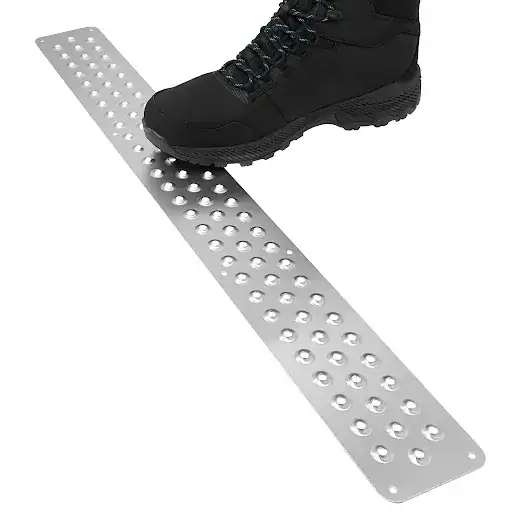
I'd go with some metal grip strips. You want something that won't hold water against the wood and allows the treads to dry or your treads will rot away faster.

metal grip strips

Image from: https://www.clearwaysupply.com/products/steady-step-stairstrip

Fresh Codemonger
  • 14,459
  • 3
  • 24
  • 57
3

As Tetsujin mentions in a comment, there's no covering on the stairs that will really prevent ice from building up in the right conditions. Refinishing the surface with something less slippery would still be helpful to make it better for walking in the wet/snow/ice, but it doesnt prevent ice from building up over the grippy surface, eventually causing a slip hazard.

Instead of relying on the grip from the stair treads (which can get icy when snow packs down, and spikes can make removing the snow difficult) it may be helpful to consider having something available to put over the ice to increase traction.

Where I live, this is typically done with rock salt, sold in large bags specifically for this purpose. The salt melts the ice/snow, and is also coarse enough to add grip too. Even in thick ice, it will melt into the surface of the ice, adding roughness that helps with grip. If you cannot use salt (sometimes there are environmental concerns), sand can also serve a similar purpose, basically temporarily turning the top of the ice into a coarse sandy surface.

Another alternative could be some sort of heated step, but that would be expensive and complicated, and you would probably want to also change the finish on the surface with that, since it could still be slippery when wet.

JMac
  • 200
  • 1
  • 5
3

When I lived in that kind of climate, I used a mix of sand and road salt.

The salt melted the snow and ice while the sand gave any ice and/or the remaining cleared ground more grip. This helped with even the next time it snowed or iced over, as any remaining salt helped prevent the steps and ground from accumulating the snow and ice, and the sand was embedded into anything the salt didn't melt.

Also, the sand helped to keep the ice from being a solid mass, allowing it to be broken up and removed easier. Adding the large grain salt of road salt to the top of thick ice can also help perforate the ice, making it easier to break up and remove.

To remove ice, I've used ice chopper tools, sometimes called sidewalk scrapers. Do a search for these terms and you'll see what I'm talking about. They can work really well, but they can also take a lot of energy to use. They can also damage wood and even concrete, but they do what they are designed to do.

The smooth varnish you say you have on the steps would make ice removal easier, since it has less to attach to, but it definitely makes it more slippery even when wet, as others have mentioned. I definitely support the suggestions of others in saying you need to change the surface of the steps, and any other walking surface that has this treatment, to something with more grip.

To add to the other suggestions, you can get rubber mats that are designed to add grip during the winter. Often these are made from what looks like old tires with steel wire reinforcement running through them. They aren't the prettiest things to look at, but they work. These can be made to be removable so you don't have to use them during the summer months.

computercarguy
  • 1,899
  • 1
  • 12
  • 18
3

As already mentioned, ice will be a problem no matter what you put, but also remember that any kind of carpet will fill with ice and be just as bad or even worse as it could provide an absorbent surface to hold water and ensure ice forms on the stairs.

My best suggestion is to add something to the "front" edge of the stair that will catch a show/boot tread should it slip. I have smaller version on my basement stairs that help sock feet catch at the edge of the stair and stop a foot from slipping off the edge to the next stair.

Whatever you find needs to be tall enough to provide a catch for the shoe/boot tread but also ensure melting water can run off and not create an ice lake overnight. Many stores sell these. If you search on amazon for "stair treads non slip outdoor" you will see lots of examples. Look for the metal/plastic ones that you screw to the edge of a stair and avoid the adhesive/carpet like ones as they will fill up.

millebi
  • 141
  • 3
3

To expand on the grippy tread tape suggestion:

I live in Wisconsin and also see snow and ice. I wanted to make my mail carrier's life a little easier and safer and install some grip tape, having done so on my mom's back stairs, as she has mobility issues.

You can find these at your local hardware store. The Ace Hardware I went to had it in big rolls. You measured and cut off what you needed, wrote down the SKU and had it rung up at the register.

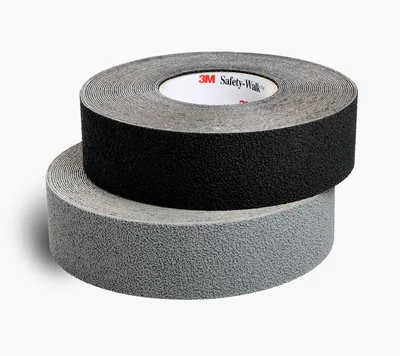
I got a 3M brand, like this:

Two rolls of grip tape, stacked on top of each other, grey on the bottom and black on the top.

Application is relatively simple. My stairs are wood, so I sanded them first. It sounds like yours are painted, so some primer or other roughing-up might help. Then, you pull a backing strip off and then apply the gluey side to your surface.

The hiccup I encountered, and would like to warn you about, is that this must be applied while the weather is still relatively warm, which is not when I think about ice prevention. The 3M tape I grabbed needs to be applied at above 50 degrees F/10 degrees C. This information is on the back of the tape, on the backing strip, so read carefully.

newtolawns
  • 31
  • 3
3

enter image description here

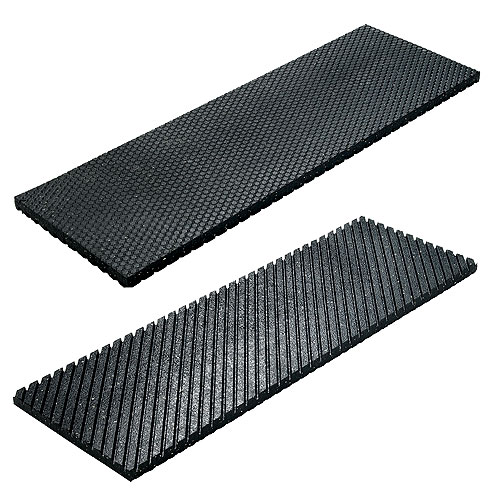
Use black rubber stair treads, you can find them in most hardware stores at the start of the cold season. You simply put them down on each step, and store them away when the icy season has passed. No further installation required and no alteration of your stairs.

They are heavy and cling well to the steps, which allows you to shovel and scrape snow. Any amount of sunshine melts away what little ice and snow remains after shovelling. Even if some snow remains, it gets squished into the grooves when you walk on it, revealing the grippy top of the grooves.

Pick the good quality ones; they are thick, heavy and have long, deep diagonal grooves. Did I mention they are heavy?

PRO TIP: Don't assume that your steps are all the same length or depth! Make sure to measure EACH step in your stairs in order to pick the right size(s) of mats that will cover as much as the step as possible. For safety, you want the edge of the mat to line up with the edge of the step as closely as possible, and less than an inch for sure, other wise your foot will accidentally touch the unprotected edge of the step and it is a slipping hazard.

All this being said, with serious ice conditions, there is no solution to save you from an occasional shovelling, scraping or use of de-icing salt.

Splambo
  • 131
  • 2
1

When ice builds up on the shady portions of my sidewalk I have had success with a light coat of rough wood chips that I refresh daily until we get a spell of sunny weather. (Usually we get warm sunny weather after 3 or 4 days of cold.) I like wood chips because they are lighter than sand (to carry from garage to sidewalk) and they don't have the bad effects on landscaping that salt has. This has worked out well for me for the past two years of experimentation. It probably would not be a good idea if you never get warm spells.

Coloradan
  • 11
  • 1
1

I use these, nailed to the treads with copper roofing nails:

https://kofflersales.com/product/stair-tread-mats

davidaug
  • 11
  • 1
0

One option not yet discussed is to staple down galvanized expanded metal lath of the type normally used in plaster/masonry jobs. It is inexpensive, readily available, and very grippy (sometimes surprisingly so).

In terms of performance in icy situations, it tolerates ice buildup quite well and seems to help break up the ice due to its three dimensionality and sharp edges. I’d rate it second in that department behind rubber mats that can be lifted and flexed and well in front of stick-down grippy material and sand-in-paint (having tried all these methods over the years). Although aesthetically, it’s not that nice (sand-in-paint being the least noticeable) — but de gustibus non est disputandem!

Travelling Man
  • 125
  • 1
  • 8
0

You live in Denver. What do they put on the roads to give traction in the winter?

Here in the Midwest, they salt the roads until the snow melts (and the cars rust).

Where I grew up in Idaho, enough salt to melt the snow pack would have killed every living thing, so they spread a sand/small gravel mixture. They do the same thing in Alaska where my son is. Get a bag of sand and/or gravel and spread it on your steps as often as necessary to keep traction.

Keep a bag/container with a scoop for spreading at the bottom of the stairs in addition to one at the top of the stairs. This way you're always prepared for a fresh snowfall, no matter which way you're traversing the treacherous, frozen tundra.

FreeMan
  • 48,261
  • 26
  • 101
  • 206